
Article and photos by Kenneth Springer published in the October 2002 issue of Barrel Horse News
It’s been 32 years since Sue Klutts-Brown, Norman, Oklahoma, established her place in barrel racing history. In 1970, when Brown earned the International Rodeo Association (IRA) barrel racing championship, now called the International Professional Rodeo Association (IPRA), there was no such thing as also being a member of the Women’s Professional Rodeo Association (WPRA) at the same time, as is often the case today. thus, the IRA top 15 was filled with the toughest of competitors, many of whom went on to make a name for themselves in the WPRA, such as Lynda Gordon, Betty Roper, Ann Bateson, Marilyn Duplissy and Jyme Beth Powell.
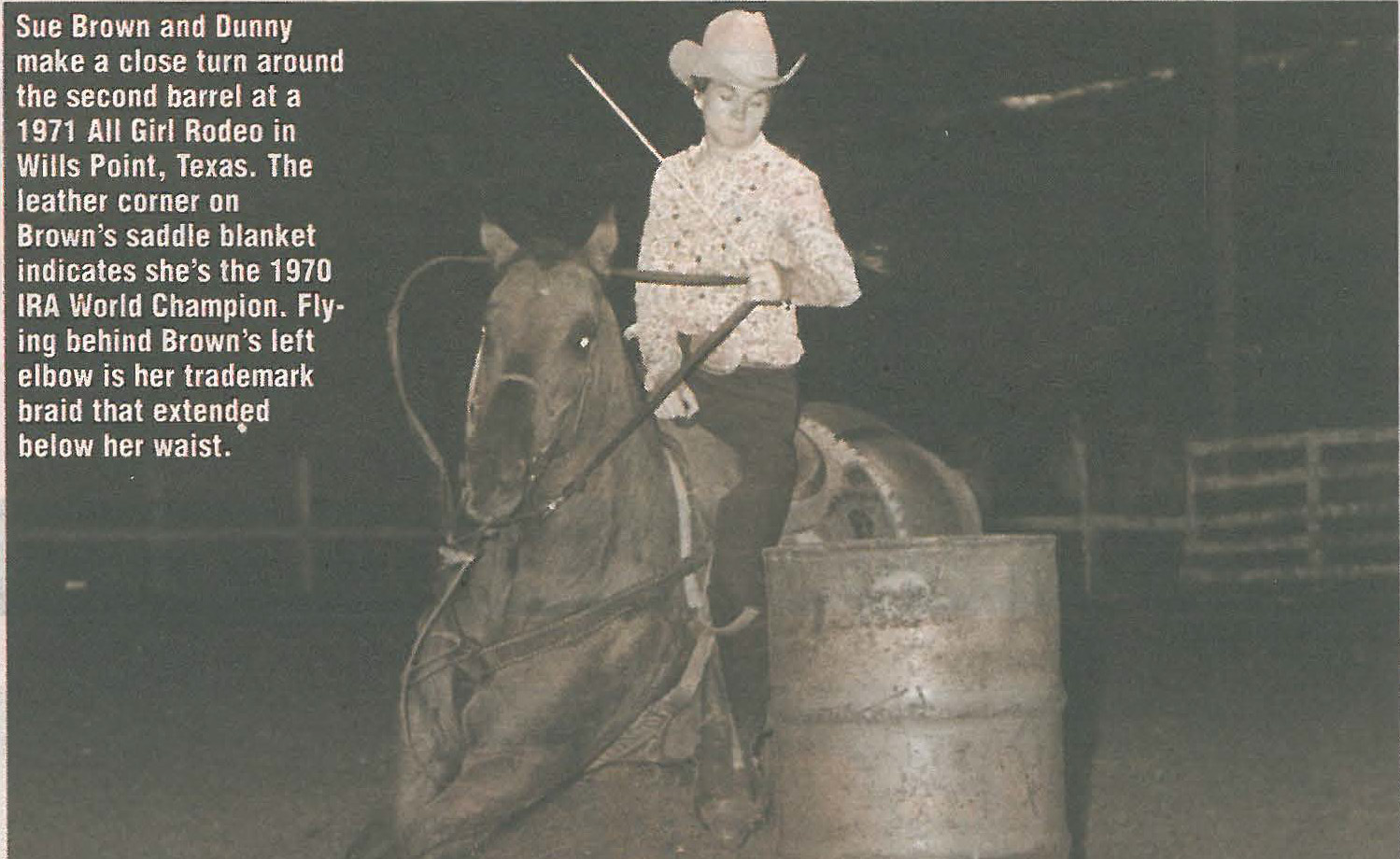
Brown’s unregistered dun gelding, Dunny, didn’t need a long pedigree to outrun the competition, whether it was on the stop watch or the electric timer. Her peers knew that when the young lady with the braided pigtail that hung down below her waist ran, they’d better have made their best run, and even then it might not be enough to beat the ever-consistent Dunny. Brown and Dunny seldom beat themselves by hitting a barrel either.
“I never really kept records on it, but Dunny hit very few barrels because of the way he turned,” said Brown. “His turns were flawless. He ran all the way around a :;; barrel in a perfect circle. Running straight away, he wasn’t that fast.”
Although Dunny had no official registration papers, he was believed by his previous owners to be of the foundation Waggoner Quarter Horse bloodline. His strong bones and stout build would validate that belief.
“Physically, he was the toughest horse I’ve ever known,” explained Brown. “He could be limping, sore or have some other problem; it didn’t matter. When it came time to run, he would go in there and do his job.”
While winning the 1970 IRA Barrel Racing World Championship was Brown and Dunny’s biggest rodeo crown, they backed it up a year later by winning the average at the second IFR. State barrel racing organizations were also tough and flourishing in the 1970’s, especially in Oklahoma and Texas, where, once. again, the likes of future WPRA World Champions Gail Barrett-Petska and Carol Goostree, along with future NFR qualifiers Martha Tompkins-Wright, Renee Youree-Ward and Lynda Gordon Perry were gaining competitive experience.
Brown and Dunny proved once again they could run with the cream of the crop, winning the Oklahoma Barrel Racing Association three years in a row, 1970- 1972. In 1970, they finished in the top five of the tough Texas Barrel Racing Association, the only year Brown was a member.
To say Dunny was a versatile athlete would be an understatement. During his heyday, open all-girl rodeos were extremely popular in Oklahoma, Texas and Arkansas. Because the all-girl contestants would enter the barrel race, some of the largest barrel races in number were generated at all-girl rodeos in those three states.
“I won several All-Around saddles on Dunny at All-Girl Rodeos,” said Brown. “I’d use Dunny in the Steer Undecorating, turn around and use him as a hazing horse for a fellow competitor in the Steer Undecorating, tie-down calf rope on him and then run barrels. And usually in that order, because the barrel race would be right before the bull riding. One of the biggest All-Around wins I had was at Hot Springs, Ark. They always had a huge All-Girl Rodeo there, put on by the Arkansas Barrel Racing Association.”
Just as the great horses of today are doing for their riders, Dunny was Sue Klutts-Brown’s dream maker over three decades ago. For as long as Brown can remember, her philosophy of life has been to take what she had at the time and make the best of it.
Born in Prague, Okla., located 60 miles east of Oklahoma City, Sue Klutts’ first remembrances are her father’s big farm where alfalfa, corn and peanuts were raised.
“Because we farmed, we always had horses to ride,” said Brown. “Horses have always been the love of my life. I have pictures of me at 2 and 3 years of age riding a horse. I would ride everywhere. We lived 15 miles from town, so horses were my entertainment and love.”
At 15, Brown and her family moved to Okemah, Okla., after selling the farm, and then to Midwest City, a suburb of Oklahoma City.
“My oldest brother started team roping and steer wrestling and it just worked around for me to start running barrels,” recalled Brown. “I rode whatever there was to ride. I was probably 18 when I entered my first small local rodeo.”
After graduating from high school, Brown enrolled in nearby Oklahoma University in Norman where she graduated in 1963 with a degree in mathematics. After earning some paychecks at her first job at Liberty National Bank in Oklahoma City, Brown purchased her own horse.
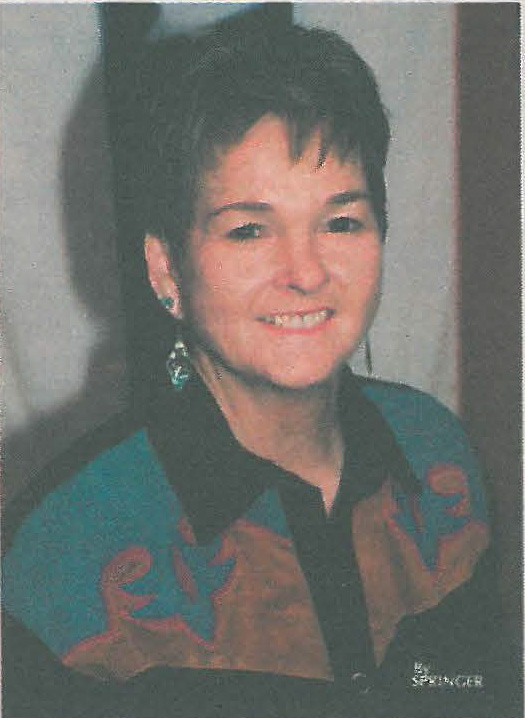 “He was Steel Bars bred,” said Brown. “His registered name was Steel Hill. I trained him for barrels, knowing nothing other than to get on his back and teach him the pattern.”
In 1965, Brown went to work at Tinker Air Force Base, where she eventually advanced to the position of Statistician. Her main duty was keeping track of the engines on the huge C-5 transport aircraft. It was there that she met her husband, IRA cowboy Ben Brown, whom she married in 1970.
In 1968, Ben was assigned to work temporarily at the Wichita Falls, Texas, Air Force Base. With nearby Burkburnet, Texas, being a hot bed of PRCA steer wrestlers, Ben spent many off work hours with the likes of C.R. Boucher, Jim Houston and Donnie Bowles. It was there that he found and bought the soon-to-be World champion barrel horse Dunny.
“Dunny had a reputation for being somewhat of an outlaw,” explained Brown. “They called him Quick Draw because when you went to get on him, he could cow kick you quicker than you could figure out what happened to you. They used him to steer wrestle on, haze on and calf rope on. He belonged to Donnie Bowles and Donnie’s wife would walk him around the barrels at home to cool him out after they’d used him in the arena.
“One day after Dunny ran off with a calf and dragged the calf to death, Donnie was disgusted with him. Ben had liked the horse and asked Donnie what he would take for him right then. Donnie said $600 and Ben shelled out the money on the spot. He brought him home. That was when Ben and I were dating and he wanted me to start running barrels on him. It took Ben a little while to convince me that I should climb on such an outlaw.”
But once she did, it was almost instant success. Novice barrel races were the popular way in that era to season a horse. Because Dunny had won no money running barrels, Brown began entering novice classes and outrunning them big time.
“That would have been in 1968,” recalled Brown. “Because I started hauling Dunny to IRA rodeos in 1969 and won the World in 1970.”
Sue and Ben were married in 1970 and three years later became the proud parents of their only child, daughter Ross Brown-Wright. Sue’s last run aboard Dunny was in 1972 while she was pregnant with Ross.
Brown wasn’t just a one-horse champion, as was common three decades ago. After retiring Dunny, she came back to win the OBRA in 1976 and 1978 on a horse she called Big John. From that point on, her focus was on keeping her daughter mounted. Ross went on to become an OBRA champion in her own right.
In 1994, Brown retired from Tinker Air Force Base after 28 years of service. Only her membership in the OBRA was longer.
 “I was a member of the OBRA for 29 years,” said Brown proudly. “Most of that time I was president.”
With a vision for the future of barrel racing, Brown recognized the merit and potential for 4D format barrel racing. Along with family members and two friends, she cofounded the Oklahoma Central 4D that produces a number of local events, as well as two Shoot Outs (one in Oklahoma City and one in Tunica, Miss.) each year.
Sue Brown knows all about facing life’s challenges – at work, in the rodeo arena and in the administration of barrel racing associations. Her greatest challenges have come with facing cancer. First that of Ben’s, who was diagnosed in 1988. She faithfully cared for and encouraged him for 12 years until his death on Jan. 7,2000.
Eleven years after Ben’s diagnosis, Sue was operated on for breast cancer in 1999. The subsequent ups and downs, ins and outs, and successes and failures of treatment have failed to quench her spirit one ounce. This summer saw her traveling abroad with friend Kathie O’Brien to Europe, where she had always wanted to go. For as long as Sue Brown can remember, her philosophy of life has been to take what you’re given and make the best of it. She’s followed that philosophy in every aspect of her life.
Barrel racing as a sport today is more glamorous, appealing, and lucrative than ever before because of trail blazers like Sue Klutts-Brown, who, although a champion, put much more back into the sport than she ever considered taking.