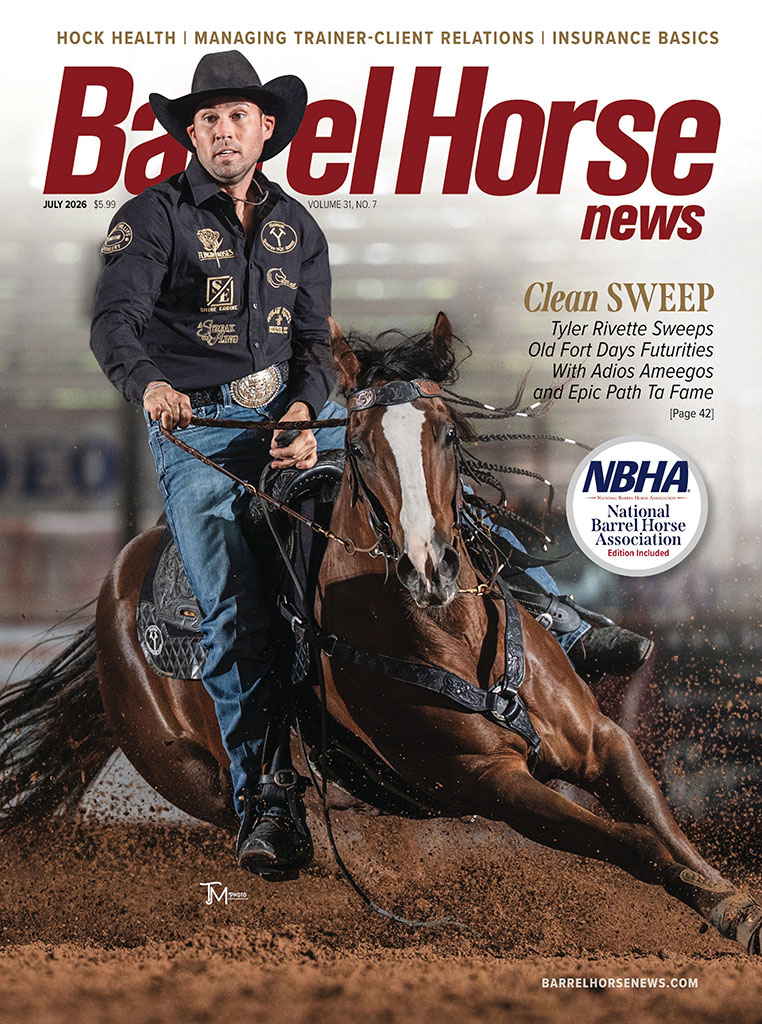

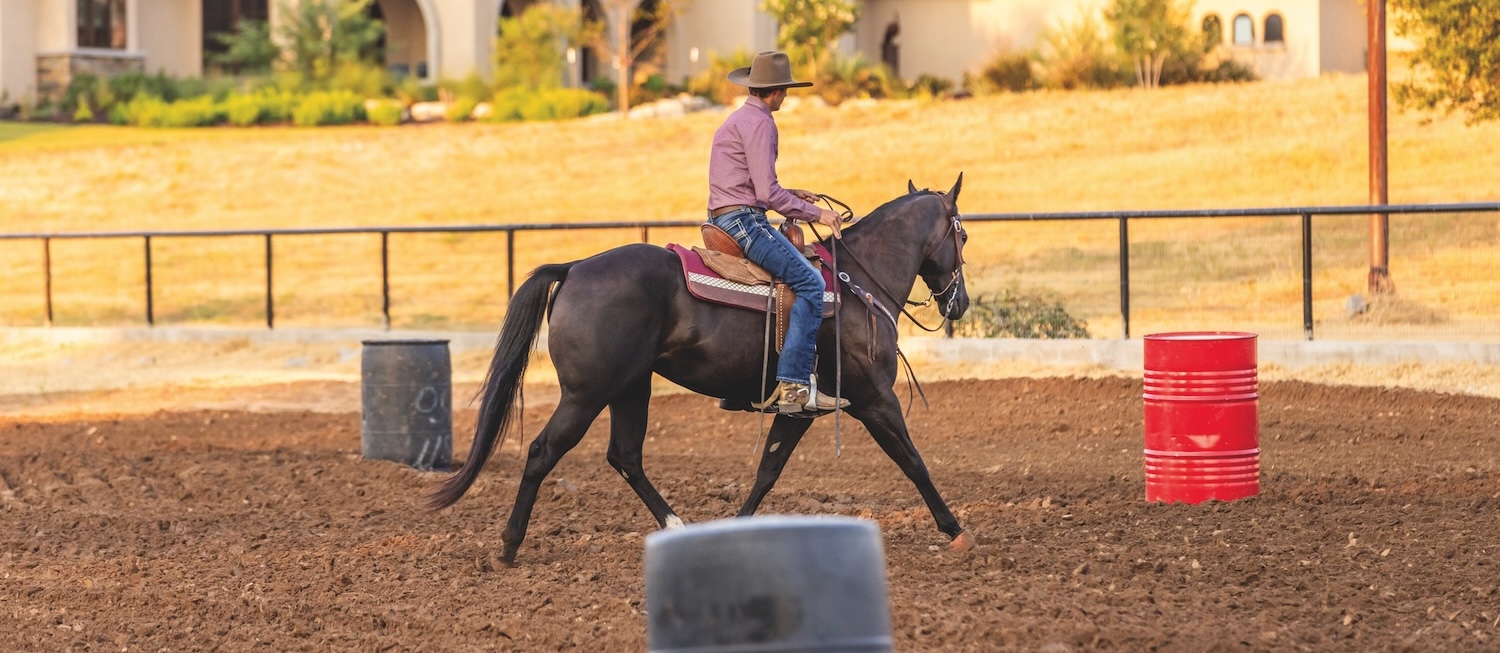
Condition your horse on this extensive pattern with trainer Dale Long.
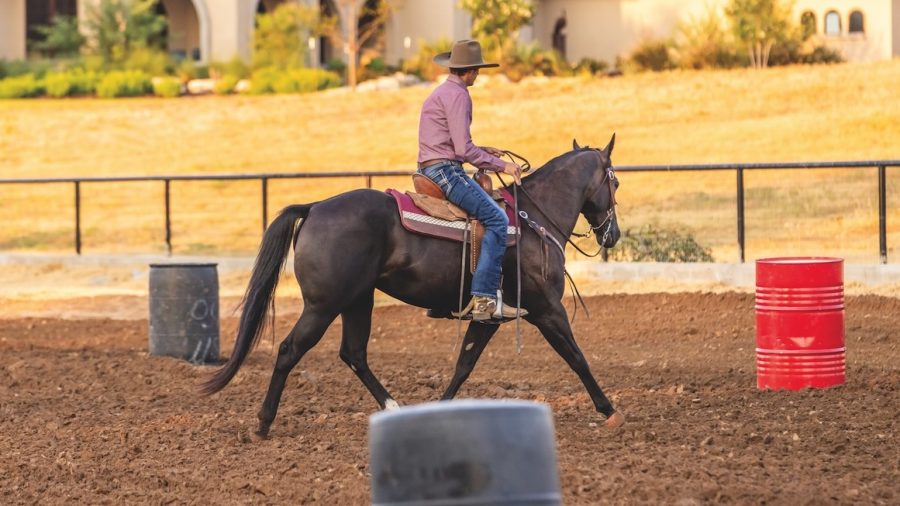
The drill I do that benefits my horses the most uses six barrels in a two-pattern format. You have a cloverleaf pattern at one end of the arena, and a mirrored cloverleaf pattern at the other end. This exercise is the only thing I ever set up, because you can address so many things with it. I mostly use it to teach a horse to wait on me so it doesn’t look to cheat and also to help quicken up its feet.
This drill helps my horses gain confidence that I’m not going to put them in a pickle, and wherever I take them and whatever I ask them to do, they’ll be prepared to do it without so much guidance and reassurance from me.
With these six barrels, I think of six benefits I feel it gives me and my horses.
- It helps with muscle memory for me and the horse on body positioning and preparation for the turn.
- Foot placement, collection, transition and helping one “crawl” through the turn.
- It helps build confidence in the turn.
- You can do the pattern but also work on the fundamentals, all in one drill.
- Direction and keeping the horse up in the bridle while letting the horse have freedom to go in straight lines, then gathering back up for the turn. This eliminates panic if I make a mistake in a run and pull on the horse — rein pressure will not be a complete shock to them.
- It really helps with patience, because there are so many transitions to be made throughout the drill, it keeps the horse waiting on your cue and helps eliminate a horse wanting to cheat or getting bored on the pattern with so many ways to go.
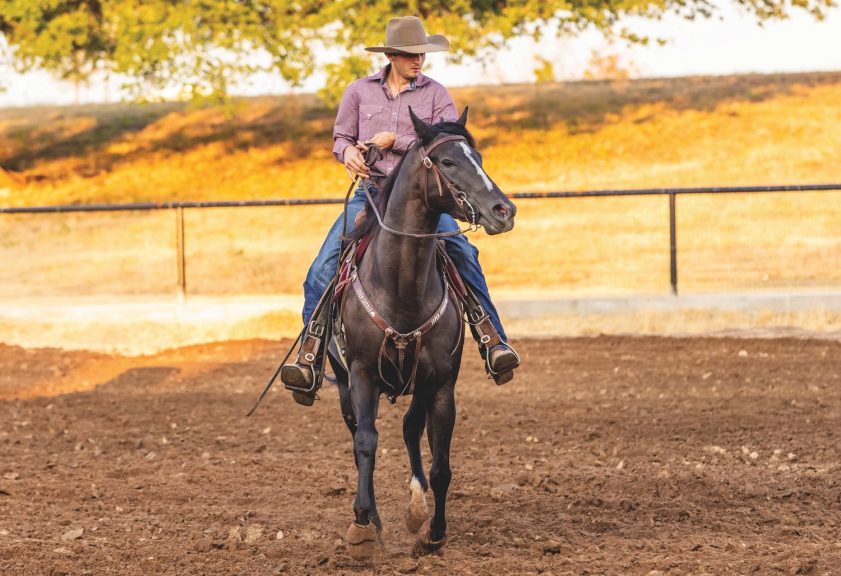
Preparing for the Drill
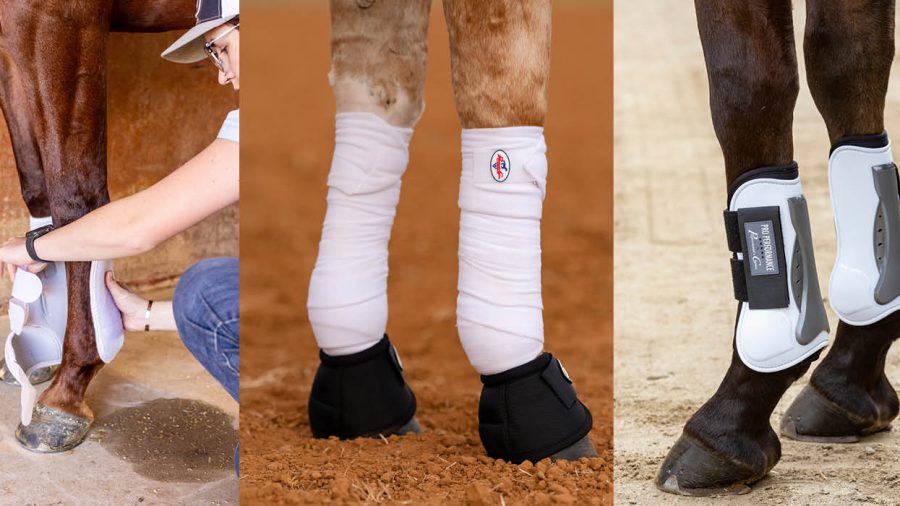
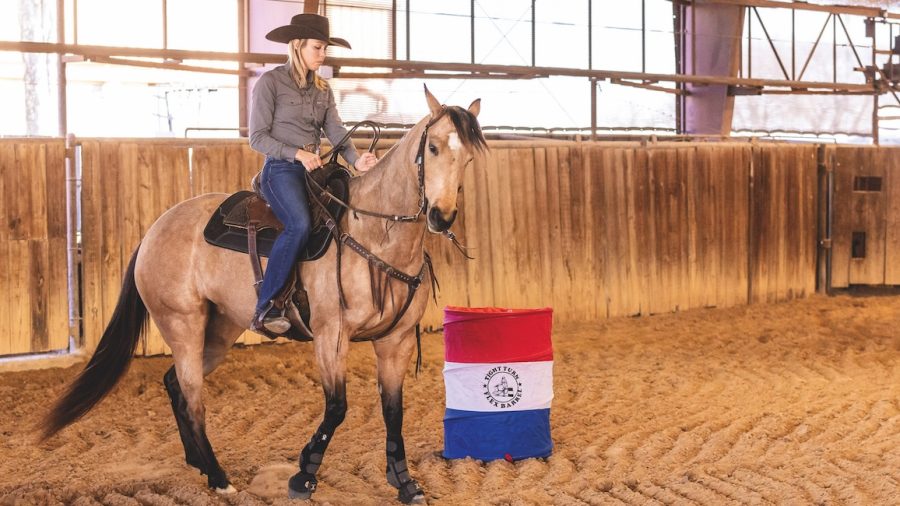
My tack setup depends on the horse. Ideally, I’d like to do this drill in either a Loomis bit and draw reins or a gag bit with a little shank and a rope as the curb strap. I find my horses get bracey with a curb chain, and this drill requires a lot of transitions to move the horse, so a bit with a little more forgiveness is normally what I want for my horses.
This drill can be a nice, easy, slow work day or it can be an extensive workout. You can do it at any speed. If I have a horse that is getting ahead of themselves or trying a little too hard, I’ll slow down and trot this drill, or I’ll trot to the transition points and then break down to the walk.
If I have a horse that’s really struggling to get up underneath itself and getting quick in the turn, you can go faster. You can cruise through this drill and make it an endurance workout.
I do this drill at least three times a week for each horse, slow or fast. I do it two or three times a week with colts. Sometimes I’ll do it every day if I’m just walking or trotting.
The Drill
There are three ways to do this drill. There are aspects of the drill to help a horse with cheating and to get better at waiting on your cues, and then there’s other ways that help if they’re weaker on one turn than the other. You can do it with all right- or left-hand turns, where you don’t do any transitions, or a mix.
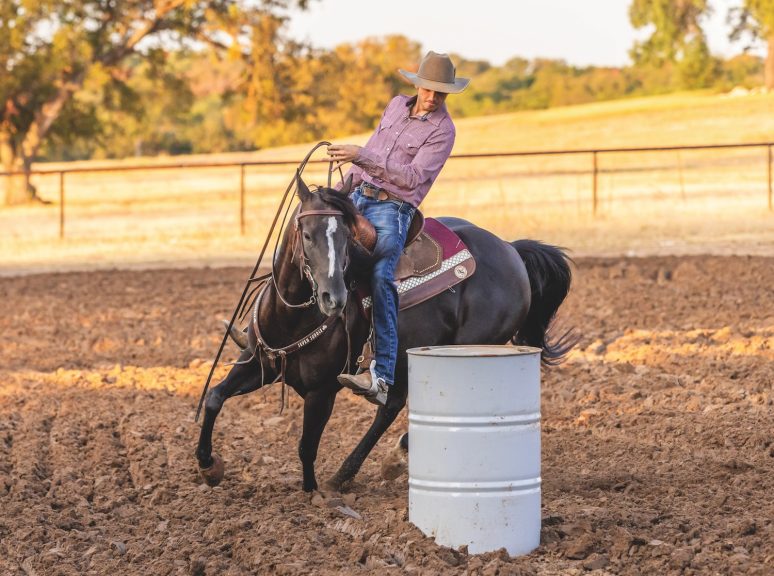
they’ll be less likely to turn until you give that cue.
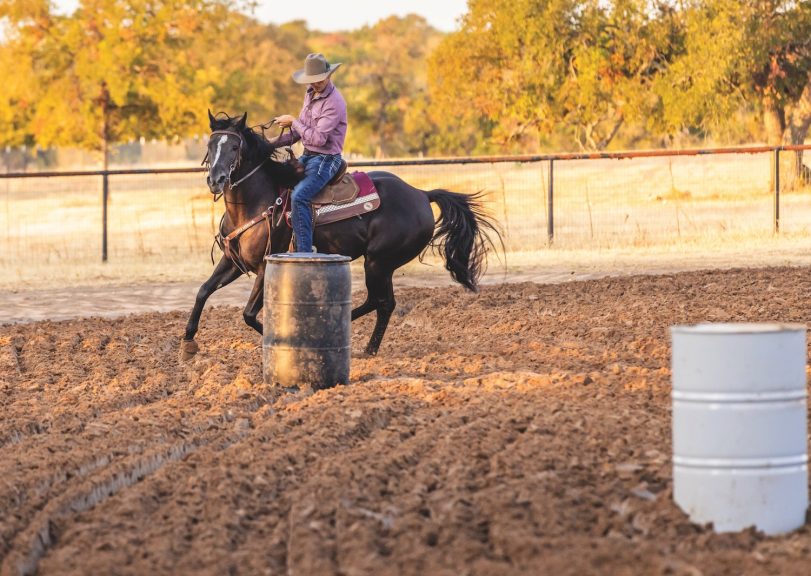
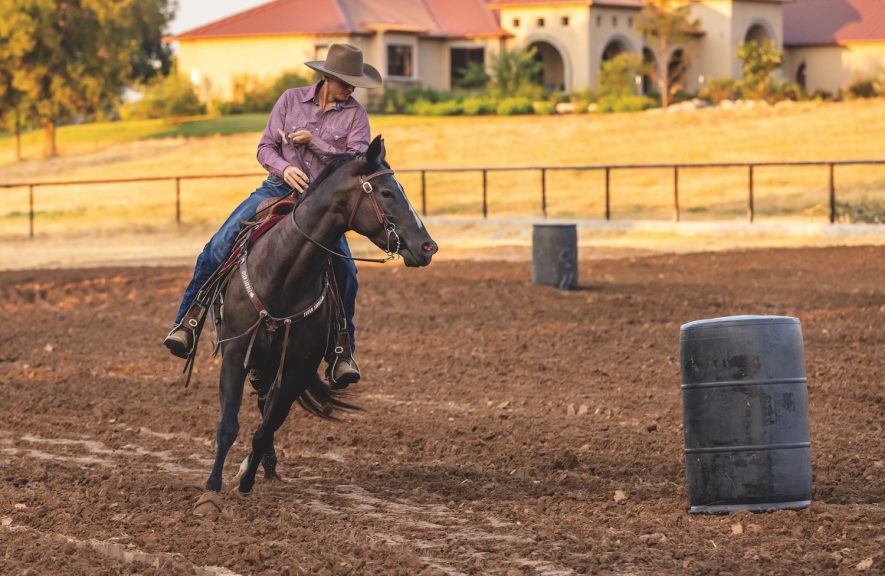
On a solid colt, I’ll go ahead and pick up a lead and lope from one end of the arena toward the first barrel on one side near the fence — let’s say the right. I’m not going to ask for a lot of curve, I just want a little shape. I’ll ask ever so slightly for what I need, and I’m just going to hold my inside rein as if I were preparing for the turn to get what I want to feel around every barrel. I want them to get soft to my hand, and I don’t want them to turn that barrel until I ask.
I want them to do a big circle around it with their shoulder picked up, and I want to keep my hand there. If they are staying where I need them to, then I will drop my hand.
I’ll ask for the turn, and then go across the arena to my second barrel, which would be the barrel on the fence closest to the end of the arena where we started. There, I do the same thing — I wait to see if they’re waiting on me. Then I go around it, and head up the arena as if we were going to a third. I’ll break down to the trot in the middle of the arena, and I’ll pick up my right lead and go up to the next set of first and second barrels. That is the second barrel on the fence on the right side, closer to the opposite end of the arena.
I’ll make a right-hand turn, then go to the second barrel on the left side, close to the opposite end of the arena for a left-hand-turn. I’ll turn the barrel at the far end of the arena as if it were my third barrel. I’ll finish by pointing my horse off to the left side of the arena and stop on the fence between the two barrels along that fence.
I make it a point not to stop and start at the same place every time, so the horse doesn’t learn what is coming next. This will also reduce the horse wanting to brace against you or anticipating getting ready for the run, because you’re stopping and starting at different places.
If you have one turn that’s weaker than the other — like going to the right — you can go through and only do right-hand turns, starting from the first barrel on the right side of the arena, and working your way up around each barrel. Keep going around all of them until you get back to the end. You can do all rights and then all lefts, if you want. There’s no one right or wrong way to do this drill.
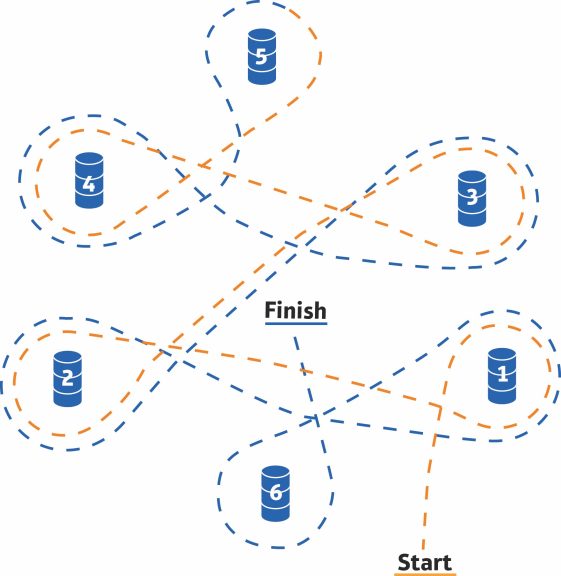
STEPS:
- Start by going around the No. 1 barrel first to the right.
- Turn the barrel and move to barrel No. 2, turning it to the left.
- Turn the second barrel and move toward the No. 3 barrel, turning it to the right.
- Turn the third barrel and move on to the No. 4 barrel, turning it to the left.
- Move toward the No. 5 barrel and turn it to the left, then move back to No. 4 barrel.
- Coming from the No. 5 barrel, turn barrel No. 4 in the right lead and move to the No. 3 barrel.
- Turn the No. 3 barrel to the left and move to barrel No. 2.
- Turn barrel No. 2 to the right and move to barrel No. 1.
- Turn barrel No. 1 to the left before moving to barrel No. 6.
- Turn barrel No. 6 to the right and move toward the middle of the drill. This finishes the drill.
Cautions
Because the pattern is so extensive, at a lope I would advice not going through the whole thing more than twice in a single riding session. At a trot, you could do it for as long as you need in that riding session.
For a young horse, be careful not to overdo it. It can overwhelm the horse or become a scary experience with so many transitions. You can also overdo it if you do it too fast, too much.
If you find your horse is getting a little worked up or starting to brace against the bit, I’ll slow down and walk or trot through it and try again the next day. Just make it a point not to overdo the pattern.
This article was originally published in the November 2023 issue of Barrel Horse News.