
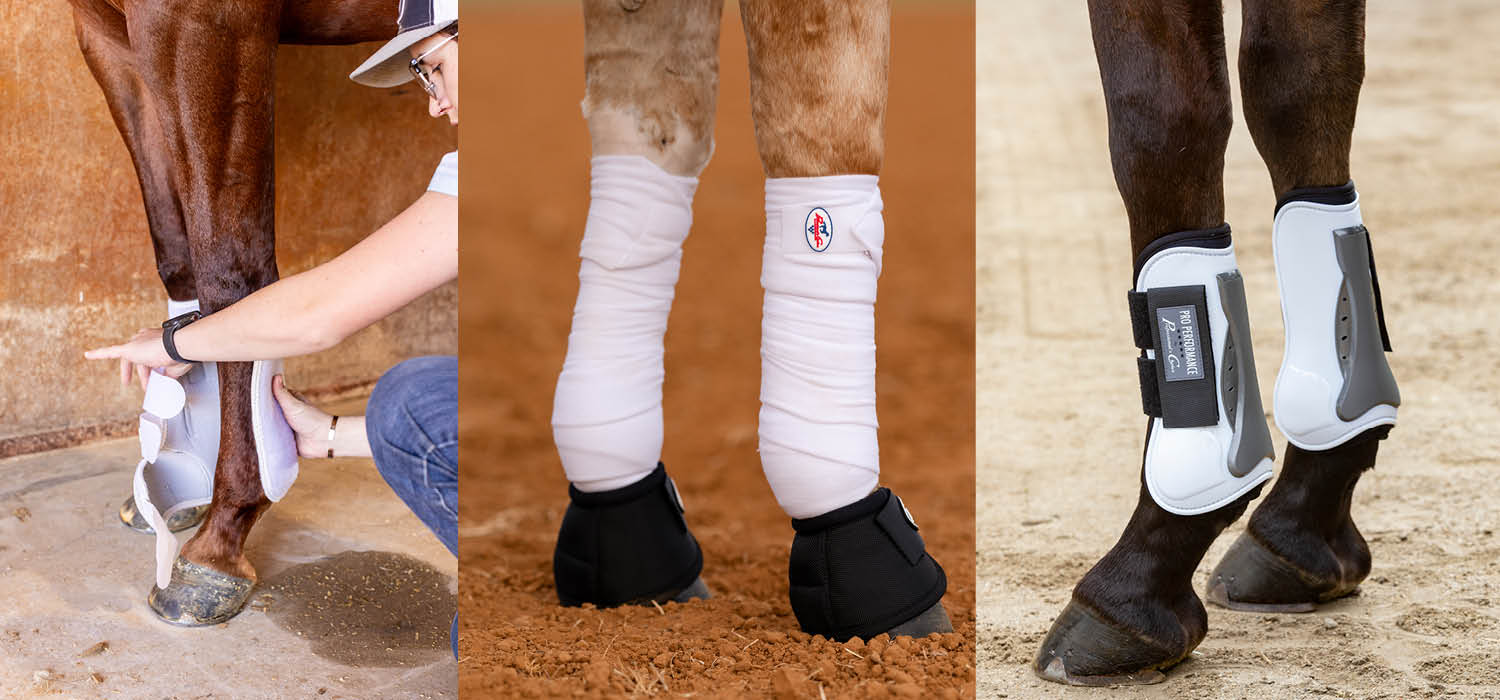
Polo wraps versus protective leg boots — what’s right for you?
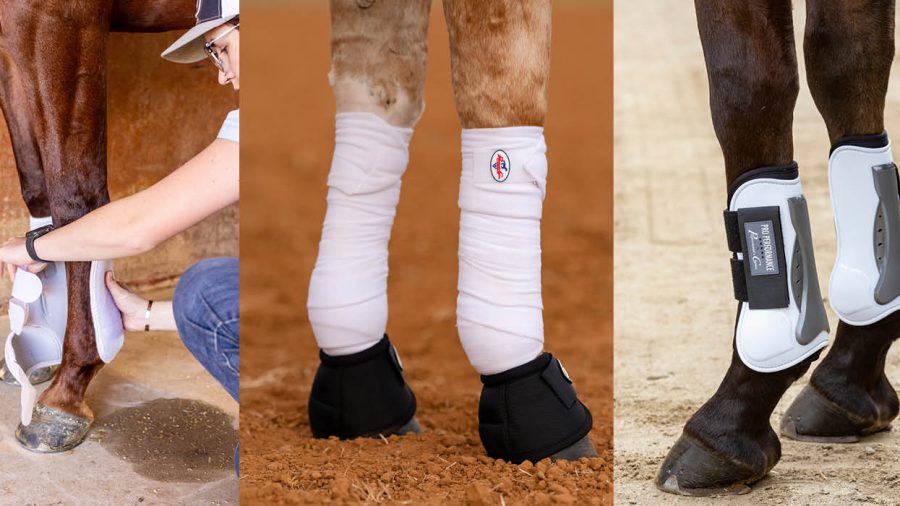
The nature of barrel racing means horses are flat out running and turning sharply at max effort. This can naturally increase chances for injury to the horses’ legs and hooves. There are several philosophies about leg protection. What type of wrap is right for you? We’ll discuss polo wraps and protective leg boots as well as the pros, cons and best-use practices of each.
Why Wrap?
Leg protection does two main things for your horse, says Dr. Charlie Buchanan, DVM of Signature Equine Hospital in Stephenville, Texas. One is protection for the horse’s vulnerable splint bones — if your horse hits itself with another hoof, boots can prevent a split bone fracture. The other purpose is support.
“It supports the tendons and ligaments in the same area — the flexor tendons, the suspensory ligaments,” Buchanan said. “It’s probably not going to keep a catastrophic injury from happening, but it’s going to make the catastrophic injury less severe.”
If your horse hyperextends or hyper flexes its leg, and you have appropriate support on the horse, Buchanan says that wrap can reduce the hyper extension by one or two millimeters.
“That may be the difference between straining the suspensory and tearing the suspensory,” Buchanan said. “That’s the reason I would use it.”
Tegan Still of Classic Equine says protective boots can prevent injury from striking or impact to the legs.
“It provides a level of impact resistance or disbursement to reduce bruising and cutting of the delicate structure of the lower limb,” Still said.
Polo wraps and protective boots do basically the same thing for your horse, Buchanan says. There are a few differences, which can make one type preferable over the other, depending on your situation.
What Can’t They Do?
While boots can be helpful, still stresses that boots are not a magic cure-all.
“No one boot can prevent all injuries to your horse’s legs, and what your horse needs may vary from time to time,” Still said. “Knowing when and how to use your boots or polos correctly, as well as not overusing leg protection can also help in the prevention of injury.”
Protective Boots
Taylor Miniat is a professional trainer and barrel racer from Olathe, Colorado. When it comes to her preference between polo wraps or protective boots, she steers toward boots.
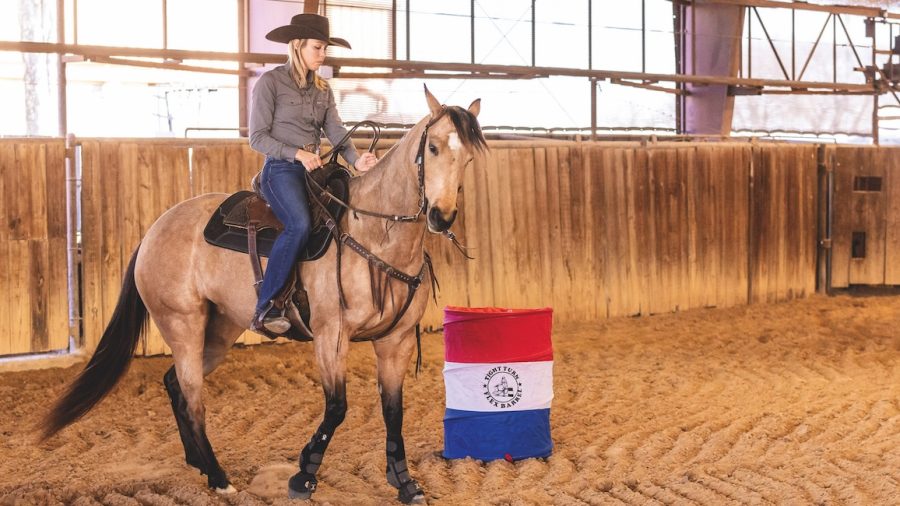
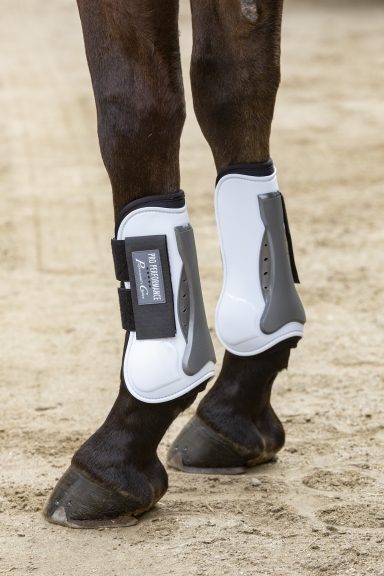
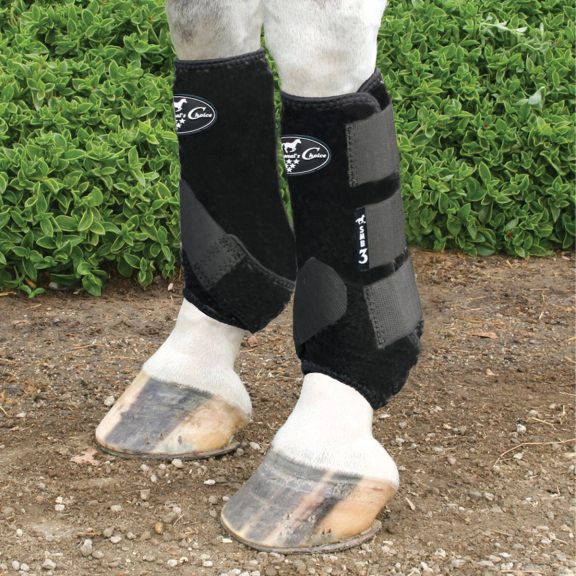
“I use Professional’s Choice boots, depending on the horse,” Miniat said. “I really like Pro Performance Show Jump front boots that are hard on the outside. For a horse I needs a little more suspensory support, I use the SMB 3 Sports Medicine Boots.”
She uses boots as a method of risk reduction. She’s seen a horse nick its leg with a hoof in a run, and the resulting tendon infection ruined the horse’s career.
“Probably nine out of 10 runs you don’t need it, but I’ve definitely had a couple take a misstep and nick the boot, and you can see where it cut the outside of the boot, but the inside is safe,” Miniat said. “In my opinion, it’s not worth the risk not to use them.”
Still says there are many different types of leg protection, and different boots serve different purposes.
“Some boots are built to provide strike protection — when a horse crosses over and hits itself with the opposite leg — such as our ClassicFit boots, and some boots are designed to provide support for the tendons and suspensory ligaments — soft tissue — such as our Legacy and Flexion collections,” Still said.
PROS:
Buchanan said protective boots are engineered to support the leg as much as possible, while being easy to apply.
“The best thing about the boot is that it’s just simple,” Buchanan said. “You just wrap one on, and you can’t over tighten it to where it’ll cause any damage. If you get it on appropriately, it’s as good as a support structure as you can get.”
CONS:
Protective boots can wear out over time. They do have a lifespan.
“You can get fabric stress, and they’re just not as supportive as they used to be,” Buchanan said.
You also want to make sure you buy boots from a reputable brand versus a knockoff, adds Buchanan.
Still says when boots are used incorrectly or for too long of a period of time, they can adversely create heat and add weight to your horse’s leg, causing fatigue.
“Fatigue is the No. 1 cause of injury,” Still said.
Application Tips
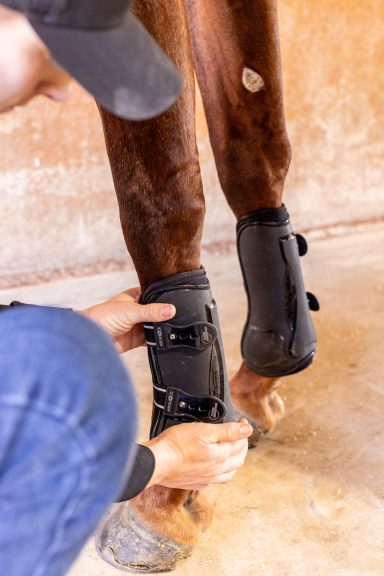
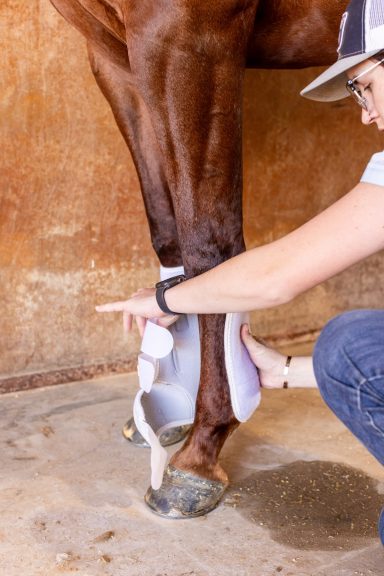
Pay attention to where the boot envelopes the back of the pastern. This is an area where irritation can cause scratches, sores or skin infections.
“Make sure there’s nothing underneath or inside the boot that is going to rub and cause irritation,” Buchanan said.
You want to clean both the leg and the inside of the boot to reduce debris and sweat. And avoid leaving boots on for long periods of time.
“Put them on when you need them, and take them off when you’re done,” Buchanan said. “That way the leg has a chance to breathe and the skin stays healthy.”
Still says you want to first make sure you are putting the correct size of boot on your horse. You can often find sizing information on the packaging of boots.
“Boots should fit snugly without causing restriction of blood flow,” Still said. “When applying your boots, you should ensure the horse’s legs are dusted free of any debris such as sand and shavings.”
When placing the boot on your horse’s leg, start slightly higher than the boot’s final position, and allow the boot to slide down until it settles into the correct position.
“When tightening the hook-and-loop closures, you should pull firmly, without over tightening, until the boot is securely in place,” Still said. “You may need to go back and adjust fastenings a second time to ensure the best fit.”
Best For:
If you’re uncomfortable applying polo wraps or are not skilled at putting polo wraps on appropriately, opt for protective boots.
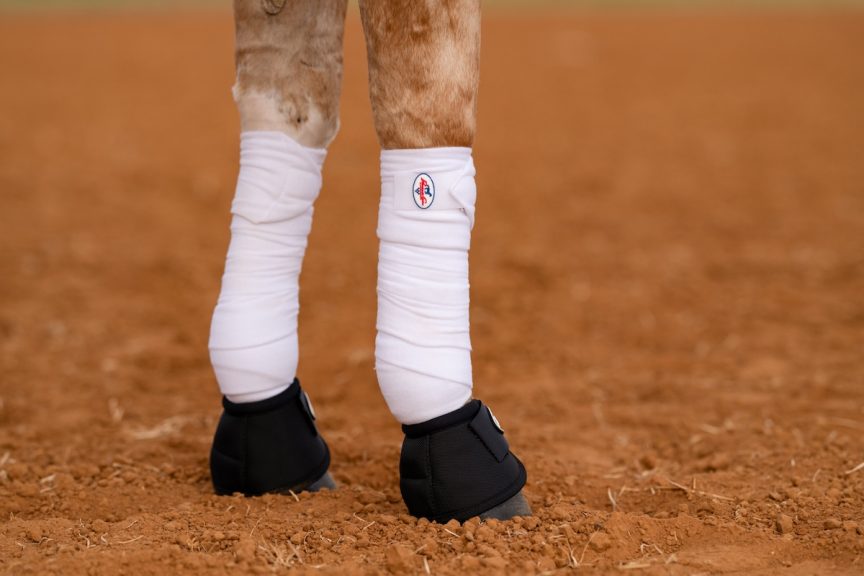
Polo Wraps
Miniat has used polo wraps in the past and says on some of her horses, she still uses them on their hind legs.
“What I like about polo wraps is I had a horse with a scarred back leg, and I felt like the support boots didn’t fit as well as I could wrap a polo wrap,” Miniat said. “I could wrap a horse with swelling in their lower tendons or ligaments with a polo wrap.”
She feels polo wraps can be hotter than protective boots, and that’s the main reason she uses boots more regularly.
Still said polo wraps offer support to soft tissue such as tendons and suspensories.
“It is very similar to us wrapping an injured ankle to support and strengthen,” Still said.
PROS:
Applied correctly, polo wraps offer the same level of protection and support as protective boots, Buchanan said. They can even offer better support sometimes.
“With a polo, if you put it on really well, you can do more things underneath a polo and inside a polo that give it a little more support than the boot,” Buchanan said. “I think the benefit over a protective boot is minimal, but it’s real.”
In some situations, a skillfully wrapped polo can be the best choice. If your horse is a little sore — not to where riding would cause further injury, but you want to get them more comfortable — a polo wrap can be the right choice.
“If your horse has an injury and you can put on a polo wrap really well, your horse is going to be better off with a polo wrap than a boot,” Buchanan said. “That horse is going to be more comfortable because you’re decreasing the load on the suspensory ligament. That would be the reason I would pick a polo over a boot.”
CONS:
Improper wrapping can cause damage or injury to your horse. You must learn to apply the wrap evenly and correctly to be useful.
“It’s definitely a learning curve to put a polo wrap on,” Buchanan said.
Still says overuse of polos can cause delays in rehabilitation of injured limbs, and incorrect application can cause further injury.
Application Tips
Putting on polo wraps is a precise process best taught by an expert. While wrapping, make sure you wrap from the outside, front to back, rather than from the inside out.
“Wrap the tendons to the inside of the leg, because there are connective tissue support structures that if you pull it to the outside too much, you can cause a bandage bow [on the tendon],” Buchanan said. “If you put them on too tight, you can also cause a bandage bow.”
Still says even pressure should be applied up and down the entire lower limb.
“The wrap should be pulled firmly, but not over-tightened,” Still said. “When reaching the fetlock, the polo should go under the fetlock and lift up to help support the suspensory ligament at the back of the horse’s lower leg.”
Best For:
Targeted or customized support and experienced wrappers
Which One Should You Choose?
With both options providing similar levels of support and protection, it’s truly your preference. Protective boots are easier to apply, while polo wraps can offer customized support.
“It’s whatever your comfort level is,” Buchanan said. “If you haven’t put on a lot of polo wraps, I would probably just go to the boots and make it simple. Polos were significantly better than boots 20 years ago, because the technology just wasn’t there. But the technology they have now and the way they’ve been engineered, I think they’re just as good. Just keep it simple. Make your life easy.”
In choosing the right boot, think about what your horse needs.
“I think horses that really use themselves and get low, they tend to need a little more support versus the ones that really want to stand up and stay more forward,” Miniat said. “I’ve had horses that tend to interfere more in a run, and those are the ones I like to put splint boots on for that extra protection from their splint boots.”
Look at your horse’s legs after a run with boots on. If you have a lot of dirt inside the boot, either the boot isn’t fitting correctly or you’re not putting it on correctly, she says.
“Notice how much they sweat inside the boot,” Miniat added. “If they are sweating a ton in hot weather, either look into another boot that might not get as hot or put them on for a shorter amount of time.”
Miniat says boot choice is personal preference and cautions using polo wraps unless you know how to apply them correctly. No matter the type of protection, putting them on correctly is key.
“Even with support boots — any type of boot — proper application is important,” Miniat said. “A lot of people put them on too loose, or too high, and you’re not getting the boots to work the way that they’re meant to work. If you have any questions or doubt you’re not doing it correctly, ask an expert and they can help you.”
Keep It Clean
Regardless of the protective gear you use with your horse, make sure the horses legs are clean as well as the wrap or boot interior. Rinse the legs and wash or rinse the wraps and boots regularly.
“We see a lot of horses in the summertime get little rubs underneath the fetlock,” Dr. Charlie Buchanan, DVM, said. “Even on the back of the fetlock if you get a little sand in there.”
Take off your boots or wraps and check over your horse’s legs periodically, because those abrasions can turn into infections or abscesses and can even cripple a horse.