
Position
Where you put the spur on your boot is a personal preference. Some boots have a spur ledge, located above the heel of the boot, on which the spur sits. Cutters and reiners typically use the spur ledge, while ropers tend to wear their spurs lower on the boot or around the heel of their boot. Barrel racers position their spurs either on the heel or on the ledge.
Band Size
The band is the part of the spur that encompasses the rider’s heel. Band size is determined by the rider’s shoe size. The band needs to fit correctly for the spur to stay in place when it is used. The band should fit snuggly around the boot. If the band is too big, the spur will either fall down the rider’s heel or get pushed forward on the rider’s foot. This could cause the spur to be uncomfortable and rub the foot or make incorrect contact with the horse when used. Similarly, a band that is too narrow will be uncomfortable for the rider.
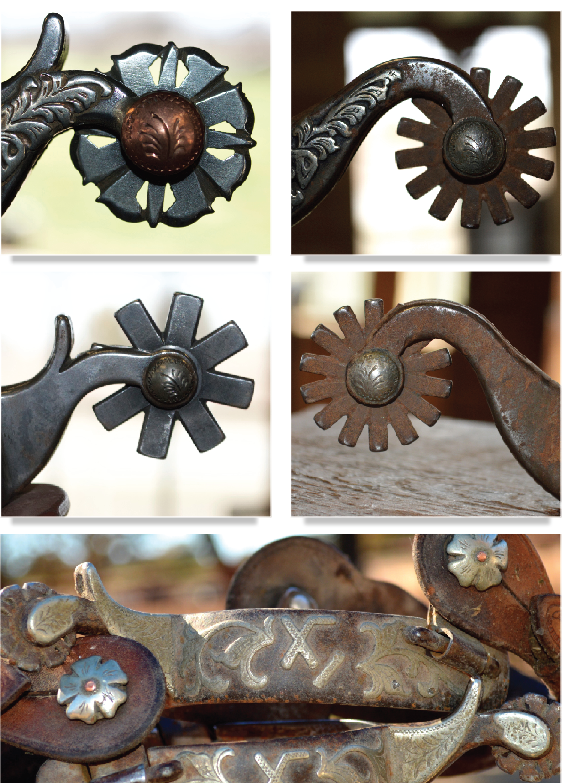 Top, left: Add a small element of feel to a disc rowel by incorporating some minor points. The shape and holes in the rowel add a measure of visual appeal. Middle, left: A chap guard adds visual interest to this short-shanked, eight-point, blunt rowel spur. Top, right: This 14-point rowel has very little space between the points, which makes it more blunt than a rowel that has fewer points of the same size. The large end piece helps improve the durability of the spur. Middle, right: With a 14-point rowel, this long-shanked, angled spur is typical of a cutting spur. Bottom: These well-used, short-shanked barrel racing and roping spurs feature a chap guard, a closed, blunt rowel, and the brand of NFR-qualifying team roper Ryan Motes.Band Width
Band width refers to the height of the band as it sits on your boot. Wide bands generally sit on the boot better than a narrow band. A wide band can also help improve the spur’s functionality by balancing and stabilizing the shank when the spur is used. Ropers and barrel racers tend to wear narrower bands that range from 3/4 to 7/8 of an inch. Cutters and reiners prefer band widths that range from 1 to 1 1/8 inches, though some look for bands that are up to 1 ½ inches wide.
Shank length and function
The length of the shank is specific to the sport and to the rider’s leg length. Many tall people prefer a longer shank coupled with a bigger rowel so they don’t have to reach as far with their leg to have contact with the horse.
Cutters and reiners usually use a longer shank than a roper, barrel racer or polo player. This is due to cutters and reiners maintaining the same body and leg position throughout their work.
“A polo player will be all over their horse; they’ll be reaching down to hit the ball and they don’t want to hit the horse in the wrong place with their spur, so they use a shorter shank and a blunt rowel,” Kelley said. “A lot of ropers and barrel racers are focused on speed, so their bodies move, too, and they usually like a shorter shank. They use the spur purely for acceleration or to make an adjustment if they get into trouble.”
Rise of Shank
The way a rider kicks a horse varies from sport to sport. Cutters use the spur differently than timed eventers, and some even prefer a spur shank that is angled upward and then drops down so the rowel is in line with the middle of the band. This angle in the shank prevents the spur from lifting up when it is used. A long, straight shank on a rider who kicks up could make the spur flip up and come out of position on the boot. Similarly, a long-legged barrel racer may prefer a shank that helps them more easily make contact.
Chap Guard
Chap guards are more of an aesthetic feature than a functional one. Chap guards are not usually seen on Texas-style spurs, but many people do like the look of them, so they are incorporated into the style.
Rowel
How much “feel” the rowel has depends on the thickness of the rowel, the number of points, the sharpness of the points, and the distance between each point.
The larger the rowel, the more feel it will have. Thin rowels have more feel than thick rowels and points spaced far apart have more feel than points that are close together.
“A closed up rowel, like a disc, will have less feel to it than one with points,” Kelley said, “so, a polo player will wear a disc that is free of notches and points because their body and legs will move a great deal all over the horse as they hit the ball. Lots of barrel racers and ropers like to use a rowel that doesn’t have a lot of feel, too, but in other sports, such as cutting and reining, many experienced trainers ride with sharper spurs because they barely touch the horse to get a response.”
Bridget Kirkwood is an avid horsewoman, native Australian and freelance writer based out of Texas. You can follow her @bridgetkirkwood on Instagram. Email comments on this article to [email protected].