
by Bonnie Wheatley * photographs by Kari deCastro

It’s an irrefutable fact that virtually no two barrel horses possess the exact same style of running, and it’s a sure bet that each and every horse is as much an individual as the person riding it. Succeeding with many horses in the barrel racing arena is proof of a rider’s skill and knowledge because of the mental and physical challenges it poses.
Barrel Horse News was fortunate enough to catch up with 10-time Mountain States Circuit Finals qualifier Laura Lambert of Colorado Springs, Colo., who took us through the paces with several of her competition horses, showing what it takes to get each of them to the winner’s circles on a consistent basis.
A life-long rodeo competitor, Lambert is always a force to be reckoned with and shared key tactics that enable her to get the best from free runners, ratey reining horse types and barrel horses of varying maturity levels, from green to well-seasoned. She takes the guess work out of winning—no matter what she’s riding—by doing her homework, taking a wise approach to the pre-race warm up routine and has mastered riding for each individual horse in competition.
 Do the Homework.
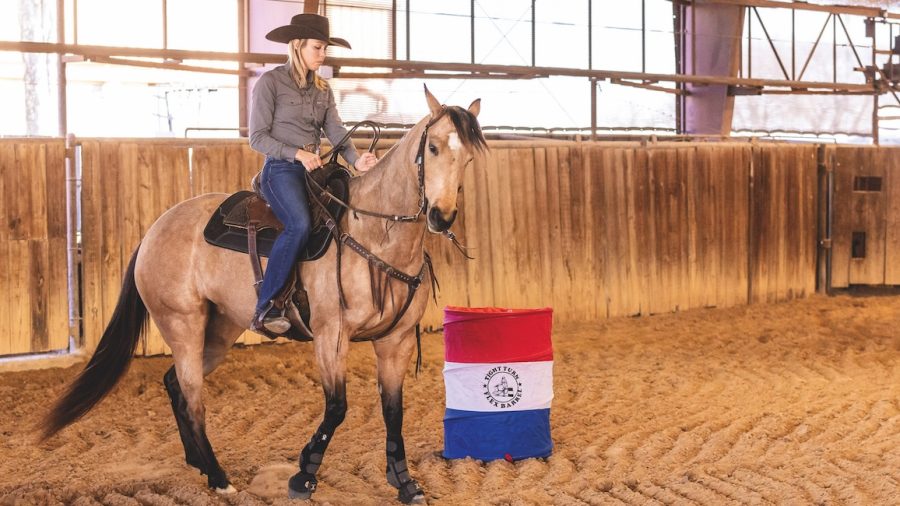
To help a horse perfect foot placement, Lambert will spend some time riding her horses on a slight incline so they learn to pay close attention and really feel the ground.
According to Lambert, there is no way to compensate for a horse that doesn’t possess the proper foundation.
“If you don’t have a good foundation on a horse you have no where to go when something goes wrong,” she says. “I like my colts broke, and when I say broke, I don’t mean broke to ride. I mean broke inside out. I want them to know lateral movements, and I want them to know about yielding to move their hips and shoulders. They need to be able to feel their feet, and that takes a while for a horse. Very few 3-year-olds are going to know that, but of course it depends on their background.
Working a horse in serpentines, straight lines, flexing and stopping while on a surface that is not completely even helps Lambert’s horses “find their feet.” At the same time, she concentrates on shoulder and hip placement, positioning the horse in the same manner that she wants them to turn the barrels.
“The horses I ride are light,” Lambert says, “but oftentimes, what people don’t see is that lightness is developed over a long period of time and work with that horse.”
Responsiveness to cues from the rider’s hips down is also big on Lambert’s checklist for determining if a horse is broke or not. Ideally she wants a horse with sensitive sides that will move off her feet, but not a horse that has “been thrashed on to have sensitive sides.” Lambert uses her feet first before pulling on a horse in a run because it only makes sense that a 110 pound rider has minimal leverage against an 1,100 pound horse.
“Horses are tender in their mouth and we can do things by communicating with the bit and good hands, but our hips and legs communicate an awful lot too,” Lambert says.
“Even when you pick a horse up at a barrel, if you think about you change your hip position in that movement and that’s a cue that tells them to rate.”
Soundness of both mind and body are a big piece of the puzzle for Lambert, who says, that, without a doubt, “they’ve got to be put together upstairs.”
She will gauge a prospect’s mental soundness before asking for more speed, taking into consideration their level of responsiveness, their nerves and overall confidence. Depending upon how a horse works at home or on the road, she’ll either apply some pressure or step back and regroup. Since she plays the rodeo game almost exclusively, Lambert is not battling the futurity payment clock.
“I love futurities,” Lambert says, “and I’m probably going to go to some more of them, but as anybody that’s been around me can tell you, I really take my time on horses, and I do that for a lot of reasons, but a big one is that I want to have rodeo horses. I have some 4-year-olds that are really nice horses and going good, but it depends on the horse how hard I will push them in competition because I don’t want them to exceed their mental limits ahead of schedule.
“I think horses really come into themselves at 7 to 8, and I want them to still be winning. I want my name to be attached to winners for the long-term. I also want rodeo horses because you know rodeo horses are pretty tough at the jackpots, too. You might not always win first, but you’re going to be right there with them.”
Picking Winners
Lambert has a knack for picking winners and an appreciation for many styles, from the free running types to ex-reining horses needing a new career.
“What I really like is the combination of reiner and working cowhorse,” she says, “because a working cowhorse has had to go fast and learned to stretch the front feet out. Reiners tend to be a little more bound up. You can get them past that, but it’s going to take longer. Another reason I like those working cowhorses is they’ve got cow and every barrel horse needs to have some cow. You don’t want them so cowy that you can’t get them to the barrels, but you want them to know that they’re hunting something because rating three barrels is not a horse’s natural inclination.”
Riding free runners versus ratey cowhorses poses a unique set of challenges, according to Lambert, who discovered that to win on hard running horses, she had to re-evaluate everything.
“I did have to rethink some things because on some of my horses that are really cowy, you don’t want to work them much,” she says. “You want to get them really free and moving and exercised and they’re going to go find the barrels. The really hard running horses need to be worked a lot more. Slow, slow work and you have to keep them backed off all the time. That’s a big consideration if a person is thinking about buying a hard running-type horse.”
Tips and Tactics
From tune ups at home, to warming up and competing, Lambert isolated some strategies that help her succeed on all types of horses. Virtually every warm up is different because every horse is different, and, for Lambert, her runs start when she saddles, and she might saddle as many as five head at a jackpot in one given day, which makes for a lot to think about. Mentally, she prepares for each run differently and let us in on how.
To maximize the talent of her hard running partner, Lambert’s goal when warming up is to get the mare’s muscles warm at a trot—never faster. She will focus on lateral flexion and a few drills, including small circles, to get her very relaxed.
“I want to sit and have her break down into small circles to where she doesn’t want to take off and lope, but just slow down,” Lambert says. “She really is an incredible horse, but it takes some patience to get along with her. She’s on the edge, and I don’t think scolding her would work. When I’m running her, she goes around the barrels everyday at home at a walk or trot to keep her calm on the pattern, and I keep my hands and feet the same every time. With her repetition is a beautiful thing. And like other free runners, they need to know that every time you approach the pattern it’s not to run all out.”
Lambert also focuses on consistent cues with her hands and feet at home, taking special care to place the mare in the same position every single trip around the pattern.
“It’s crucial on her,” she says, “because going full tilt, she’s so fast that I don’t have the time on her to adjust. I’ve got to have it right through repetition at home.”
Futuritied lightly at age 4, Lizzie performed well, but quit working for a period of time due to soreness.
“That was a really good learning experience for me because a good horse doesn’t just quit working,” Lambert says. “They are giving you a sign. Now, the first thing I do is go find out if there’s a problem. I don’t care what kind of horse you have or what personality they are, if something goes wrong take them to the vet first. Go find out. The money that you’re going to spend finding out if there’s a problem is going to save you time and time again. It’s part of figuring out what makes a horse tick.”
Lambert knows her horses inside and out and develops her habits and rituals around their individual needs.
“I know on Lizzie when she’s going to work outstanding, and those days are usually the days when she’s hardest to warm up,” Lambert says. “I mean she’s hard to get on, hard to cinch up, but the thing about her is—and this is where I think people get into a lot of fights—I know she’s hard to get along with at the barrel race. At home, she’s one of the most broke horses I have, but she is a different horse at game time and that’s OK. I know I have to put up with that to win.
“My pre-game with Lizzie is to stay out of her way. I might saddle her in the second or third event of the rodeo. I like to long trot straight instead of in circles, so I try to find a straightaway, and I often ride her in a D-ring. I want her to want to go, so I keep her energy a little balled up. I trot a while and then I get off of her and totally let her get her breath back.
“She’s always ratey,” Lambert says. “The only thing I ever do to her now at home, at her age, is in the spring when I bring her back I get her in great shape and then before I go somewhere I’m going to take her to the first barrel and really hustle her around it and get her to really blow hard out of the barrel because that horse wins a lot by being the fastest leaving a barrel. I don’t run her at home, ever. Horses need runs to build up their wind, but I prefer to do that away from home.”
“He’s kind of one that you’ve got to get his attention and I’ve got to help him a little,” Lambert says. “I want his mouth to feel a certain way, and I want him to be responding to me a certain way. You’ll see me do things with him that you would never see me do with a very ratey horse. I’ll go do some fence work, some rollbacks, and I make sure when he rolls back that it’s not straight over his hocks, but right back around following his nose. I’ll set him in the ground a couple of times and back him up a few steps. Nothing I do is a major distraction to him, but it’s getting him tuned up. I think that will stop with him in a year or two when he understands that it’s serious business every time.”
Another item to note with the “Easy” personality is that it’s necessary that they hunt and really get around a barrel when worked at home.
“My normal routine with Easy is to ride him all week, and if we’re leaving on Friday, then on Wednesday, I tune him up really well and Thursday is a very light workout,” Lambert says. “That’s if he’s going to get three runs or more over Friday, Saturday and Sunday. There are times when maybe he did something the last day of the weekend prior that I didn’t like, so then I will ride him light on Monday and work him Tuesday. I might even come back Wednesday and just lope him one time through the pattern to ensure I have that corrected.”
 Evaluating Equipment
While some barrel racers find one bit their horse likes and never try another, Lambert believes in switching things up at home in order to be prepared, lest she have an equipment malfunction at the rodeo, have a favorite bit lost or stolen or encounter conditions that demand a bit change.
“Lizzie has about three bits I run her in and it depends on ground conditions, how she felt the run before and if we’re running indoors or out,” she says. “The bit has to work with your hands and your horse. The terms “light hands,” or “a check,” might mean something totally different from one person to the next. I keep them backed off the bit a lot because I don’t want one that I have to pull on all the time. My goal is that when I get done with a horse anybody should be able to ride them and when somebody else does crawl on them, they don’t feel like they need to pull all the time.”
Younger horses require a lot of bit changes in Lambert’s opinion. She also won’t limit her selection to just “barrel racing bits,” because there are plenty of leverage bits that have their place, provided a person has the knowledge to use the tool.
“Some days I’ll use a tie down and sometimes not,” Lambert says. “I switch from rawhide to leather.”
Similarly, Lambert is not one to ride with spurs everyday on every horse, and has been known to remove the chin strap from a horse’s headgear if she feels it’s necessary to help free one up.
“With multiple horses you make a multitude of decisions and adjustments, but the key is knowing why you’re doing it. My number one reason to use spurs is on a flat-sided horse to get more bend in the ribcage and more responsiveness.”
Laura Lambert
Well-known in the Rocky Mountain region, Lambert grew up in the sport of rodeo, working her way up from Little Britches to the pros. Her parents Jody and Dale Motley, and brother Josh, are all accomplished rodeo competitors. Her husband, Ricky, is a well-known calf roper, farrier and horse trainer. Laura, Ricky and their son, Brayden, 7, recently celebrated the addition of Boedy Tagg Lambert to their family on April 13.
Lambert’s most recent crop of winning mounts—and the ones that were used to demonstrate her methods in this article—include “Easy,” who won the Colorado Professional Rodeo Association Finals average title by half a second in 2007. In so doing, he was largely responsible for sewing up the CPRA barrel racing year-end title for Lambert. He has been a standout money earner in the Mile Hi Barrel Horse Association, where he won two out of three go rounds at the 2006 year-end Finals. “Lizzie” is a five-time MSCFR qualifier, a two-time Cheyenne Frontier Days short round qualifier, and took Lambert to reserve honors in the MSC in 2004, but was unable to compete at the Circuit Finals Rodeo when her season was interrupted by colic surgery. She did, however, enable Lambert to qualify for the Dodge National Circuit Finals Rodeo.
Top-notch care also ensures that Lambert’s horses last for the long haul.
“My vet, Chris Morrow of Mobile Veterinary Practice in Amarillo, Texas, is undoubtedly one of the foundations of my success. I think it’s important that people find a qualified vet they can trust. Also Formula 707 supplements are huge for me because I know they really work. There are very few horses that I’ve run across that didn’t need any type of maintenance. You don’t find that very often in rodeo horses because everything we do is hard on them, from the trailering to the ground conditions. The key to success with riding a lot of horses is that you’ve got to know your horses, how they eat, how they feel and supplements and veterinary care are integral to that.”
E-mail comments on this article to [email protected].