
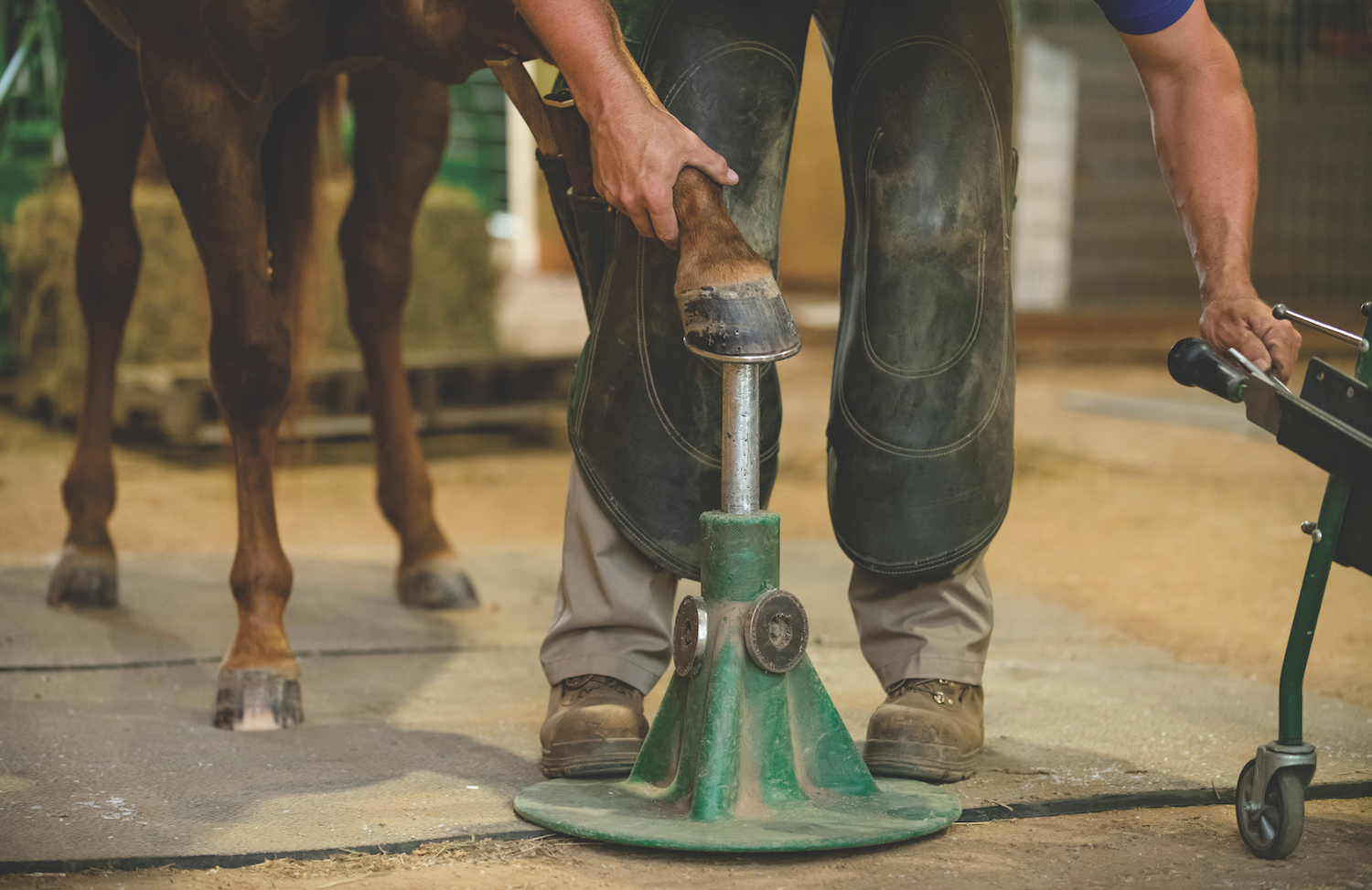
Barrel Horse News experts share their best advice for managing navicular syndrome in performance horses.
You can’t pinpoint it, but something just doesn’t seem quite right. Maybe your horse is a little short-strided when you warm him up. Maybe he takes a few funny steps after a barrel race and you’re not sure why. Or maybe he’s clearly lame, but you can’t find any heat, swelling, or an obvious reason to blame.
Few things strike more fear into the heart of a barrel racer than hearing the word “navicular,” but advances in diagnostic accuracy, shoeing practices and medical management are giving horse owners every reason to approach the diagnosis with a newfound optimism. Scott Fleming, DVM, of Rood and Riddle Equine Hospital in Lexington, Kentucky, and Noah Grimes, DVM, of Athens Equine in Athens, Texas, shed light on the evolution of navicular syndrome and share why this frightening diagnosis doesn’t have to signal the end of a horse’s performance career.
What is Navicular Syndrome?
Navicular syndrome is a term that encompasses any pain that originates from the navicular apparatus. This can include the navicular bone itself, the deep digital flexor tendon, the navicular bursa, the collateral ligaments on either side of the navicular bone, and the impar ligament. While a navicular diagnosis was once reserved only for horses who presented with pathology within the navicular bone itself, a better understanding of the apparatus as a whole has broadened the diagnostic criteria considerably.
“Generally speaking, navicular syndrome or caudal heel pain syndrome is injury, inflammation or pain associated with the back half of the foot,” Fleming explained. “There are so many different anatomical structures that have to work, bear weight and accommodate the range of motion back there that it is very easy for any one thing to cause an issue.”
Fleming says that navicular syndrome and caudal heel pain syndrome are terms that are often used interchangeably, although caudal heel pain syndrome is a more generic term that simply denotes a horse with pain in the back half of the hoof. In horses diagnosed with caudal heel pain, there may not be a clearly defined cause; in horses with navicular syndrome, there will be clinically significant findings within the navicular apparatus.
Obtaining an Accurate Diagnosis
Because of the complexity of the navicular apparatus—and because treatment for navicular syndrome can vary considerably—Grimes emphasizes that the first step in successful management is an accurate diagnosis.
For both Fleming and Grimes, diagnosis begins with a clinical evaluation that involves blocking the palmar, or back half, of the hoof. This nerve block allows a diagnosing veterinarian to be certain that the horse’s lameness is originating from the back half of the hoof and not from further up the limb or from a different part of the hoof altogether.
If the horse is sound after the palmar block, radiographs of the hooves are the next step in the diagnostic process. While they play an important role in diagnosing navicular syndrome, Grimes says the information that radiographs can provide is limited.
“Radiographs only show you bone,” explained Grimes. “We are looking for any changes in the navicular bone itself, such as a cyst, irregular bone margins, or changes in the distinction between the cortex and the medullary cavity, as well as any signs of arthritis in the coffin or pastern joints.”
In instances where radiographs are inconclusive or more information is needed, an ultrasound or MRI may be recommended.
“In cases where I have an MRI, I have more information, and that lets me make a more informed decision,” explained Fleming. “On an MRI, you can actually see the bursitis within the bursa. You can also see surface defects of the deep digital flexor tendon or the flexor surface of the navicular bone.”
Grimes stresses that an accurate diagnosis is paramount in ensuring that a horse with navicular syndrome has the best possible treatment outcome.
“At the end of the day, completing all of the diagnostic steps will save you money because you have a targeted treatment approach. And that’s really where your prognosis comes from—having that correct diagnosis, and it’s huge,” Grimes said.
Prescription Shoeing
Once a diagnosis is made, prescription shoeing is the first stop for Fleming and Grimes. Both veterinarians say that proper shoeing is the single most important step in managing a horse with navicular syndrome. Shoeing needs vary widely depending on the specific dysfunction within the navicular apparatus. The horse’s job, his work and footing conditions, and how he responds to the shoeing also play a role.
In general, prescription shoeing will help ease breakover and reduce the impact on the back half of the hoof. Fleming says it usually takes about two weeks to gauge the impact that shoeing changes will have.
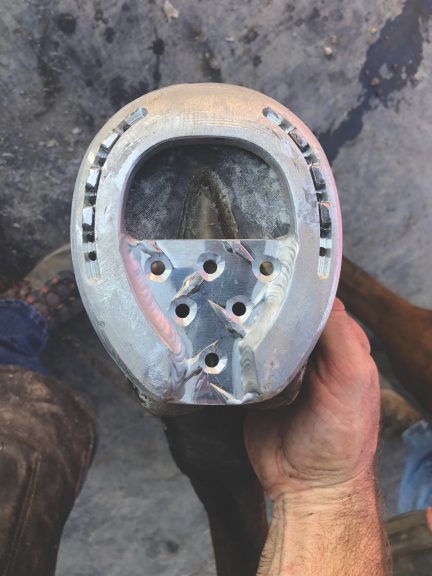
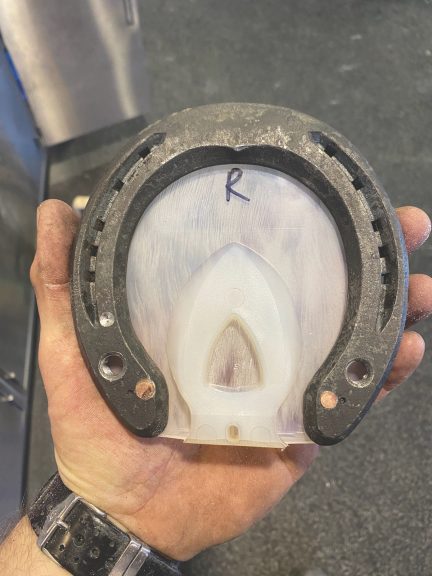
“A lot of times these horses are going to try to protect concussion in the back half of the hoof, so we will put a rigid, welded plate over the whole back half of the foot, as opposed to the heart bar or straight bar shoe that will cover a much smaller surface area,” explained Fleming. “Then we will use either a soft impression material or a soft pour-in in the back, because we still want to stimulate those internal hoof structures while reducing the physical force and concussion those sensitive areas are experiencing under load. Often times, those things are incorporated into a shoe that has a mild wedge and a rolled or rocker toe—just something to try to reduce breakover.”
Grimes says he takes a similar approach to shoeing a horse with navicular syndrome.
“I want to ease breakover, bring the toe back, and provide adequate heel support while also making sure we manage things like collapsed heels. Those can be really difficult to manage, and I don’t want to make them worse by having the horse in a wedge shoe. I like wedge shoes, and I use them frequently, but an incorrectly applied wedge can cause more harm than good by causing collapsed heels. A wedge that supplies adequate heel support is ideal to provide the mechanics needed for the foot while also correcting a negative palmar angle,” Grimes explained.
Grimes says that while significant changes in shoeing are often needed immediately following a diagnosis, the goal is always to reduce the need for aggressive shoeing over time so that the hoof mechanics can return to a more normal baseline as much as possible, while still keeping the horse comfortable.
Managing With Medication
Non-steroidal anti-inflammatory drugs (NSAIDs), bisphosphonates and corticosteroid injections are the most commonly prescribed medications for horses with navicular syndrome.
While NSAIDs such a phenylbutazone and Equioxx can be beneficial in the early stages of treatment and during acute flares in pain, Fleming cautions against relying on them for long-term use.
“A lot of times I will give three to five days of bute just to help quiet things down but long term, I try not to have horses on it,” Fleming cautioned. “Equioxx is a little bit less potent than bute but has been found to be easier on the gastric system, so I will use if for more chronic, low-grade pain. You have to be cognizant that with anything like that, there are downsides—gastric ulcerations and inflammation of the intestinal tract are big ones.”
Similarly, Grimes says that he tries to minimize the use of daily NSAIDs as much as possible, often preferring to start with shoeing changes and then moving directly to steroid injections.
Bisphosphonates can also be part of a comprehensive plan for managing horses with navicular syndrome—especially those with compromised navicular bone integrity. Known by their brand names Tildren and Osphos, bisphosphonates work by modulating bone growth.
“You have two cellular components that either break down or build bones,” explained Fleming. “You have osteoclasts, which break down bone, and osteoblasts, which build bone. The idea behind bisphosphonates is that we are trying to establish a better equilibrium between these two processes. Essentially, for navicular horses, bisphosphonates reduce the bone resorption or osteoclastic component of that process. They offer some anti-inflammatory effects and pain modulation, as well.”
Grimes also finds the use of Tildren and Osphos to be valuable, even if it is case-dependent.
“Horses that have a bruised navicular bone, or horses with cortex lesions or cystic lesions are good candidates for bisphosphonates,” Grimes said. “Typically, I’m going to recommend that every 6-12 months. The caveat is that it should only be given to horses that are 4 years old and up.”
While NSAIDs and bisphosphonates both have a place in treating navicular syndrome, Fleming and Grimes agree that injecting either the coffin joint or the navicular bursa—or both—with steroids can be one of the most beneficial options for managing pain and inflammation.
“I will often inject the coffin joint to see if we can get relief and get the horse more sound with just that,” Grimes shared. “The coffin joint is really close to the navicular bone, so we’re putting the steroid in very close proximity to the navicular apparatus without having to go into the bursa. I will come back and inject the bursa if I have to. I try to give them the benefit of the steroid to quiet things down.”
Fleming takes a similar approach, noting that injecting the coffin joint is his first-line choice unless a horse presents with a flexor surface deformity or an MRI shows inflammation within the navicular bursa.
Pulling All the Stops: The Palmar Digital Neurectomy
In the majority of cases, horses with navicular syndrome can be successfully managed for many years through a combination of prescription shoeing and medication. But despite a veterinarian’s best efforts, sometimes the desired outcome simply cannot be achieved. In these cases, a palmar digital neurectomy—often referred to as a heel neurectomy—may allow a horse to continue in a career that otherwise would not be salvageable.
“I will recommend it as a last resort,” shared Fleming. “If your horse is at the top of its game and you have a lot invested, sometimes it is an opportunity to extend its career. It’s a very heavy decision to make. If that horse can’t feel its foot, a lot of times things can get really bad before you know it—for example, an abscess that progresses to a bone infection.”
Grimes also recommends the procedure only when all other options have been exhausted. He cautions that, because the neurectomy severs the nerve and removes the horse’s ability to feel pain, it can result in a catastrophic injury, such as a tendon rupture that forces euthanasia.
“Once you have a neurectomy, it’s not just done either,” Grimes cautioned. “You still have to keep on top of the shoeing. I’ll still inject coffin joints. It’s not a complete fix.”
Finding the Future
While receiving a diagnosis of navicular syndrome feels overwhelming, there are many viable paths forward.
“It is not the death sentence that it once was to a horse’s career,” Grimes encouraged. “But again, accurate diagnosis is key so that we can manage it correctly.”
Fleming is cautiously optimistic about the future for horses with navicular syndrome.
“At the end of the day, it’s still a degenerative process, and the vast majority of them are going to get worse over time,” Fleming said. “But we’ve gotten so much better about finding it early and finding methods to reduce inflammation and concussion, and the medication has certainly found its place in treatment. I don’t think it’s necessarily changed the end run, but I think we have been able to slow it to the point where we’re seeing a lot better quality of life, and longer careers, for these horses.”
MEET THE EXPERTS
Scott Fleming, DVM, CF is a 2013 graduate of Texas A&M University. He is a shareholding member of Rood and Riddle Equine Hospital in Lexington, Kentucky, where he specializes in equine podiatry. A special interest for Dr. Fleming is participating in Equitarian Initiative trips to Central America to help working equids in the region.
Noah Grimes, DVM, is a 2013 graduate of Texas A&M University. He is a shareholding member of Rood and Riddle Equine Hospital in Lexington, Kentucky, where he specializes in equine podiatry. A special interest for Dr. Fleming is participating in Equitarian Initiative trips to Central America to help working equids in the region.