
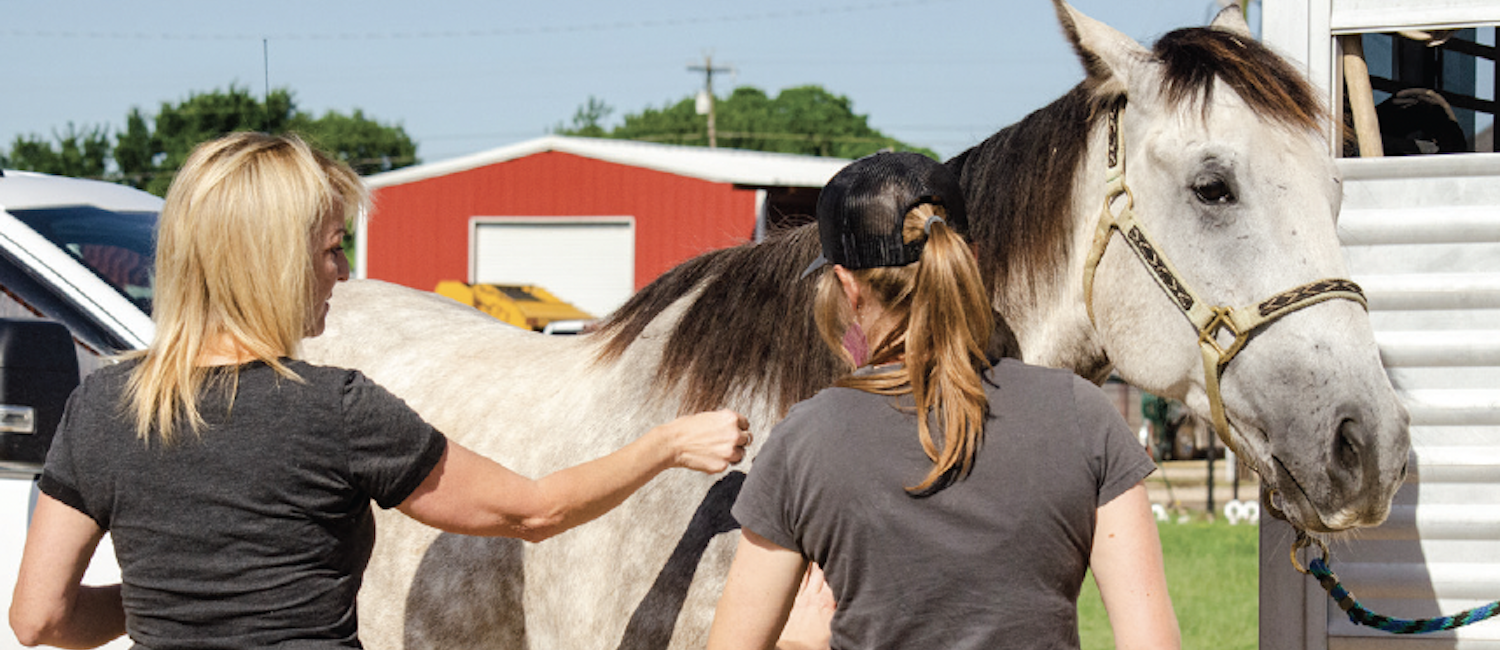
Have you ever wondered what your horse was thinking? You might be able to find out with the help of an animal communicator.
It’s a situation horse people are all familiar with—you have a horse that has an issue, whether it’s health or behavioral, and no matter what, you can’t seem to figure out what the problem is. Your veterinarian has done an exam and run diagnostics; your farrier has checked the horse over; and perhaps you’ve even called in a chiropractor or similar professional. Still, the problem persists, and you have no leads to follow.
One option you might not have considered is bringing in an animal communicator. These professionals, who talk to horses and other animals, may be unconventional, but in fact, many work with veterinarians and other specialists to help find and diagnose pain, uncover training issues and strengthen the human-animal bond. If you have an open mind and a sense of intrigue, using an animal communicator could be the ticket to solving unexplainable issues and helping you and your horses become even closer than before.
Not A Psychic
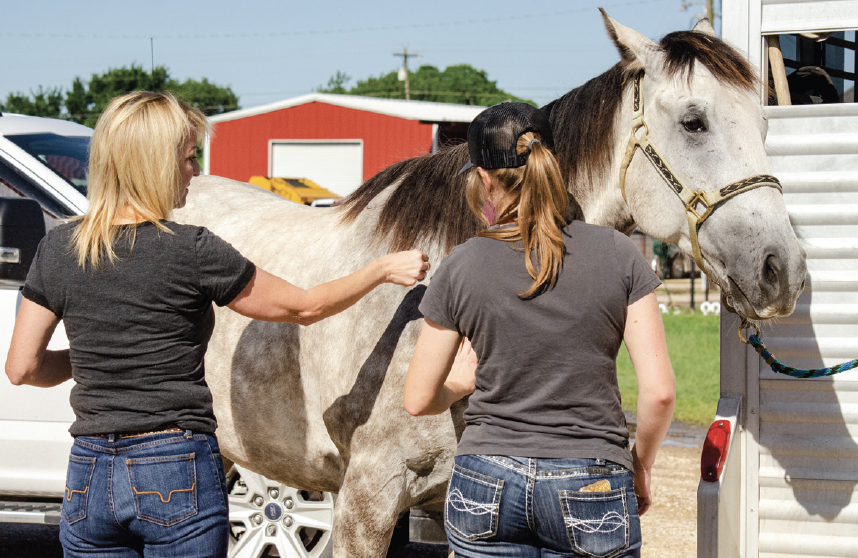
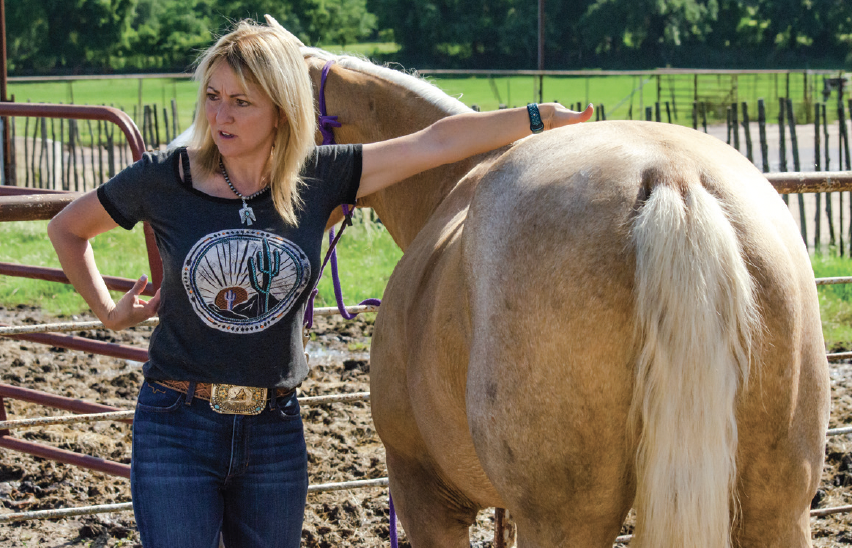
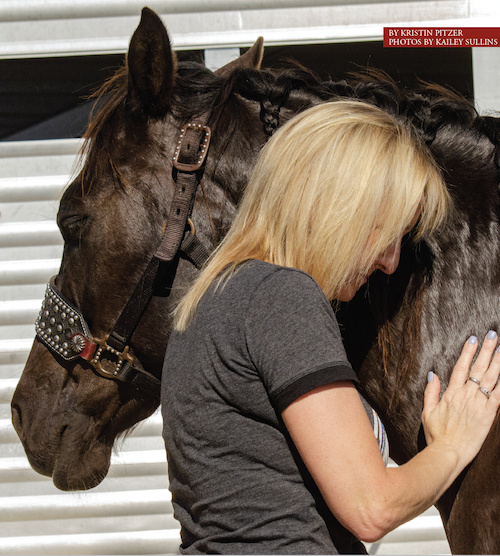
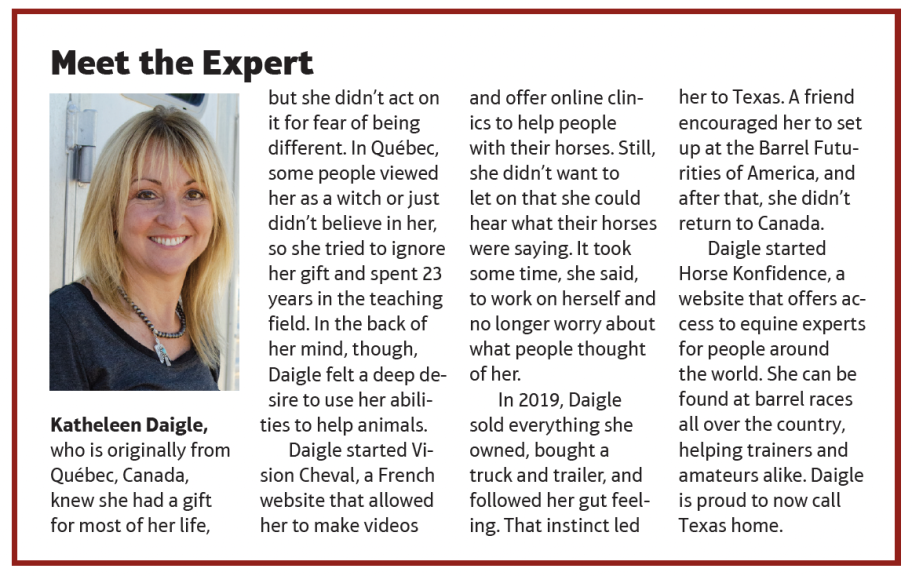
The job of an animal communicator seems self-explanatory—a person who converses with horses, dogs, cats, and more—but for Katheleen Daigle, who has been communicating with animals since she was young, a more apt way to describe her role is as a translator. Horses and other animals tell or show her what they have to say, and then she translates that info to their owners. In that capacity, she acts as an advocate for the horse, expressing what she hears and feels to convey to its owner any problems it is experiencing.
“I’m there to help the owners of the animals know what the animals have to say,” Daigle said. “There’s some that have a lot to say, and there’s some that don’t say anything. I work a lot with vets, chiropractorsand others because I really feel what the horse feels, like pain. Sometimes they show me other complications, too. So, when they cannot find something on the horse, I’m another tool to help them.”
When searching for unexplained pain on a horse, often times all Daigle has to do is connect with the horse either in person or from afar. If the horse has ulcers, she feels pain in her stomach. If it is suffering from an injury to its foot, she can sense which foot has the problem. She doesn’t always know what the pain is or why it’s happening, so that’s generally when a veterinarian or another professional steps in.
“Sometimes I say what I’m feeling, but I can’t tell what the name of it is,” Daigle said. “Like, the horse doesn’t say, ‘Hey, I’ve got EPM.’ I feel the pressure there, and then the vet will say, ‘What you’re feeling there is the EPM.’”
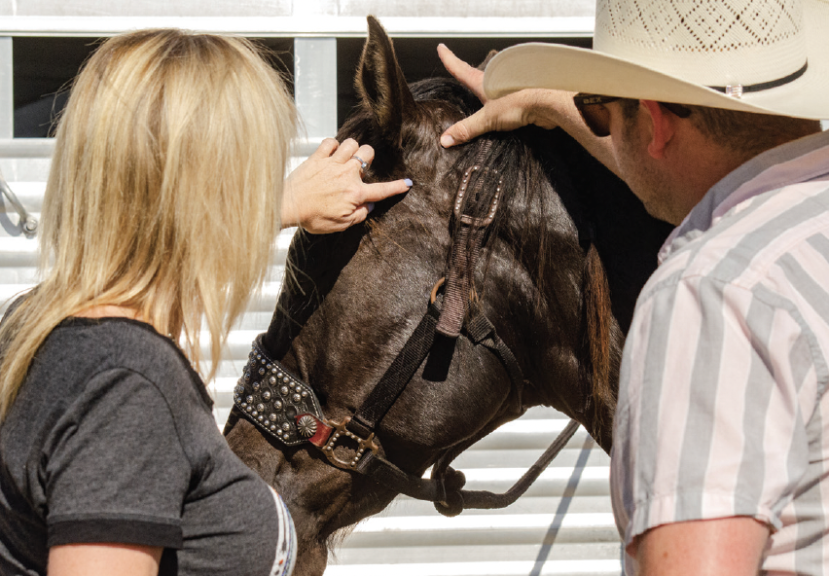
Daigle doesn’t just feel pain and pressure, though. She says she can actually talk to horses and ask them questions. This is especially helpful if a horse goes from working well to suddenly ill-tempered or off in some way. The horse in question might tell her what is making it unhappy, or sometimes, Daigle said, it’s like watching it on a screen. Other times, she feels like she’s inside the horse’s body and going through the movements that are causing the issues.
For instance, a horse might make her feel the motion of moving its front end one shoulder at a time. That’s where the translator part of her job comes in. Daigle doesn’t know if the horse is performing an exercise or doing an event like pole bending, so she’ll ask the owner some questions. Then, together they can figure out what the horse likes or doesn’t like about the movement.
One thing Daigle is not, she said, is a psychic—a big misconception for some people. Some riders think perhaps the horse can tell her things for the future, like if it’s going to be a futurity star. If that were the case, Daigle said with a laugh, she would be a rich woman indeed.
“If I knew that the horse would be the best and he would win everything, sorry, but I would buy it for me,” Daigle said. “I’m just talking with the horse. If the horse tells me it wants to do something in the future, that’s one thing, but I cannot see the future.”
Learning from the Horse
There are several reasons an owner might try an animal communicator, but the cases Daigle sees the most are the ones where the horse is having an issue, and the owner has exhausted all other diagnostics. That’s how trainer Dustin Angelle of Lafayette, Louisiana, first became connected with an animal communicator 10 years ago. He had a horse that was continuously sore, and veterinarians couldn’t find anything wrong with it. As a last resort, he reached out to a communicator, though he admitted he was skeptical at first.
“They were able to diagnose my horse and then help the vets diagnose him, and then we were able to get him sound again,” Angelle said.
He met Daigle a few years later at a futurity, and at the time, he had another horse that was in the same boat. Angelle asked Daigle to help him out, and Daigle diagnosed the horse and told Angelle about injuries that had happened to it, vet work that had been done, medications it had been given — things nobody else would have known about. Since then, Angelle has become a firm believer in Daigle’s gift and has continued to work with her weekly.
Ashley Schafer, a futurity trainer based in Millsap, Texas, found Daigle through the recommendations of her friends. She was intrigued by the idea of an animal communicator, and since she had a horse she had been having some struggles with, she decided to give it a try.
“I was a little skeptical at first because I didn’t know if it was going to be worth the money and that kind of thing,” Schafer said. “The first time I used her it was crazy to me, because the stuff she said was stuff that you can’t guess, and it would be really risky to say if you didn’t know, because people would doubt you or say it wasn’t true. Multiple times she’s been pretty much spot on about things like bits or shoeing.”
While people most commonly call upon animal communicators for problems, sometimes they just want to know if their horse likes their riding program, if their saddle fits, or if the horse likes them as an owner. Some owners have found that communicating with their horses had the added benefit of getting advice on how to improve their own riding straight from the source.
“I had a horse tell me its owner was always off on her left side because she had pain, so it needed to compensate for her all the time,” Daigle said. “I told the owner that, and she said it was true. I said, ‘You do chiro work on your horse, but you need to do it on yourself, too. If you don’t take care of yourself, you cannot be the best rider for your horse.’”
Daigle said one thing many horses tell her is that their riders put too much pressure on themselves and forget how to have fun. People don’t leave their baggage at the barn door when they groom their horses,clean stalls or ride, and horses often interpret that stress as fear or pain.
“If you can just sit there and enjoy a little moment with them, they don’t need more than that,” Daigle said. “If you want them to be part of your life, you need ton be part of their life. Be in the moment, not just there and doing things without thinking what you’re doing.”
Unorthodox, But Accepted
They may be untraditional, but animal communicators are becoming more accepted in the barrel racing community. There’s a few reasons for that, Angelle believes, but one reason is just the broadmindedness of the people.
“I think not every sport is as open-minded,” Angelle said. “We strive to win, and we are always looking for a better way. Anytime you tell a barrel racer you have something that can help them go faster or do better, we are always listening.”
Everyone can benefit from learning how to listen to their horses more, Angelle added. With Daigle’s help, he’s been able to understand his horses’ personalities, likes and dislikes more clearly. As a trainer who often rides other horses he does not have as close of a bond with, he’s found he is able to sync up with them more quickly.
“I feel like my communication with my animals is so much better even when she’s not with me, because she’s taught me more about how to listen,” Angelle said. “She’s taught me to pay attention when they are trying to tell us different things and how to look for signs they are giving us to try to communicate with us.”
Schafer has also found Daigle helpful for working through miscommunications with her horses, whether they were confidence issues or a lack of understanding of the maneuvers. Using an animal communicator isn’t necessarily going to put you in the winner’s circle, she conceded, but when the level of competition is as high as it is at futurities and rodeos, every little thing counts.
“I urge people to try it,” Schafer said. “Especially if there’s a specific horse that you’re really struggling with, I think it’s worth giving her a try and seeing if she can get to the bottom of it. Sometimes it’s just one little, tiny thing that makes all the difference for these horses.”
If you are interested in trying a communicator but location is a factor, some communicators don’t need to be present to speak with a horse. Daigle enjoys working with horses in person most, but she does quite a few readings remotely, requiring only a photo of the animal and its name. Once she has established that connection, sometimes horses even “call” her, giving her messages that she then passes on to the owner. Be aware that not every horse always has things to say, though, and some can be quite aloof when Daigle tries to speak with them.
“Some horses are more difficult to approach,” Daigle said. “It’s more difficult when they’re like that, but sometimes, if they don’t have a lot to say, it’s because everything is OK in their life.”
There are many things that might motivate a person to reach out to an animal communicator. Whether it’s issues in the alley, undiagnosed pain, or simply wanting to open up a line of communication to gain a closer bond, any reason that brings the horse and rider closer together is valid in Daigle’s book.
“One of my expectations is to make people see that there’s something else—a horse is not like a car that you put the keys in and you turn,” Daigle said. “If I can help people to be more open and to be betterwith their horse, if I can help one person, I will have achieved my goal.”
This article was originally published in the July 2021 issue of Barrel Horse News.