

Recip mares might be background players, but their role in the reproductive process is crucial.
Barrel horses are unique in the performance horse world. Unlike cutters or reiners, it’s not unusual for a barrel horse to continue competing at a high level into their teens. But what’s to be done when you want to breed a high-quality mare while she’s still busy competing? Embryo transfer is a good option, but to do that, you need a good surrogate—also known as a recipient mare. Have you ever thought about the mares tasked with carrying the embryos that go on to become great horses? Two experts unpack the mysteries of these unsung heroes.

The Role of a Recip
When a mare is a competitor, carrying a foal to term can affect her performance and could also affect the foal. That’s why recip mares, the recipient of a fertilized donor mare’s egg and a stallion’s sperm, are so important. Dr. Matt Parsons, DVM, of Arnold Reproduction Center in Weatherford, Texas, says the role of a recip is crucial.
“They’re important because they’re carrying a valuable investment—that of a live foal, born healthy,” Parsons said. “Recip mares give mares an avenue to continue competing but start having their progeny on the market. It allows them to start their breeding careers a lot earlier.”
Rick Ford of Cinder Lakes Ranch says with the help of a recip mare, a mare with highly desired genes could produce more than one foal in a year. And if your mare isn’t able to carry a foal—whether due to age or physical condition—a recip mare is a game-changer. Ford says a mare will usually produce eggs until their mid-20s, although they may not be able to carry a foal at that age.
“It works great in the early stages of their life and the later stages of their life, to flush an embryo and not have them go through the physical part of having a baby,” Ford said. “It’s allowed us to keep our mares going longer.”

Recip mares have been a part of breeding since embryo transfers became possible in the 1970s, says Ford. Since then, it’s gotten more streamlined and more common, especially after more than one foal from the mare in a calendar year could be registered with the American Quarter Horse Association in the mid-1990s. In 2018, 5,144 AQHA foals were born via embryo transfer. From 2009 to 2018, an average of about 4,860 foals were bred through this method.
What’s the Life Cycle?
Arnold Reproduction Center keeps a herd of 800 recip mares, with 400 of them pregnant and out at farms and 400 at the facility’s two locations getting ready for the upcoming breeding year. Most mares have a foal every other year.
To bring recip mares into heat at Parsons’ facility, staff puts them under stadium lights in a large pen. The facility has four large pens where the mares are placed at sundown. They’ll stay until about 11 p.m. The mares stay on this routine from around Thanksgiving until Daylight Savings Time in the spring.

Once a recip mare is synced with a donor mare at a breeding facility like Cinder Lakes and the donor mare has been bred—either live cover or artificial insemination—the donor mare’s embryo is flushed. In other situations, such as if ICSI is going to be employed, the process will look different, but the end result is a fertilized egg, or embryo. The embryo is then stabilized for transit and sent to a recip mare farm like Arnold Reproduction Center. There, the embryo is implanted in the recip mare’s uterus.
After the recip mare is confirmed and 40 days pregnant, the client will pick up the mare and take her to either another breeding facility like Cinder Lakes or to the owner’s home to care for her until she foals. The mare will be pregnant for 11 months. Once the foal is born, it’ll stay with its dam for five or six months before weaning.
After the foal is weaned, the recip mare is returned to the recip farm, usually between August and October.
There’s a misconception that recip mares who are open—unbred—are kicked out in a field and forgotten until they’re needed again. Parsons says that’s not typically the case. For example, at Arnold Reproduction Center, mares are turned out but still receiving regular care.

“We normally put those mares out on a coastal [hay] field and let them relax,” Parsons said.
Ford says recip mares receive the same high-quality feed as the breeding operation’s top competitors.
“The nutrition of the recip mare matters in terms of when they can accept an embryo,” Ford said. “And the donor mare will get pregnant easier if she’s on a positive plane of nutrition. So when those mares go under lights to get into heat, they’ll get increased feed to be on a positive plane of nutrition.”
What Makes a Good Recip?
Most recip mares for Arnold Reproduction Center are found at auctions around Texas or from horse buyers, says Parsons. They’re typically Quarter Horses and Paint Horses, both because that’s what’s most readily available and also because they’re more suitable than Thoroughbreds.
“Quarter Horses and Paints seem to be much easier keepers, and they have the good body frame and temperament, so that’s what we prefer to purchase,” Parsons said.

Ford agrees and says he sees some Appaloosas too, but Paints tend to be the most fertile in his experience. Recip mare breeds vary by region.
“In California, you’ll see more Thoroughbred mares because there’s a lot of them coming off the track needing a job,” Ford said. “Back East, you’ll see some Standardbreds or Arabians.”
Surprisingly, bigger is not always better. Ford says draft mares were used early on, but they were actually too big.
“You want to fit with what you’re breeding,” Ford said “You want a recip mare that’s a little bigger than what you’re having, because it does make foaling easier. But you don’t want too big where the baby can have trouble nursing.”
Fertility is the most important feature of a recip mare, concur both experts.
‘They have to be free of any reproductive problems,” Parsons said.
Ford says an ideal recip mare has already had at least one foal, because maiden mares can sometimes produce a smaller baby.
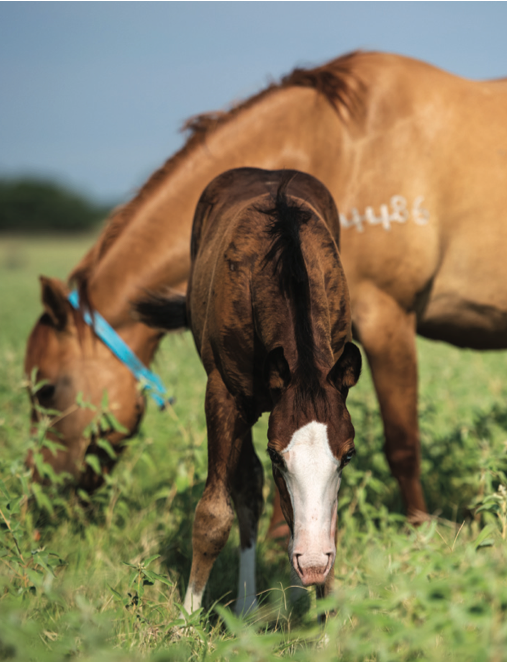
Size is also important. Often, smaller recip mares are paired with embryos from cutting horses, while prospective barrel foals will need a larger mare. To put what will be a large foal in a small recip mare is a recipe for disaster.
“We try to size the donor mare to the recip mare to make sure there are no foaling problems and so that foal can grow to its full potential,” Parsons said.
Temperment is a key factor. In past years, a mare’s handling wasn’t considered as important, but both experts say being able to handle and catch a recip mare makes the whole process easier and safer.
“Ideally, you want them to be easy to catch—that’s one of the client’s main preferences, and in general, good to be around other horses,” Parsons said. “They’re normally turned out in a large group, but being easy to catch and halter broke is our main criteria when we buy them.”
Some horse owners want to use one of their own mares as a recipient, and while that’s something you can do, Parsons says your mare needs to be young enough that she won’t have any fertility issues. The mare also needs to be in good physical health.
“We tell people they need to be at least under the age of 15 to even consider using them as a recip,” Parsons said.
For some horses, being a recip mare can be a great career when they might otherwise have trouble finding a home.
“It’s given a lot of unwanted horses the opportunity to have a good life,” Parsons said. “These mares get pregnant, and they go to some of the nicest farms in the country.”
This article was originally published in the February 2021 issue of Barrel Horse News