

The Up-and-Comers
For the most part, Key pulls into a rodeo with a full trailer. She presently rides six young horses, but pulls a five-horse trailer.
“If there are four holes in the trailer, four colts are going to go,” Key said. “At the Circuit Finals, I ran Roundpen and took four extra horses to work every morning when they opened the arena.”
Key says if she’s entered in the slack and contestants are allowed to exhibition, she’ll exhibition every time with the colts.
She also says the other horses she brings along to rodeos get to do the “extra” stuff as well, like going through the grand entries.
In addition to hauling youngsters to rodeos to absorb all the commotion, Key says colts that have been at her place for a while are used to hustle and bustle.
“I have an 11-year-old son who rides circle around you on his 4-wheeler, and he also has a dirt bike. I trail ride a lot, and my arena is about a quarter-mile ride from my barn. I have four dogs and they’ll cut through the woods and cut out in front of you or a deer will run out of the trees. After [horses] have been here for a while, they’re a little more apt to commotion,” Key said with a laugh.
There are cows where Key lives, and her family ropes and pens cattle, so the calves and steers at the rodeos aren’t a surprise for her colts. She also says the radio in her barn plays all the time.
“At the futurities, you don’t get that loud music, but you go to a Bad Company Rodeo and you can’t hear yourself think,” Key said. “Those things are important.”
Welcome to the Rodeo
Find a Tie Space
Even if Key isn’t working her extra colts in the arena, they’re still getting in on the action.
“I try to get close to the arena, or lots of times there’s a practice pen beside it,” Key said. “When I take Roundpen to warm up, I’ll pony another horse up there and tie it in the warm-up pen, so they get used to people riding by them and the guys going by swinging ropes. They can figure out it’s all going to be alright and adjust to all that without me on them.”
Warming Up
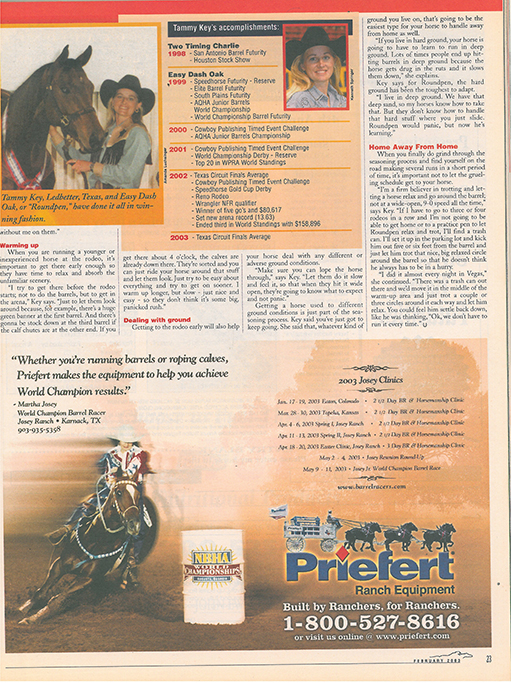
When you are running a younger or inexperienced horse at the rodeo, it’s important to get there early enough so they have time to relax and absorb the unfamiliar scenery.
“I try to get there before the rodeo starts; not to do the barrels, but to get in the arena,” Key said. “Just to let them look around because, for example, there’s a huge green banner at the first barrel. And there’s gonna be stock down at the third barrel if the calf chutes are at the other end. If you get there about 4 p.m., the calves are already down there. They’re sorted and you can just ride your horse around that stuff and let them look. Just try to be easy about everything and try to get on sooner. I warm up longer, but slow—just nice and easy—so they don’t think it’s some big panicked rush.”
Dealing With Ground
Getting to the rodeo early will also help your horse deal with any different or adverse ground conditions.
“Make sure you can lope the horse through,” Key said. “Let them do it slow and feel it, so when they hit it wide open, they’re going to know what to expect and not panic.”
Getting a horse used to different ground conditions is just part of the seasoning process. Key says you’ve just got to keep going. She says that whatever kind of ground you live on is probably going to be the easiest type for your horse to handle away from home as well.
“If you live in hard ground, your horse is going to have to learn to run in deep ground. Lots of times people end up hitting barrels in deep ground, because the horse gets drug in the ruts and it slows them down,” Key said.
Key says for Roundpen, the hard ground has been the toughest to adapt.
“I live in deep ground. We have that deep sand, so my horses know how to take that,” Key said. “But they don’t know how to handle that hard stuff where you just slide. Roundpen would panic, but now he’s learning.”
Home Away From Home
When you finally grind through the seasoning process and find yourself on the road making several runs in a short period of time, it’s important not to let the grueling schedule get to your horse.
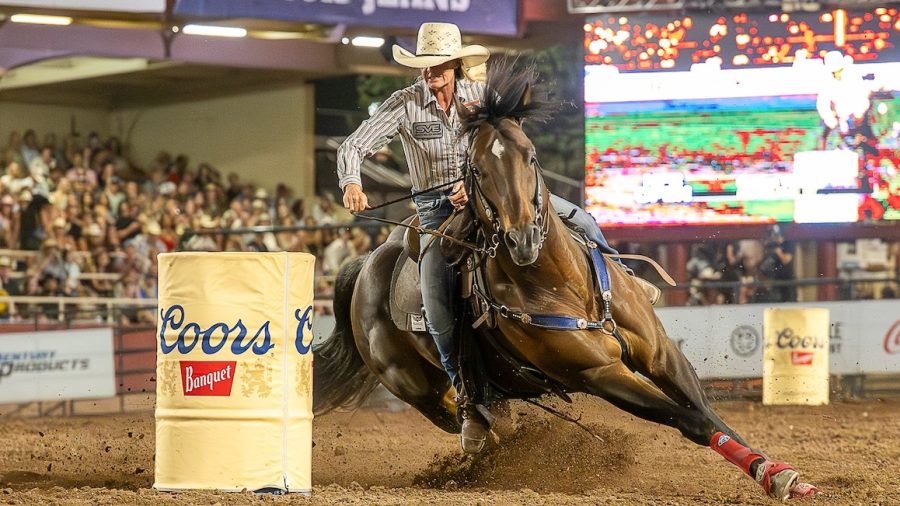
“I’m a firm believer in trotting and letting a horse relax and go around the barrel; not at a wide-open, 9-0 speed all the time,” Key said. “If I have to go to three or four rodeos in a row and I’m not going to be able to get home or to a practice pen to let Roundpen relax and trot, I’ll find a trash can. I’ll set it up in the parking lot and kick him out five or six feet from the barrel and just let him trot that nice, big relaxed circle around the barrel so he doesn’t think he always has to be in a hurry.”
Key’s relaxation strategies came in handy at the NFR.
“I did it almost every night in Vegas,” Key said. “There was a trash can out there, and we’d move it in the middle of the warm-up area and just trot two or three circles around it each way and let him relax. You could feel him settle back down, like he was thinking, ‘OK, we don’t have to run it every time.’”
Tammy (Key) Fischer is an accomplished trainer and barrel racer with multiple National Finals Rodeo qualifications and futurity championships. For more on Tammy’s training program, visit tammyfischerbarrelhorses.com. Email comments on this article to [email protected].