

Nestled in the rolling hills of the South Dakota Badlands, Sampson Family Ranch produces beef cattle, registered Longhorns and some of the best bloodlines in the barrel racing industry.
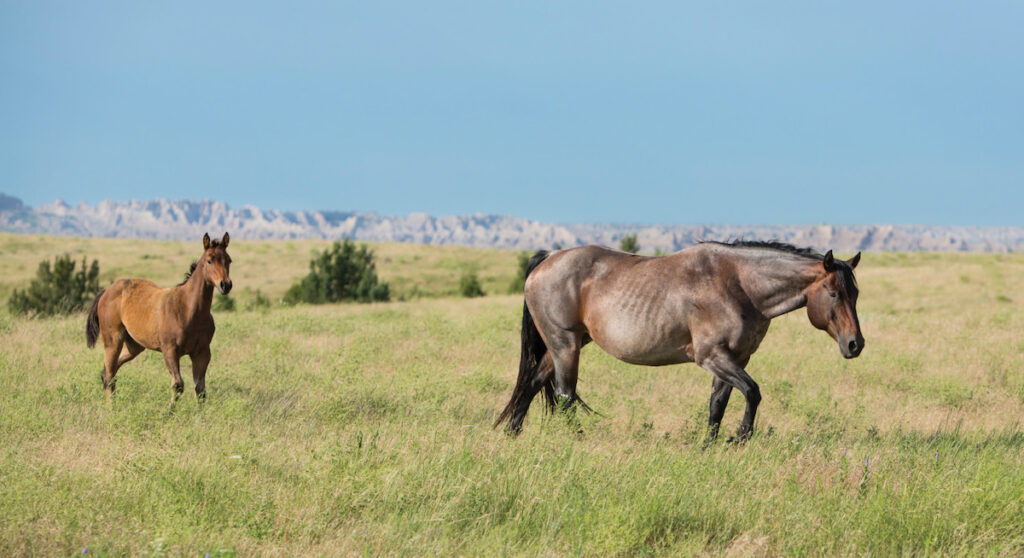
Two large mule deer jumped out of chest-high yellow clover and ran across the driveway, sprinting away down a long, winding draw that stretched far into the rugged backdrop of the South Dakota Badlands. It’s one of many locations on the Sampson Family Ranch that looks to be the setting for Hollywood’s next blockbuster Western film. The family of four’s official mailing address is Interior, South Dakota, but in reality, TK, Lainee, Cooper, and Kace Sampson are a long way from anything resembling a town. A visitor to the ranch is likely to see all kinds of wildlife as they traverse the gravel road that winds back several miles through mystical hills imbued with subtle hues of pink, blue and purple. The family’s ranch headquarters lies nestled in a vale surrounded by rolling hills. The cozy ranch house sits atop a gentle swell overlooking a stall barn, five-horse walker and cedar-pole roping arena below.
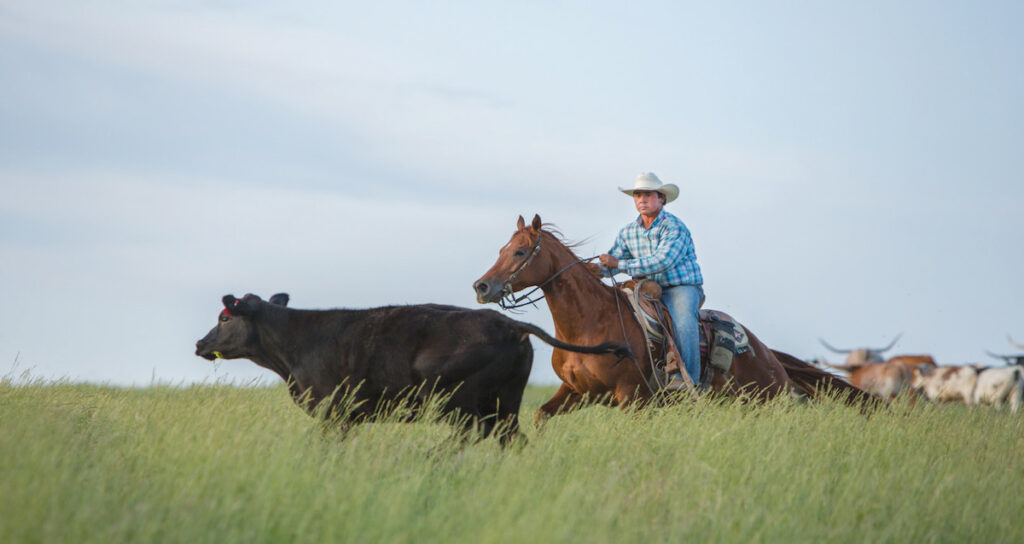
The equine facility is tidy and thoughtfully built, designed from the distinctly practical perspective of ranchers who appreciate good equipment, nice horses and functional corrals. After all, this is a working ranch where the cattle pay the bills and the horses are called upon for ranch work each and every day. Since Lainee and TK married in 2009, producing versatile ranch horses that also excel in the arena has been a top priority for the Sampsons. They both had the opportunity to grow up in western South Dakota raising great cattle and horses, and their wish is to continue that tradition with their sons, Cooper, 9, and Kace, 7. Their ranching operation is quite diverse, including beef cattle, registered Texas Longhorns, Quarter Horses, and professionally guided hunts.

Barrel Racing in Her Blood
Lainee grew up on a family ranch near Wall, South Dakota. Her parents, Greg and Lori Shearer, raised horses for as long as Lainee can remember, choosing to focus on the versatile Doc Bruce bloodline. The all-around horses her parents raised took Lainee and her siblings to numerous wins in goat-tying, breakaway roping and barrel racing. Lainee was a 1999 South Dakota high school rodeo all-around champion and four-time National High School Finals Rodeo qualifier. Lori Shearer and her friend Deb Myers often traveled together to circuit and amateur rodeos. Myers ran Frenchmans Guy and Lori ran a Doc Bruce gelding named “Crickett.” The Shearers brought mares to Frenchmans Guy early on, and their belief in his abilities as a sire was justified through the success of their children winning on his colts.
Lainee’s maternal grandparents owned the great mare Willys Rockin, and when crossed on Frenchmans Guy she gave them three special full sisters—barrel racing legend SX Frenchmans Vanila, futurity standout French Fancy Face, and money earner Rock On Rita. While SX Frenchmans Vanila eventually sold to new owners in Brazil, Lainee’s grandparents elected to keep the remaining full sisters for their granddaughters to ride in high school and college rodeo. A few years ago, Lainee and TK were given the opportunity to add French Fancy Face to their broodmare band. They currently have three Irish Pay offspring out of the special mare and are expecting a fourth in 2020.

Growing up on the backs of the industry’s best barrel horses taught Lainee what was required to make an elite barrel horse. She trained her first futurity colt when she was in eighth grade, a Frenchmans Guy son dubbed “Little Grey.” Her next futurity mount was Frenchmans Guy daughter SX Frenchmans Mocha, whom she trained while she was a junior in high school. She took a break from futurity competition while she attended college at Southeastern Oklahoma State University, where she competed on the rodeo team. Lainee earned great success in college rodeo, winning the Central Plains region in goat-tying as a sophomore and winning the breakaway roping, barrel racing and all-around regional titles as a senior. She’s also a four-time College National Finals Rodeo qualifier and a five-time Badlands Circuit Finals qualifier.
Versatility is required of the humans on the Sampson Family Ranch just as much as the horses. Today, Lainee continues her family’s winning tradition by training, competing and winning on their home-raised Irish Pay colts.
Ranching in His Roots
TK Sampson is a third-generation rancher who began training horses when he was 7 years old. One day, his father brought home a herd of ponies for young TK to start under saddle, and he’s been working at the fine art of horsemanship ever since. A student of the horse, Lainee says he rarely watches anything on TV unless it’s about training horses. He starts all the ranch’s colts under saddle, and the family uses their Irish Pay horses for every aspect of ranch work.
TK also has a colorful rodeo background. He’s the 2001 Northwest Ranch Cowboy Association all-around cowboy, the 2005 South Dakota Rodeo Association and NRCA bareback riding champion, the 2006 NRCA bareback and all-around champion, and an eight-time Badlands Circuit Finals qualifier. He retired from riding bareback horses in 2009, trading his bareback rigging for a string of pickup horses. He began working part-time as a rodeo pickup man seven years ago and now picks up at several events around South Dakota and Wyoming.
“A pickup horse needs to be super broke, quick-footed and brave,” TK said. “They need to be willing to dive into the chaos that comes with the job, and it takes a few years to put together six or eight of the right kind of horses to do that.”
TK and Lainee met through youth and high school rodeos, and according to Lainee, they always knew of one another. They began dating in 2007 and married in 2009. They received a unique wedding present from Lainee’s parents in the form of a Doc Bruce-bred broodmare, SX Letta Shasta Do It and four registered Texas Longhorn cows. Today, their Longhorn herd has grown to 17 head, and they still have “Lonesome Dove,” one of the four original wedding cows. While the Longhorns are a fun and colorful addition to the ranch, TK and Lainee’s main business is a commercial herd of Angus cattle.
The couple officially started their Quarter Horse breeding program when they purchased Brays Moon Bug, a son of Marthas Six Moons, in 2011. Attracted to his excellent conformation, gentle disposition and talent in the arena, they spent the next two years breeding him to their band of ranch mares. In 2013, a serendipitous trip to the vet clinic introduced the Sampsons to their next great adventure, a 2004 son of Paddys Irish Whiskey named Irish Pay.
“I happened to see him at the vet clinic, and he had the ‘wow factor.’ He’s everything I ever wanted in a horse, and people tell us he’s even more impressive in person than his pictures show,” TK said.
TK liked Irish Pay enough that he took a video of him at the vet and sent it to Lainee.
“When he got home, he told me, ‘If we ever have the chance to own another stud, that’s the one I want,’” Lainee said with a smile. “Three months later, we saw Frenchmans Quarter Horses was selling him at the Open Box Rafter Ranch sale.”
They arrived on sale day with a specific budget in mind, and as Irish Pay stepped into the ring, the bidding began. The price soon passed their pre-set threshold, and Lainee began to get nervous. As the bids climbed higher and higher, nerves turned to nausea. Soon she began tugging at TK’s sleeve, saying, “Hey, that’s enough. It’s too expensive.”
“I think the auctioneer stopped the bidding for a moment and said, ‘Someone go do something with Lainee. Put her in another room so TK can buy a horse,’’’ Lainee said with a laugh. “I left the auction area before it was over, but I heard them say over the loudspeaker, ‘Sold! He’s heading to the Badlands of South Dakota.’”
Though Irish Pay cost more than TK and Lainee wanted to spend, divine intervention once again appeared. They paid $50,000 for Irish Pay on a Saturday. The following Tuesday, TK rounded up a bunch of dry cows and hauled them to the sale barn. After they sold through the ring, the sale barn office handed him a check for $49,998. TK and Lainee breathed a sigh of relief and got to work helping their new stallion build his career.
The Sampsons made several smart moves when they purchased Irish Pay. One of them was buying several of his colts from other breeders so they could begin riding and competing on his offspring right away. TK and Lainee also focused on updating the ranch’s mare band. A diverse mixture of run and cow breeding, the group includes daughters of Frenchmans Guy, A Streak Of Fling, Dash Ta Fame, First Down Dash, Letta Hank Do It, A Smooth Guy, Sadies Frosty Drift, Smoke N Sparks, Metallic Cat and Peptos Blueprint.
Because Irish Pay represents an excellent outcross opportunity on modern barrel racing and cow-horse bloodlines, they were free to build a mare band comprised of the best genetics from both industries. TK and Lainee acknowledge that Irish Pay’s appeal as an outcross sire was one of the factors which drew them to the stallion in the first place.
“We’ve tried to pay attention to what crosses well on the Paddys Irish Whiskey horses and keep doing that. For example, one of the leading crosses on Frenchmans Guy horses, other than Dash Ta Fame, is Paddys Irish Whiskey,” Lainee said.
TK says their own standards for horses drive the type of horses they breed to sell.
“Our ideal horse is something just like Irish—speed, with cow and athletic ability, plus willingness to get along, learn and do whatever you ask them to do,” TK said. “Versatility is what we love most about the Irish Pay colts.”
Another of the family’s avenues for promoting Irish Pay was to work with the world-renowned equine photographer and advertising consultant Larry Larson, who previously photographed Irish Pay for Frenchmans Quarter Horses. Lainee and TK continue to work with Larson on their website, photos of broodmares and colts for sale, stallion ads, and other promotional materials.
“[TK and Lainee] are always on top of their advertising opportunities and make sure their ranch gets promoted as it should be. They’ve been really nice to work with,” Larson said. “They’re very united and know exactly where they’re going and what they want the future to bring, but they’re open to suggestions to improve their advertising and breeding program as well. They want it to be the best it can be.”
TK and Lainee have coined the hashtag #ItPaysToOwnAnIrishPay on social media, and they’ve backed that promise by enrolling Irish Pay in the most exciting incentives and programs the barrel racing industry has to offer. He’s currently nominated to the Pink Buckle, Blue Collar, 5-State Breeders, Grid Iron, Cowboy State, Future Fortunes and Valley Girls Barrel Racing Association incentives.
At the inaugural 2018 Pink Buckle Barrel Race, Irish Pay offspring made an excellent showing, winning more than $43,000 with just six horses running. South Dakota’s Brandee Wardell took her home-raised Irish Pay gelding Irish I Was Joking to the Lazy E and came home with nearly $22,000 in her pocket after winning the 4D average in the Open.
“I was drawn to breed to Irish Pay because, at the time, I was working for Lis Hollmann, who owned him, so I spent a lot of time with him. He was a gentleman to be around and had great conformation,” Wardell said. “My mare was a great barrel horse but lacked bone, and I was hopeful he would help with that. I think anyone who has the chance to spend time with ‘Irish’ would find a mare to breed to him. He is truly a special horse.”
The Pink Buckle is a significant investment for stallion owners, but according to Larson, the Sampson family recognized the magnitude of the opportunity.
“They’re willing to invest in the stallion, in their horses, and in their clients. In the long run, it rewards the people who are breeding to their stallion,” Larson said. “Not everybody is willing to do that, but they’ve been very open to it…the price didn’t stop them because they saw the ROI for the future. They’re very supportive of their clients.”
Wardell echoed Larson’s sentiments recalling her success at the Pink Buckle.
“In total, I won $22,000 with my open winnings and breeder payout. I have never won even close to that much in my career, and that money helped me make a lot of great investments—one of them being another Pink Buckle-eligible Irish Pay colt,” Wardell said. “Besides the first 30 days, I did all the work with my horse, ‘Joker.’ That was probably my favorite part of the experience, to see something I raised and trained win that much money.”
In addition to Wardell’s success, the other five Irish Pay horses also made a strong showing. Cooper Sampson became a crowd favorite when he and his then- 5-year-old Irish Pay mare Irish Ivy won several thousand dollars in the Youth division. Lainee and TK sent in Cooper’s entry for the Youth event September 1, and Lainee started “Ivy” on the barrels September 2. Prior to becoming Cooper’s barrel horse, the young mare was one of TK’s best pickup horses.
“Ivy had been on the barrels for four weeks, and the Pink Buckle was her first barrel race ever. She was amazing,” Lainee said with a smile. “Cooper was the youngest competitor there. Heading down [to Lazy E] I thought, ‘What am I doing? Putting my then-7-year-old on a 5-year-old horse that’s never been to a barrel race?’ But they were great and stole the show.”
Family First
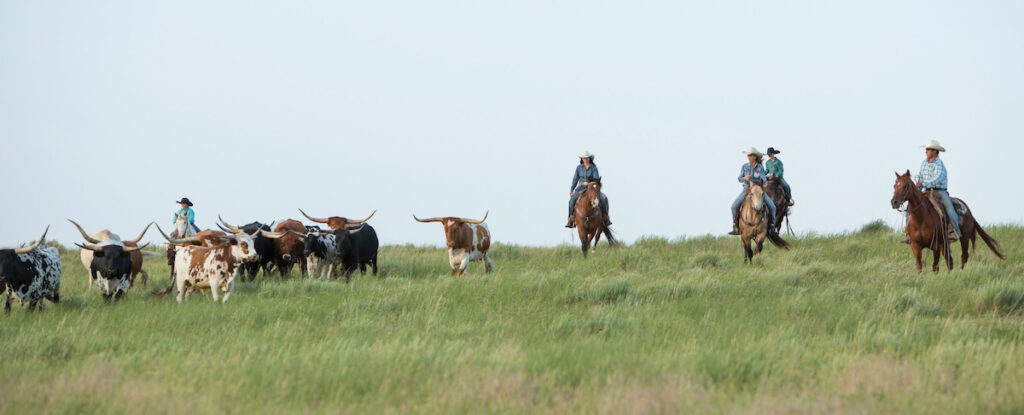
TK and Lainee named their business the Sampson Family Ranch because they are committed to running a true family operation. From involving the boys in events like the Pink Buckle to doing day-to-day ranch work as a family, TK and Lainee involve Cooper and Kace in every aspect of the family business.
“TK and Lainee always find time to include Cooper and Kace in their schedules and make sure they are involved in their school and horse activities,” Larson said. “They are very family-oriented.”
Irish Pay’s influence as an outcross sire is producing a horse with more athleticism and hardiness to handle what most Northern-Central horse owners need—a dual-purpose mount that can work on the ranch and excel in the arena. The Sampsons are serving the needs of their friends, neighbors and clients by sharing Irish Pay’s athleticism and versatility with the public. While some breeders may let the challenges of living in a remote location interfere with the growth of their program, TK and Lainee believe their ranching roots are an advantage to Irish Pay’s promotion.
“We really don’t feel restricted because of where we live. This is where all our friends live. Lifetime rodeo friends. Barrel racing friends. That’s so much of our clientele,” TK said. “It’s family or even ranchers who see us riding Irish’s colts at brandings and want to breed a mare to him because of it. I think our clientele is closer than a person thinks. Owning Irish has been like a dream come true. It’s been life-changing for us. Ever since I was a little kid, I’ve dreamt of having a nice stud. But you don’t just fall into ones like him. He’s changed our life.”
This article was originally published in the November 2019 issue of Barrel Horse News.