

He wasn’t what she was looking for, but “Billy” became the horse that changed Jimmie Gibbs Munroe’s life.
When Jimmie Gibbs Munroe was knee-high to a grasshopper, she would corral a stick horse and “play rodeo” in her parents’ front yard. Of course, when playing rodeo, you had to choose which rodeo star you wanted to portray, and Munroe always selected the same competitor — barrel racing champion Wanda Bush.
“I’d make my mother call me out as Wanda Bush, and I’d ride that stick horse around three coffee cans,” Munroe says, laughing. “I’ve always thought Wanda was one of the greatest cowgirls ever, not only because she won 32 world championships in several different events, but because of the way she’s always conducted herself. She’s always been a role model for young people.”
Now, more than 35 years after Munroe filled her first Women’s Professional Rodeo Association card, the same is often said about her. A 1992 inductee into the Cowgirls Hall of Fame, an all-around champion, 11-time National Finals Rodeo qualifier and a past WPRA President, Munroe is one of the most respected and recognizable figures in the sport.
“Jimmie has the responsibility of being WPRA President and competing at the same time,” friend and fellow barrel racer Vickie Adams explains. “Most people just have to worry about their horses and getting down the road, but Jimmie had to worry about getting to meetings and being pulled in a thousand different directions. It was amazing that she was able to do that and then go right back in the arena and win. You can’t help but be a little in awe of her for that.”
Although it’s almost impossible to imagine what modern barrel racing would be like without her influence. Munroe’s grand entrance into rodeo was one of chance. In fact, it might never have happened if she hadn’t crossed paths with an extraordinary horse, a 1967 gelding named Robin Flint Bar, who the world would come to know as “Billy.”
“Billy changed the course of my life,” Munroe says. “Sure, I might have continued to run barrels, and I might have had a really nice horse and eventually joined the GRA [Girls Rodeo Association], but it was really Billy that was the deciding factor for me. He had so much talent that I wanted to give him an opportunity in professional rodeo.”
Riding 101
Munroe grew up in a small community north of Waco, Texas, named Valley Mills. It was there that her father, jIm, and mother, Blevins, ranched and raised cattle and horses.
Neither of Munroe’s parents aspired to rodeo professionally, but Jim did participate in Amateur calf and team roping. Blevins, who grew up on her family’s spread, the Miller Brothers’ famous 101 Ranch in Oklahoma, enjoyed cutting and reining. Together, they made sure their daughter started riding by age 3 and competing in local horse shows on her first pony.
When she was 10, Munroe’s father taught her to rope from the back of a horse, and she instantly fell in love with the thrill of tossing and catching.
“That’s when I started to compete in the American Junior Rodeo Association,” Munroe says.

At the beginning of her rodeo career, Munroe had a 15-year-old Ed Echols-bred gelding who was trained in a variety of events, including breakaway roping, cutting and reining. But as substantial as the gelding’s skill set was, Munroe elected to add one more event to his list. She wanted to be a barrel racer, like Wanda Bush.
“Billy changed the course of my life. Sure, I might have continued to run barrels, and I might have had a really nice horse and eventually joined the GRA, but it was really Billy that was the deciding factor for me. I had to give him an opportunity in professional rodeo.” — Jimmie Gibbs Munroe
“When I decided to barrel race, well, my parents had never done it,” Munroe says, “so, we just got three barrels, and [my gelding] was so smart that he just picked it right up — the barrels, the poles, the flags, all of it.”
Blevins also had a secret weapon to prepare her daughter for competition. Through friends, she made the acquaintance of Wanda Bush, and the two had an instant connection.
“Blevins was a great fan of barrel racers,” Bush remembers. “She wanted everybody to do well. And she was a great mom. She asked me if her little girl could come stay with me for a week, so that I could give her some help with roping and barrel racing.”
So Munroe spent her first overnight stay away from home at her idol’s Texas ranch.
“You know, I completely worshipped her,” Munroe says of Bush, “and I wasn’t disappointed meeting her and staying with her.”
Bush coached Munroe through the barrel pattern and in the roping box, where the young cowgirl’s love for horses became obvious to the seasoned champion.
“Her little horse kept shortening her out when she was trying to rope,” Bush says. “He was just measuring her rope. I told her one evening, ‘Jimmie, I’m going to have to bust his butt. He’s going to have to get up there where you can have a throw.’
“Well, great, big tears rolled down her cheeks and she said, ‘Alright, if you have to.'”
Tears and all, Munroe says she came away from her stay with Bush a more skilled rider. It showed when she won her first major barrel racing championship in the AJRA that same year. The win marked the beginning of what would become a successful jaunt through the junior and high school rodeo circuit.
Munroe’s main concentration throughout high school was not barrel racing, but all-around titles and roping events. The cloverleaf speed event was often relegated to the back of her teenage mind, and it was reflected in the horses she rode.
“My dad always made sure I had a good roping horse,” Munroe says. “And sometimes my barrel horses were horses I roped off of, and we just converted them to barrel horses. They were all-around horses, not specialized.”
But by 1970, Munroe was a senior in high school, and her life as a horsewoman had to become more defined. A rodeo scholarship to Sam Houston State University in Huntsville, Texas, made it vital that Munroe find a horse who specialized in barrel racing — the flagship event for women in rodeo — to compete on the collegiate level. She and her parents set out to find a 5- or 6-year-old prospect who was well broke and ready to start on the pattern, and Munroe already had an idea of the lineage in which she wanted to invest her time and money.
“At the time, there were several people running Flit Bar horses who were doing well,” she says. “Sadie Shellenburger and Karen Walls had geldings they were running, and I liked their style and the way they worked. It just seemed like a lot of people were having luck with the Flit Bars.”
Munroe and her parents soon found a 5-year-old gelding sired by Flit Bar and out of a King Ranch-bred mare that was being offered for sale by influential horsewoman and American Paint Horse Association founder Rebecca Tyler Lockhart.
“We drove to her place in Uvalde the spring of my senior year,” Munroe remembers, “and we never took a horse trailer when we went to look at a horse because my dad believed that made you look like you’d come to buy.”
Shortly after arriving at Lockhart’s ranch, Munroe mounted the 5-year-old so she and her father could evaluate him. While they did so, Blevins decided to walk through Lockhart’s pastures and have a look at the breeder’s impressive array of horses.
“Mother came back up to where I was riding, insisting that we go look at this other horse she had seen in another pen,” Munroe says. “She said there was something about his look. He had this big, beautiful eye, and she said, ‘You have to come see him.'”
The horse that caught Blevins’ eye was a half-brother to the 5-year-old Munroe was thinking of purchasing — a 3-year-old Flit Bar son who barely had been under saddle.
“He did catch your eye,” Munroe admits. “He was a deep bay with white on his face and a big eye. But he was still small and looked like a colt.”
“I said, ‘Oh yes, he’s really cute, but I don’t need a 3-year-old who’s hardly been ridden.’ So I went back and rode the other gelding again, and we went home to decide.”
Jim and Munroe believed the case on the younger horse was closed. That type of project wasn’t practical for the next step in Munroe’s career.
But Blevins had other ideas, and she couldn’t keep those ideas to herself.

Billy on Barrels
Upon arriving home, Munroe and her father decided they would buy the 5-year-old Flit Bar gelding. While they mulled it over, however, Blevins continued to talk about the 3-year-old they had seen.
“She couldn’t forget about him.” Munroe says.
At an impasse, Jim called Lockhart and agreed to pay $1,000 for the 5-year-old. Then out of respect for his wife, he asked how much she would take for the 3-year-old, as well.
“She added $400 to the price,” Munroe says, “so Dad said, ‘Fine. We’ll take them both.'”
Munroe was suddenly the owner of two Flit Bar sons, but she still planned to devote the majority of her training efforts to the 5-year-old. The 3-year-old, whose registered name was Robin Flit Bar, was sent to family friend Marty Petska in Carlsbad, N.M., for finishing work under saddle.
When the young gelding came home from Petska’s a few months later, he was broke, started on barrels, and he has a nickname — Billy.
The Gibbs brought Billy back to Valley View and put him on a regular regimen of ranch riding. Munroe says she noticed right away that although he never really offered to buck, the gelding did spook easily and would often shy away from objects and sounds. Still, she continued to slowly work with him with the objective of taking him back to school with her the next fall.
“I was far from an experienced barrel racer,” Munroe says, “but I could tell Billy has so much ability. And on top of that, he had so much speed. I also was smart enough to know that if I put too much pressure on him, I would ruin him. I had to be very careful with how I worked with him.”
The college sophomore took Billy back to school with her the next fall in an effort to build his confidence in their relationship.
“Keeping him at school was quite an experience in the beginning,” Munroe says. “After that, he truly was broke and not nearly as fractious.”
Munroe’s first major competitive outing with Billy was to the Invitational Girls Barrel Race at the Fort Worth Stock Show. She didn’t push him to win during the event, but rather loped him to the first barrel before letting him finish the rest of the pattern at a run.
Veteran barrel racing journalist Kenneth Springer remembers seeing the team for the first time in Fort Worth — and loving them.
“From the first time I saw Jimmie run, actually lope, Billy in the Novice class, he was a thrill to watch,” Springer says. “You instantly knew he had that something special that couldn’t be trained.”
Even loping to the first barrel, Billy placed in two rounds of the Invitational. His success gave Munroe the confidence to run him that summer at the 1972 College National Finals, after it became apparent that Billy’s older half-brother wasn’t going to work out as well as Munroe had hoped.
“Billy was still pretty green,” Munroe says, “but I won a round at the college finals on him, and then he hit a barrel in the second round.”
A downed barrel aside, Munroe was impressed with Billy’s performance. The gelding wasn’t, however, without his Achilles Heel. He frequently tried to shoot past the first barrel. Thankfully, his young rider never grew frustrated with his difficult development around the first run.
“Jimmie took a lot of time with him,” Bush says. “He was a horse cocked on go, and Jimmie is the kind of person to spend time on one. She eased him to the first barrel for a long time and still placed on him.”
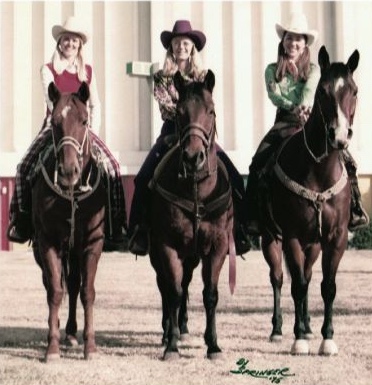
In 1973, Munroe also eased onto the Amateur rodeo circuit with Adams, who was her college roommate. It was in that environment that Munroe felt Billy began to fulfill his potential.
“We went to the Texas Barrel Racing Association Finals and qualified for the Texas Rodeo Association Finals,” Munroe remembers. “He was just really starting to do well.”
Billy’s progress didn’t go unnoticed by Adams. Munroe’s travel buddy had already competed professionally with the Girls Rodeo Association (now the Women’s Professional Rodeo Association) on a Flit Bar-bred mare, and she believed Billy had the qualities needed to compete against the best barrel horses in the worlds.
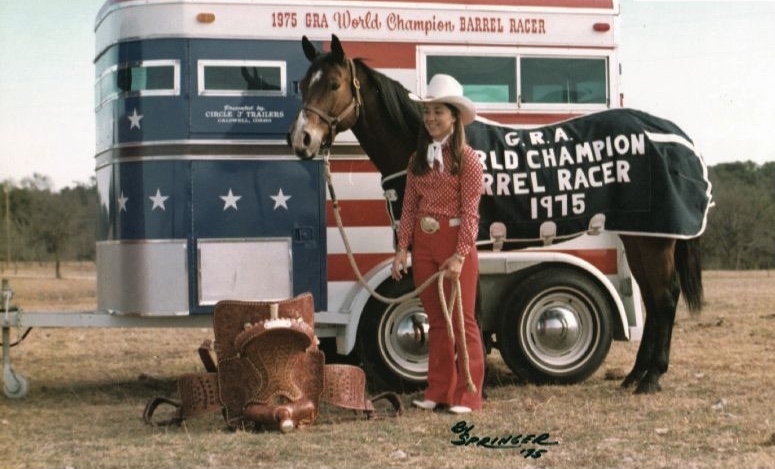
“There were a few horses at that time who were running 16.8 and 16.9 on the standard pattern,” Adams says, “but not a lot. Billy had that explosive speed and all the best qualities of the Flit Bar horses. They naturally use their hind ends and are just so athletic that they can change directions in a one-step turn. You might see that a lot now, but you didn’t then.
“I’d been to all the big rodeos on my mare [Flit Rose], so I kind of knew what it took to place at the GRA level, and I knew Jimmie had the horse to do it.”
Adams pushed Munroe to get her GRA card and compete on the professional circuit. Munroe, however, wasn’t so sure.
She finally agreed to apply only when Adams, who had given up her card after her mare was injured, said she would apply for a card again too, so they could travel together.
“Then we found out Vickie wasn’t eligible to get her GRA card back until that summer,” Munroe says. “I called the GRA and tried to get out of getting my card, but Lydia Moore, who has since become my good friend, told me, ‘Well, I’d be glad to stop it, but I’ve already mailed it, so the only thing you can do is resign, but then you couldn’t get your card back for two years.’
“So, I thought, ‘I’ve got to do it.'”
Two for the Road
Blevins traveled with Munroe in 1974. That year, Munroe and Billy ran at Odessa and San Antonio, winning a round in each city, and won San Angelo and Bay City.
Then, after a “wild ride” in Houston that left her at the bottom of the money, Munroe found herself in the midst of her college rodeo obligations. Sam Houston won the CNFR Team championship in 1974 due in part to Billy and Jimmie earning the barrel racing and all-around titles.
Then, the duo was back out on the professional circuit for the 4th of July rodeos.
“Billy ran better in the summer when you were just going non-stop, hauling and running, than at any other time,” Munroe remembers. “He seemed to be at his best when we were making four or five runs a week, and that’s so important. You can have a horse who is capable of winning the world, but if they don’t haul well, it’s hard.”
Munroe’s horse would soon have a chance to prove if he was the stuff world champions were made of. Billy helped his young rider qualify for her first NFR back in 1974. They were in second place going into the Finals.
“My first Finals was not that great,” Munroe says, laughing. “I didn’t place in the first five rounds, and I just wanted to go home. I could not get to the first barrel in the right place. He was running by it, and I just could not figure out how to fix it.
“I remember telling my mother, ‘People just won’t even believe I qualified.'”
Munroe’s luck changed in the sixth round, when she and Billy finally figured out the first barrel and won a check.
“They had two performances on Saturday, and we won both those rounds and then won second in the last round,” she says. “We always laughed because back then, the only rounds that were televised were the last three. Our friends who watched it on television were like, ‘Wow, you had a tremendous NFR! You must have just won it all!'”
The Texas cowgirl didn’t win it all that year, but she came close. The final GRA standings had her in third place with $11,893 in earnings. The 1974 world champion, Jeana Day Felts, had earned $14,384.
That NFR was the first of six that Munroe and Billy participated in together. They won a traditional world championship in 1975, and then were named GRA Champions in 1976 and ’77 when that title was decided by the most money won throughout the year.
During that time, they also became crowd favorites, thanks in no small part to Billy’s hard-running, head-turning style.
“He was a tough horse,” Bush recalls. “He could get in that dirt and turn. If you blinked your eye at the second barrel, you’d miss him turning, and that’s the truth.”
Springer also remembers Billy’s second barrel as being exceedingly fast.
“Billy had such a pretty style,” he says, “and he would get especially low in the turn on the second barrel.
“I would put his second barrel up against any barrel horse that I’ve ever seen.”
The Past and the President
In the late 1970s, Munroe continued to stay on the rodeo circuit, hauling Billy and conquering arenas around the country.
Billy had always done well traveling, so Munroe never worried much about the long distances they traveled. Then, on one unassuming day in 1979, their lucky streak came to an end on a remote stretch of road between Burwell and Valentine, Neb.
Munroe’s truck blew a tire, and the impact caused the horse trailer Billy was riding in to come loose from the hitch. The trailer flipped several times before coming to a rest — with Billy trapped inside.
“He was in the trailer for several hours,” Munroe says. “We were in the middle of nowhere and couldn’t get him out.”
Miraculously, Billy stayed calm as they waited for help. When he was finally freed from the trailer and taken to a vet, it was discovered that, at worst, he had damaged a couple of vertebrae in his neck.
The veterinarians reassured Munroe that Billy could eventually return to competition, and he did. They made it back to the NFR in 1979, although Munroe didn’t feel Billy was 100 percent even through the finals.
“It took him a long time to come back,” Munroe says. “The winter of 1980, I just didn’t haul him like I had.”
“I guess that’s the way I remember him, as a horse who tried regardless of the conditions. He always gave 100 percent every time he ran.” — Jimmie Gibbs Munroe
“Finally, in Houston [in 1980], we won the short go, and I felt as if he was running like himself again.”
Not only did Billy come back, but that summer, he burned through the most impressive month of his career. From June 13 to July 13, he made 18 runs in 13 rodeos without hitting a barrel. He placed in every round and earned more than $7,000.
The winnings pulled Munroe up to second in the world. She had no idea that on July 13, she had experienced her great gelding’s last explosive run.
Billy became ill during Munroe’s next rodeo in Nampa, Idaho. He refused to eat and was running an alarmingly high temperature. Munroe quickly got him help.
“We took him to the vet, and he stayed there several days,” Munroe says. “They gave him antibiotics, and the fever would go down, but then it would come back up again.”
During one of the periods when Billy’s fever subsided, Munroe hauled him to her uncle’s ranch in Montana, where she asked veterinarian James Van Zandt to treat him. Van Zandt eventually got Billy’s temperature to come down, but the damage had been done. The long-lasting fever had mortally damaged his live, and he colicked.
Billy died on July 24, 1980. He was 13 years old.
Munroe had her gelding’s body hauled back to Texas, where she saw to it that he was buried beside her house at the ranch he had known as home.
“I know it’s hard when you have a great horse to watch him slow down and have to decide when to retire him,” Munroe says. “I never had to face that with Billy. My last memories of him are of him running at the top of his game, and that’s a blessing.”
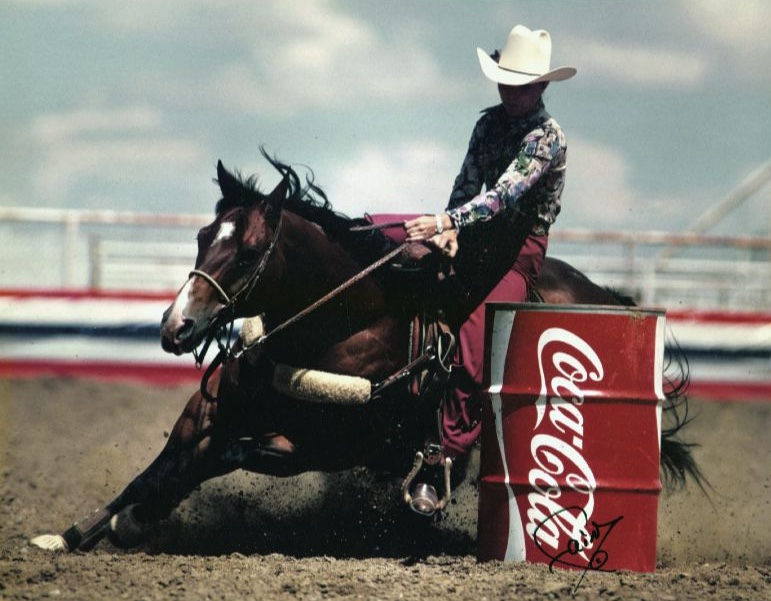
In her lifetime, Jimmie Gibbs Munroe has qualified for 11 NFRs on three different horses. She owns five WPRA titles. She also served as WPRA President from 1978-1993, leading the women of barrel racing to equal prize money and championing the mandatory use of electronic timers and better arena conditions in professional rodeo.
Because of his influence on Munroe, it could be said that Billy’s life has affected the competitive circumstances of every professional barrel racer who has benefited from the changes Munroe helped implement.
“I can’t say it enough — he changed my life,” Munroe says of Billy. “He had so much try and such a big heart. That’s the way it is with great horses. There are horses that have tremendous ability, but in order to reach the level that Billy and some other horses reach, they have to have that heart.
“I guess that’s the way I remember him, as a horse who tried regardless of the conditions. He always gave 100 percent every time he ran. I think he really loved to run barrels.”