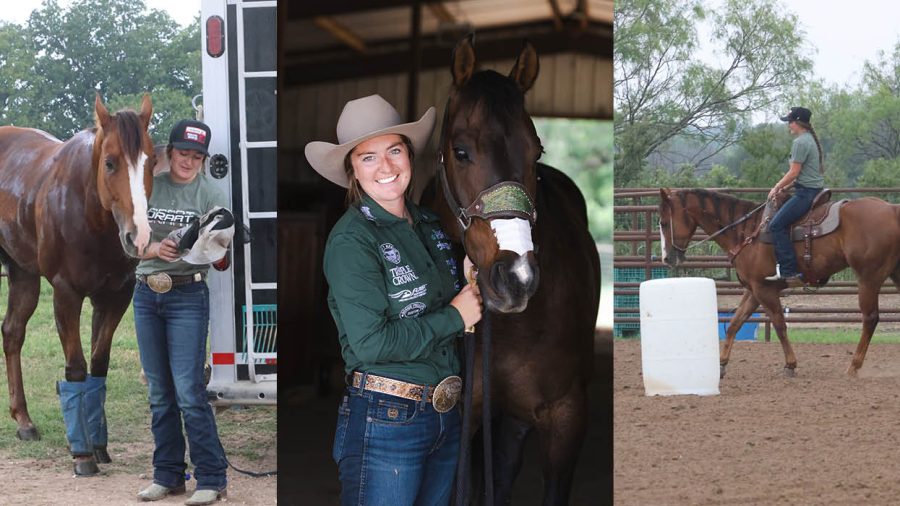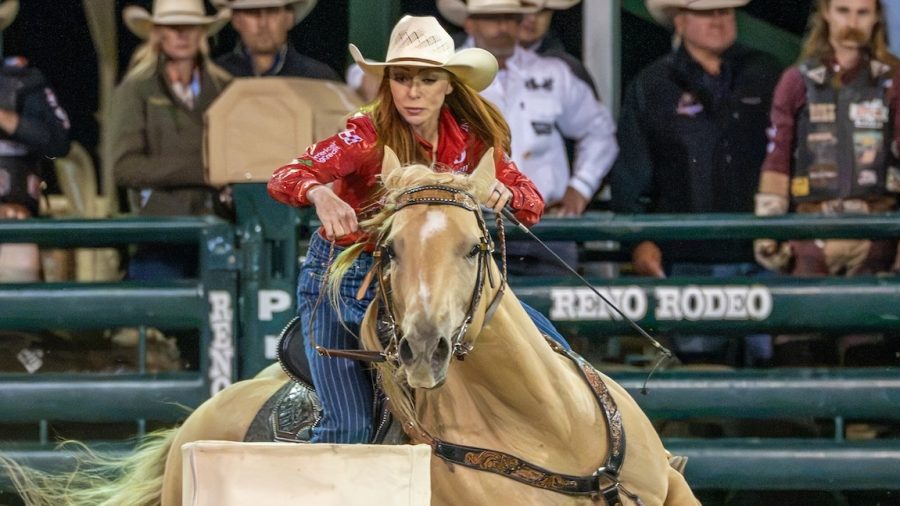


Get to know Women’s Professional Rodeo Association barrel racer and Fort Worth Stock Show and Rodeo standout, Toria Madsen.
“Who was that? And what horse was she riding?”
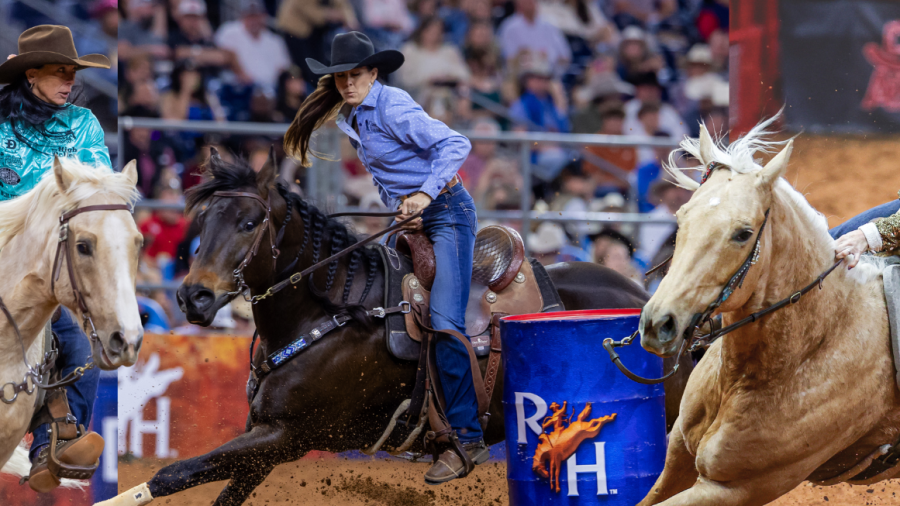
For those who don’t follow the WPRA Wilderness Circuit, these questions were on your mind while watching Toria Madsen during the barrel racing action at the 2025 Fort Worth Stock Show and Rodeo. The Idaho native dove in and made a big splash, winning two rounds and finishing fourth in the finals on her 13-year-old gelding Dial N Zoom. Though she may have been unknown to the masses, Madsen has been well acquainted with the winner’s circle from a young age.
From Humble Beginnings
Raised the daughter of rodeo cowboy Curtis Reay in the small town of Arco, Idaho, Madsen’s passion for rodeo began early. She came up through the ranks of Little Britches, high school, intercollegiate and amateur rodeo, training her own winners every step of the way.
“When you have not a lot of money backing you, you learn to train your own and learn from leaders and champions above you,” Madsen said. “I swear I’ve ridden a million horses, but I remember my first champion horse — a half-Arab named Hobo. I won tons of championships on him; it was incredible. I did everything; roped, goat tied, won multiple all-around championships. Going for an all-around, you become average at everything. But when you get specific, grow up, and really focus on one event, that’s when you get really strong.”
Mentors Whitey Fletcher and Harvey Helderman helped Madsen hone her horsemanship skills.
“I was very much taught that you can always swing a rope, and everybody can ride a horse,” she shared. “But when you put the horsemanship in front, that’s when you really become a champion. That’s the difference from your average to your advanced.”
After taking a post-grad job in Washington for a spell, Madsen made her way back home to Idaho. She resides today in Blackfoot with her husband Heath, son Wylee and daughter Maquell. In addition to being a wife, mother and trainer, Madsen has a full-time job in the IT department for Battelle Energy Alliance, which is the primary contractor for the Idaho National Laboratory. Though she has enjoyed working remotely in the aftermath of COVID-19, she may be returning to the office soon.
“My feelings aren’t hurt; I can still rodeo and train all my horses,” Madsen said. “It’ll keep me closer to circuit rodeos, but for the big ones — well, I have vacation.”
Though she starts out with colts and does attend some futurities, Madsen prefers the rodeo road. The rodeo environment is one big reason, but another more practical reason is that it’s flat-out tough to get a futurity horse prepared in Idaho without an indoor arena.
“I can actually do quite a bit of training in the snow, because I can get some traction,” she said. “If they can circle a barrel in snow, they’re pretty sure-footed. I ride a lot of colts outside. I will use indoors, but it costs a lot of money if you’re going in every day.”
A proud member of the Wilderness Circuit, Madsen typically sticks fairly close to home.
“In the northwest, it’s a snake pit all the time,” she said. “Our committees make it so safe for us. Everybody comes in because our ground is amazing and the big money pots are there.”

Finding “The One”
Madsen happened upon her life-changing mount “Bert” after she was outbid at the Hermiston, Oregon, horse sale on purchasing his dam, Dials Lucky Sparks (Smoke N Sparks x Molly Be Lucky x Jet N Rocket).
“I got outbid, so I went and talked to the owner of the mare, Pat Suter out of Boardman, Oregon. He said, ‘Well, I’ve got this colt at the house out of her if you want to come take a look at it.’ I got his phone number, but couldn’t reach him,” Madsen said. “My dad was with me, and we were not leaving Oregon until we saw that colt.”
The determined duo drove on to the small town of Boardman and asked around at a gas station for directions to Suter’s place.
“We get there and he’s out feeding and just had a slew of beautiful colts,” Madsen said. “It was like a candy jar. His wife, Leslie, had recently passed, and that’s what they did for retirement. They drove all around buying broodmares and crossing them with the right racehorses. She designed all these colts. There were many dream babies there, but we bought Bert.”
As it turned out, Madsen and Curtis had chosen a dream that wouldn’t come true without some hard work.
“He was a renegade; has always been one,” Madsen said. “Nothing easy about him. He’ll bite, he’ll kick, he’ll strike; he’s just naughty. I pick my battles for sure. Really, I let him be who he is until it almost crosses the line, then I have to recalibrate him. He’s a hot horse, and you don’t want to get after him too much. When they’re in that warmup pen, they have to have release somehow or they’ll explode. He stays in a stable mind when I go down that alleyway, so if he needs to prance in the warmup arena or get excited, I let him have that. That’s just what works for him; my next horse may be totally different.”
With the goal of not getting bucked off in mind, Madsen sent Bert to a colt starter for a 30-60 day stint.
“Getting him broke was tough,” Madsen said. “He is a massive horse. But I got him home, and I just felt magic. He could make moves a big horse should never make. He started winning locally, and I took him to a few 5-year-old futurities. But I was just a poor girl with a career and had babies. At that time in my life, I really couldn’t leave to go rodeo. So Bert’s pro rodeo career didn’t launch at a young age. At that time, for me, there was really a lot of ‘Am I good enough?’ I just don’t know if it was really in my stars at that time. I wanted to focus on my daughter’s high school rodeo career, and my son was a baseball player on a traveling team. I wanted to make them my No. 1 priorities.”
Madsen ended up taking the leap and buying her permit in 2019 and filled it within a week at a jackpot. Her first major rodeo was Logan, Utah, where she and Bert smoked a run and people began to take notice of the pair.
“He is hotter than Hades in a warmup pen. Chomping at the bit, jumping straight up in the air. Warming him up can be not a luxury, but the most valuable thing about that horse is when you actually go in a gate, he gets quiet and you can talk him into pretty much walking down an alleyway. But once you send him, he is so focused — you are not going to go by a barrel. He will turn on anything; you’re either going to turn him or go down. You can just super count on him no matter what to find his spots and turn. He feeds off the crowd — the louder it is, the more fireworks, he loves it. He’s a fun horse, you’ve just got to kick and ride hard like he’s running hard.”
The following year, Madsen bought her card as a 45-year-old WPRA Rookie. Unfortunately, that coincided with 2020, and many of the rodeos were cancelled.
“I just did circuit rodeos, but Bert got really sick that year,” Madsen said. “We got on the road and went half the year. I had a lot of learning to do, and he got severe ulcers. There was so much of a learning curve to hauling horses that hard and that far.”
Despite missing several of the fall rodeos, the pair still wound up finishing fourth in the Wilderness Circuit. The following year, Madsen entered Reno. While trying to get prepped and ready, Bert went down at a local race and injured his stifle.
“I thought he was out, that I’d crippled him, we were done,” Madsen recalled. “I thought I’d had my one hurrah, and at least I could still hold my card.”
Despite her doubts, Madsen’s veterinarian kept assuring her that Bert was going to get well. They discovered Bert had injured his sacroiliac joint as well, but with therapy on both, the big gelding was able to move soundly in about four months. After giving her mount a full year to recover, Madsen followed her vet’s recommendation to get him back in as good of shape as possible, make some runs and see what would happen.
“I never thought in a million years that this horse would run again,” Madsen said. “I went to my first rodeo, and he just laid down a run. I got smarter, learned how to give meds right, feed him right, and to have a vet on emergency call at all times. I learned from the girls who travel, and I asked a lot of questions. What makes their horses better, what feed they use. I learned to master entering and drawing out, and manage the stress in between. Last year, I had the year of a lifetime in the circuit and won about $33,000. But I didn’t know about the Playoff Series, or that you need to be in the top 30 to make it in to these top rodeos.”

Fate & Fort Worth
Though she has a family and full-time job, Madsen is not unlike most barrel racers in that it’s still a dream to potentially qualify for the National Finals Rodeo one day.
“I have a really nice futurity horse that I’m investing some time in, and I wanted to go to Arizona for the futurities,” she said. “My husband talked me into taking Bert with me — I think he just didn’t want to take care of him. I had thrown my hat in and entered Fort Worth in December, but I was drawn out. Bert hadn’t even been ridden in a month. Six days in to the stock show going hot, the PRCA called and said they had a spot open in Bracket One of the rodeo. I was cleaning stalls, and said I’ve got to look at my schedule. They said I had until 8:30 the next morning to answer.”
Madsen calculated that if she went to Fort Worth and ended up making the finals, she would have two days to get back to Arizona in time for the Royal Crown futurity.
“I called a few people, some said yes and some said no,” Madsen said. “The deciding factor was my husband. He said, ‘You’re the most dedicated and determined person I know to go out and ride in the snowbanks, why shouldn’t you run down the alley at Fort Worth?’ So after a very sleepless night, I called PRCA the next morning and said I’d take it. I loaded up and landed in Texas two days before I ran. I kept looking at Bert in the stall and asking him, ‘Are you in shape enough to go?’”
Over the next few weeks, he would prove to her that he most certainly was.
The pair had an uncharacteristic down first barrel in Round One. After some reassurance from fellow Wilderness Circuit racer Ashley Castleberry that moving on in that format is all about money won, Madsen made up her mind to just go for it. She was able to work Bert in the arena prior to the second round and focused on getting him really freed up. The pair clocked a 16.46, and Madsen got to take her first FWSSR victory lap, while earning $2,300.
“I felt like a million bucks; my bucket list was really filled,” she said.
After some initial confusion about the results that were on the Cowboy Channel, it was confirmed by the rodeo secretary that Madsen and Bert were in fact moving on to the Wild Card round.
But the elation of moving on was soon laced with concern about her horses’ well-being. Having never dealt with humidity before, they were struggling to stay comfortable in the stalls in their thick Idaho winter coats. Fortunately, after her second run, Madsen and her horses were able to move out and stay at her friend Teresa McClendon’s house in Grandview, Texas, for the remainder of the rodeo.
“Teresa was so much help at Fort Worth. Bert got real ratty in the alleys, and Teresa brought a buddy rope horse the last day and he was quiet. It was so much fun to share that experience with Teresa; it was not just me going down that alleyway. She got every part of it — warmup to cooldown, she made that trip worth it. She was almost physically sick with nerves for me, and it was literally like she was on the back of that saddle running every step with me,” Madsen said.
Madsen had the “just go for it” mindset again in the Wild Card Round, and the pair posted a sizzling 16.15 to win the round and advance to the semifinals $2,000 richer. After placing third in Semifinals A with a 16.28, the dynamic duo went on to clock a 16.31 and finish fourth in the finals.
“I knew they only took the top two of Wild Card [to the semifinals], so I went in and worked him the same way as the day that I won it,” Madsen said. “I sent him down the alley and it ended up being a smoking fast time, but I rocked that second barrel. It’s a hard transition right there, and I was pretty excited that barrel kept standing. Again, just grateful — here I am sitting in Fort Worth, and then the world went crazy and I had 100 million Facebook friend requests coming in. When the final round came, I think I heard everybody cheering from Idaho. I’m not kidding you, I had so many friends and family cheering for me. Even in the bars they’d turn off the football game and watch the barrels. I was so dang proud about taking fourth. Six out of the eight girls ran down the alley at the NFR, and the other two were from Idaho. It just shows you how tough the Idaho and Utah girls really are.”
The support she felt from home was matched by her fellow competitors as well.
“When you run at a professional level with professional people, the way they think, there’s no negativity,” she observed. “They’re the most positive aura I’ve ever been around in my life. It’s incredible to be in.”
What’s Next
In addition to chasing her circuit title, Madsen is hoping to make a run at the Daddy of ‘Em All in Cheyenne this year, and possibly the Calgary Stampede.
“You’re only one run away from never doing it again,” she said. “My biggest thank-you at this moment is the committees and the tractor drivers who donate their time to make it as safe as they possibly can. It makes a world of difference that that person cares so much about me and my horse. They educate themselves, they have the right implements, and are investing in our safety. We couldn’t run these fast times and do what we do without those people. They’re the ones who make it possible for us, and they’re the ones who make dreams come true.”