
This drill is for a horse that wants to run past the barrel, or run wide from the barrel. Any time the brakes aren’t working on the horse, we’ve got to get that horse really stopping and backing up, while we are shaping his body to pick up the correct lead, at all times
This drill works on speed control so you can go around the curve of the barrel. Most people think of the turn as being 90 degrees. But that’s not the way we go around. We go around the barrel in a curve, with the horse’s body shaped. So the goal is to be able to negotiate the curve going around the barrels, while being in total control of the speed.
You should do this drill whenever the horse has lost his education when he goes to the barrel race. Our horse tells us everything. When we’re running, whatever he does is what he’s thinking. We’ve just got to be sure we understand what he’s thinking.
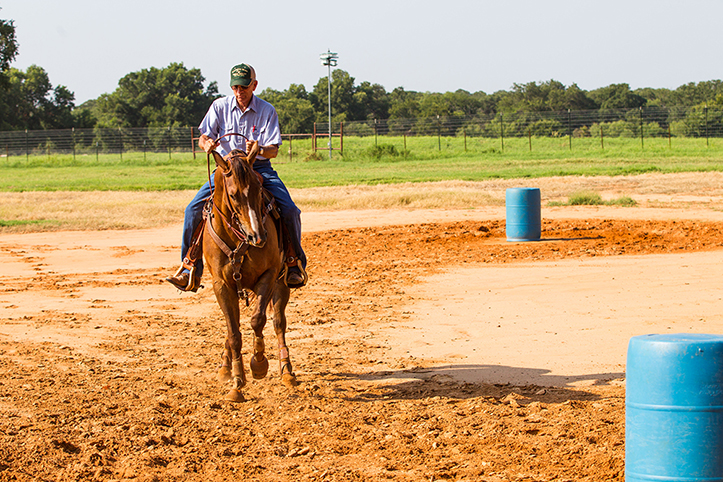
If I went to a barrel race and the horse forgot his education, blowing past the barrel and turning too wide, I’m going to stay after the barrel race and try to lease the arena, or get some exhibitions to correct him right then. Any time I leave a barrel race with a problem, the horse keeps the problem in his mind if I don’t correct the problem as soon as I have the arena available.
It’s hard for the rider to totally tell what he horse is thinking until they’ve had enough education and experience in horsemanship to be able to really listen to the horse and know what the horse is thinking. The next, even larger and harder step, is to put the thought that you want the horse to think in their mind. But that’s what we’re doing. We are educating the horse’s mind to understand what we want him to do. And after we get him educated, we do enough repetitions until he forms a habit and helps us do the six things we want him to do: emotional control, direction control, speed control, leads, body shape and the desired route.
Your horse should be outfitted in equipment that he understands and can totally respond to correctly. That goes for
This drill is simple. Anywhere I am, whether I’m warming up in the back away from the arena, coming in the alley, going around a barrel, going to the barrel or headed to the gate—anywhere the horse isn’t listening to me, I have to get him listening—right then. Let’s say the horse is loping toward the right barrel, but he’s not listening to you. You want to shape his body toward the right, toward lead he’s on by using your inside, right hand more than your outside hand, and use your inside, right leg adequately. You then take the energy out of your body, quit riding, stop and back with your hands while keeping the horse shaped. The hands shape the body. And you do it all in one
When you first start backing the horse with this drill, don’t back more than one or two steps. After he really gets familiar with this, if he’s not quickly responding, you should back three or four steps, using your legs to really get his feet moving, get him light in the face and get him collected in the bridle
So once you’ve backed a few steps, let the horse sit there and digest the information you provided. If you go on right then, he won’t remember as much of it, and you’re helping him learn to be patient. Sit there until you feel him totally relax and then slowly count to five. Then move on and go on with your education. Repeat as necessary.

You need to always have patience as a rider. The horse doesn’t learn everything in one classroom session. Just as you don’t go from kindergarten until graduating with a high school diploma overnight, it takes time. Most people, especially competitors, don’t have enough patience for the horse.
Meet Ed Wright
A lifetime horseman, the late Ed Wright of Dublin, Texas, trained professionally since 1978. For more than 20 years, Ed and his wife
This article was originally published in the April 2016 issue of BHN