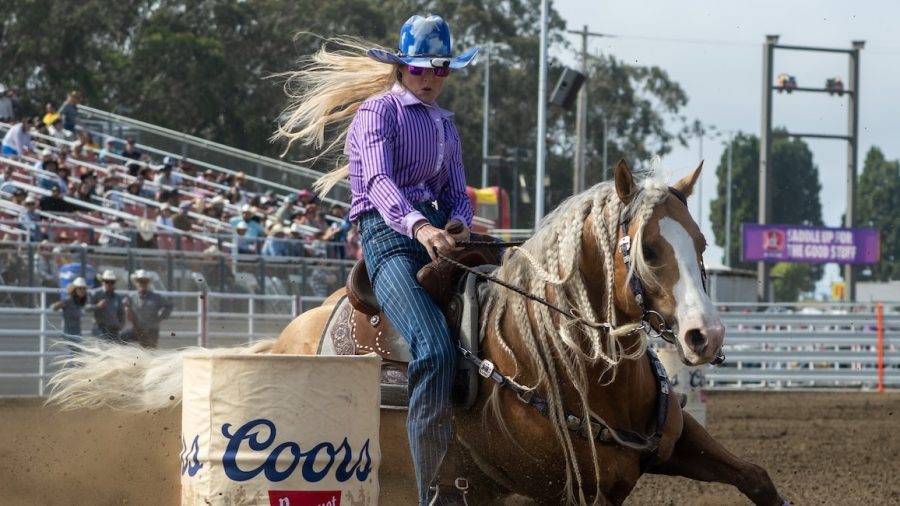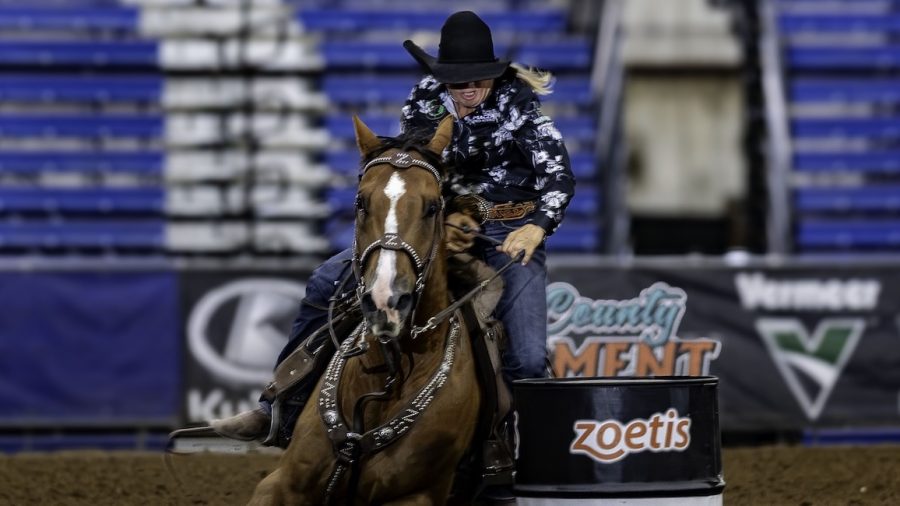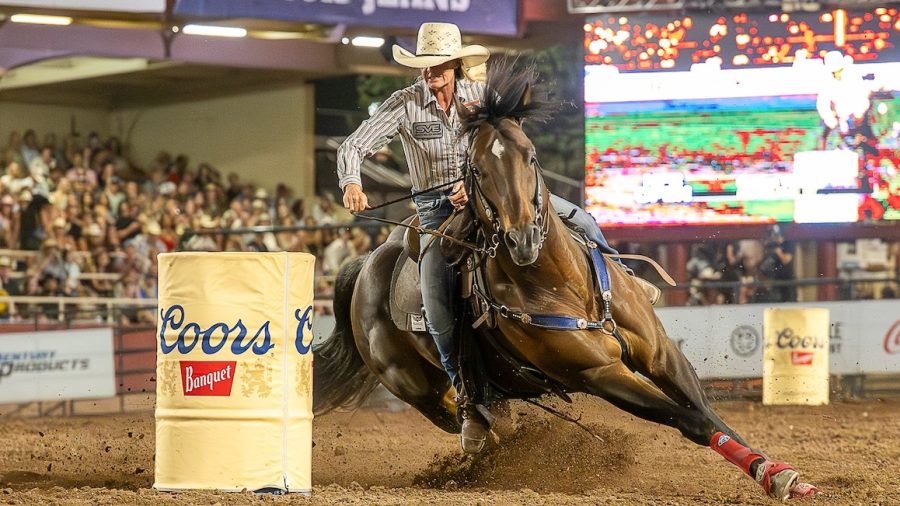

Learning to ride correctly through the turn will help your horse finish strong.
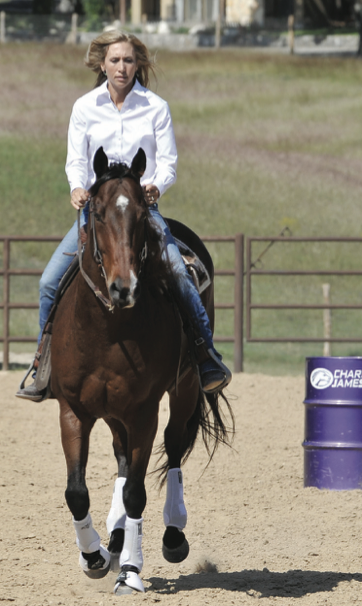
My niece has been riding with me lately, and I’m helping her learn the basics of barrel racing. Through working with her, as well as with lots of other people over the years at my clinics, it’s reminded me of how sometimes people, especially green riders, get to the backside of the turn and forget the importance of finishing the turn. A lot of people new to barrel racing don’t think as much about finishing the turn. If you’re new to the sport or even starting a horse, finishing the turn is an important thing to learn because when you’re loping the pattern and in a habit of not finishing the turn, a lot of horses will float out or not finish the turn tight enough. This can easily become a habit. This is definitely an issue I see at my clinics.
In the past I’ve ridden a lot of horses that were blown up or had problems to fix on the barrel pattern. I’m not saying that not finishing the turns is something that can’t be fixed, but in my experience, it can be a hard thing to fix. When horses have learned that they don’t have to complete the turns, it can take a lot of work to reprogram them, so it’s important when starting a horse to maintain correct position through the turns.
School Correctly
When you’re schooling a horse, stay in that track of 6 to 8 feet as you’re going into the turn. When your leg crosses Axis Point One (see diagram), the horse’s body should be framed up with its hip up underneath itself and its shoulders pointed slightly out. The horse should be framed up straight and not angled in toward the barrel. Then, at Axis Point Three, it’s the same body position, whether you’re within 6 or 8 feet of proximity to the barrel. This is the distance to keep when you are schooling and will vary a bit depending on the horse. The first and third axis points are very important.
Additionally, I always remind people that the second barrel is different because you’re making a complete turn at that barrel, so for the second barrel Axis Point Five becomes really important. All the axis points through the turn are important, but especially so when completing your turn around the second barrel. When you cross Axis Point Five, that’s when you want to close the turn so your horse doesn’t leave too wide.
If you’re a parent or a trainer helping a novice rider, keep in mind that riders who are just learning often have a tendency to not finish the turn tight. They do have a tendency to leave the turn and accelerate too soon. A lot of times I’ll place a cone to block them from going out too far, to almost act as a wall to teach them to finish that turn. Or, I’ll stand near the spot I’m telling someone to ride to if they’re unsure. A visual point of reference is helpful as riders learn the feel for where to finish their turns. Once people gain confidence about what they’re doing, riding to the correct position becomes more natural.
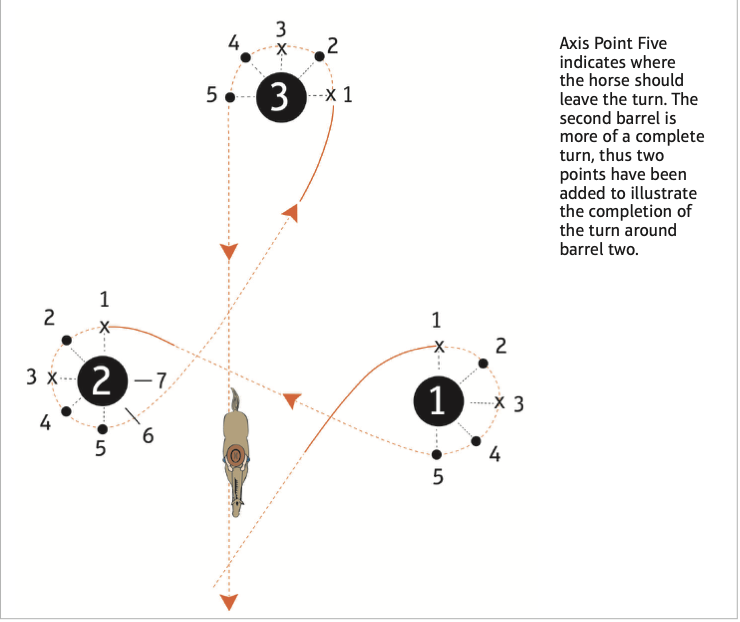
Another thing to keep in mind is if you cut off Axis Point Three, your horse won’t have enough room. Without enough room, the horse can’t keep its hindquarters engaged through the turn to finish correctly. When a horse drops at Axis Point Three, its weight usually transfers to the front end and the hip kicks out. If the hip kicks out, they’re usually going to go wide leaving the turn because they can’t drive through to finish the turn correctly.
There are certain horses—and it often runs in bloodlines—that want to turn really badly and will try to leave the turn too tight. With those horses, you have to help them relax and leave the turn with less urgency. You still want them to be framed up and collected, but you don’t have to motivate them much to leave the turn. I had two horses that were full brothers that both wanted to instantly turn and leave the turns too tight. With them, I had to know the best position to work them to keep them from leaving the turns too soon in a run.
My horse Grasshopper, on the other hand, didn’t always finish tight. With him I had to be aware of using my legs to keep him tighter to the turn. I had to keep his hip tight to the turn, not letting him get strung out at all. I had to really use my legs to ride him up through the turn. Pulling on him to finish the turns made it worse, so a lot of what I did was schooling and riding with my legs to encourage him to finish the turns strong. You need to ride each horse for the individuals they are, but recognize that certain families of horses often share tendencies. A lot of a horse’s style will have to do with if the sire or dam ran barrels and how they worked. This is especially true of the mares that go on to produce barrel horses that will often resemble their style very closely. If you have a horse with a reining, cutting or roping background, a lot of horses with that type of training in their history have learned to stay collected in small circles and it doesn’t frustrate them. When you’re starting them on the barrel pattern, they already know something about running and shortening their stride. These horses know more about collection than a green-broke horse, which can make things a little easier. With whatever type of horse you’re dealing with, just remember to use common sense and good fundamentals on the pattern to guide you. Every horse is different.
If you’re having trouble, keep in mind that you can set up cones to help you ride the correct position through the turn. Break things down until you’ve figured out what will help your horse stay smooth and correct. I’ve even used flour placed in a line on the ground to help people ride over the correct points through the turn. Don’t be afraid to use visual cues to help you.
One thing to mention is that going through the pattern is different than working on barrel drills. With some horses, if you work them wide all the time on the pattern, they think that’s what’s supposed to happen in a run. Horses wired that way won’t finish their turns—they’ll go wide because that’s what you’ve taught them in your slow work. Know your horse and learn how to slow-work them to prepare them for competition.
Keep in mind that when you’re doing slow work, guiding from point to point and breaking the turn down is different from just making a practice run. It will carry through to when you do make that run, which is why correct position and form are both so important.
This article was originally published in the June 2020 issue of Barrel Horse News.