
Karlin’s reasoning is simple: A horse will always tell you what he’s thinking and how he’s feeling. You just have to know your horse and pay attention to the subtle, and sometimes not so subtle, clues he is giving you. For Karlin, “listening to your horse” is the number one skill every owner should develop. Once you know your horse, it’s easier to make sure he stays healthy, happy and willing to work for you.
Know Your Horse
You have to know your horse in order to get the most out of him.
It’s a simple concept, but one Karlin believes is often overlooked by horse owners and trainers, whether they are running on the track or running barrels. It was a concept Karlin himself never truly understood until he met the late training legend Ray Hunt while working with champion Thoroughbred trainer D. Wayne Lucas in California.
“I’d had the background with the Thoroughbreds and conditioning and the leg work and the miles you put into them and all that,” Karlin says, “and Ray introduced me to ‘the difference.’ I knew every horse was different, but I didn’t realize to what extent they were until I got around Ray.”
Lucas had a philosophy similar to Hunt’s—“train the mind, the body will follow”—but it was the insight Karlin gained from Hunt that allowed him to fully grasp the meaning of the words.
“Ray Hunt really made me aware of how to do that,” he says. “You have to treat each horse individually because there are no two the same.”
For Karlin, a horse that is unhappy with its job is easy to spot.
“A horse would kind of tell you,” he says. “You’d go out there and gallop him every two or three days, and you’d get a horse come back into the barn, and he might not clean up right away, or he might kind of stand in the back of the stall, and a horse like that you needed to change his training schedule, something to keep him bright to where when you go get him to go someplace, he’s anxious to go, and it’s not a dreaded event.”
It’s a problem Karlin sees routinely at the racetrack.
“I know trainers today that don’t even know their own horses,” Karlin says. “They walk up to the track, and they see them coming, and they’ll have to ask the rider on their back who that horse is.
“I think if you’re going to train a horse, if you’re going to condition a horse, you’ve got to know your horse. If that horse isn’t eating right, if you’re not working on his teeth, if you’re not keeping him shod, there’s so many areas that are the fine points, the little things that make the difference between winning and losing.”
Karlin always wants his horses to be happy to see him and to greet him when he approaches their stalls. When they don’t, he knows something is amiss.
“I’m big on attitude,” he says. “To me, when I go to my barn, I’m going to my barn because that’s how I want to pay the bills, and I want them all to be happy and want to go do something. Now they’ve got to work, but I want them to enjoy what they’re doing. It’s just like the people out there working, they’re not going to do the same job if they aren’t happy.
“If I go to a horse every day or several days, and I walk up to his stall to get him to go do something, and I go up there one day and he stays in the back of his stall, I’m going to stand there a minute and watch and see what the deal is. And when I do get him out to move him around and do something, I’m going to watch him more closely than I would normally because there’s something there that’s not right.”
Knowing your horse gives you the ability to recognize these sorts of subtle changes.
“They will tell you so much, if you’ll listen to them,” he says. “They will not lie to you. A horse wants to be well.”
The Importance of Blood Work
While getting blood work done on a horse may not be a common routine for most horse owners, Karlin believes it should be. By running blood work on a horse when he is feeling good, an owner gets a baseline reading that any future tests can be compared to once the horse becomes ill or injured. This can give your regular vet, or an emergency vet you’re seeing at a show, insight that they otherwise wouldn’t have.
“On [barrel horses], I’d run one before you got started,” Karlin says. “Like, you lay a horse off, just before you bring him back, and you’re going to start to make a lot of changes in him, run blood and see where you are. And then come back in 30 days. If everything’s all right, I’ll come back in 30 days, and I’ll run one more and see if I’m where I’m supposed to be.”
This sort of preventative maintenance gives an owner a leg up if the horse starts to show signs of illness. In a Thoroughbred industry that he sees as having gone “medication happy,” Karlin believes more can be done to keep a horse healthy and working correctly by simply being proactive.
“If you run blood on that horse to start with, then you know what you need,” Karlin says. “If you just go to doing things, then you don’t know where you are, and that’s not good for any competition horse, not just for us in the Thoroughbred world.”
Short-Distance Conditioning
Whether your horse has been out of action due to injury, illness or just because he deserved a vacation, how you get him back into competitive shape is important.
Karlin starts slowly with sprinting horses that are out of shape or just need a fitness boost.
“I’m going to put him in the round pen, let him play, and see what we’re doing,” he says. “If it’s a horse I had ponied before, I might pony him three or four days, just to let him get some air, watch him go and see that he’s hitting the ground all right.”
Once the horse’s air has returned, he’ll exercise the horse with a rider, jogging a mile, then galloping a mile, then progressing to a half mile jog and 1.5 mile gallop as the horse becomes stronger.
“When I go out, I want to make sure he wants to go do something, number one,” Karlin says, “and number two, when I come off of the racetrack, I want him to have wanted to do a little more than I let him do because that keeps him looking for tomorrow.”
Once Karlin knows he has a horse that is physically and mentally ready to perform, he trains his sprinting horses to have shorter gallops and shorter works than his long-distance runners to keep an edge on them.
Then, he maintains a consistent workout regimen for his horses once he has them fit. In between races, which are typically two to three weeks apart, he will pony them at a gallop for a mile to a mile and a half once or twice a week to keep their wind up, and then he works the horse at full speed for a half mile once every week. He also does an additional training four to five days before they run, to sharpen them up.
“You want them sharp, and you want them quick, and you want them to relax, but you want that speed fitness in there,” he says.
They also need to have a reserve burst of speed that they can tap into at the end of a run, something he relates to coming home after turning the third barrel.
“You want that sprint,” he says. “You want them to run to the barrel, relax around the barrel, and that last little bit, you want everything there.”
Leg Soundness
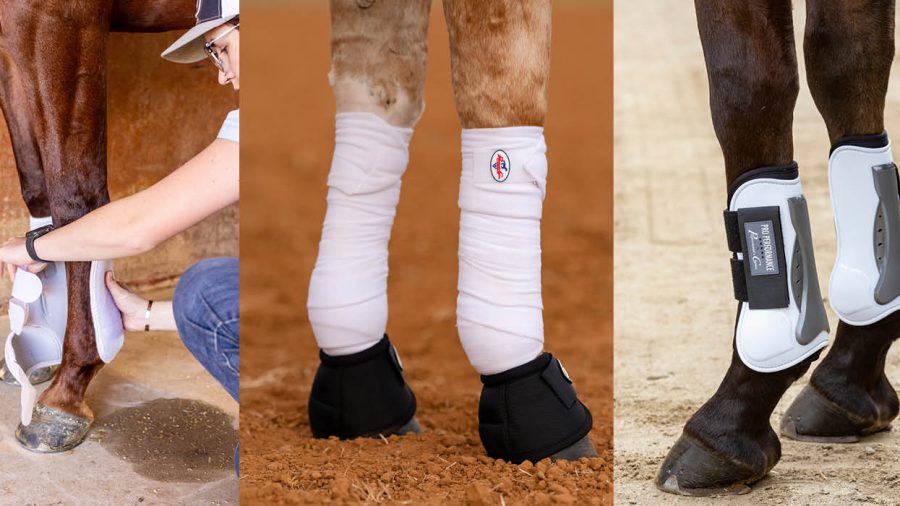
Maintaining a horse’s legs and joints is another high priority for Karlin, and his most important tool in doing so is an ice boot, which he uses three or four times a week, in addition to an assortment of other treatments.
“If I work a horse and let him extend himself, I’ll come back with that horse after we cool him out, put him in his stall, let the ice boots be on him 25–30 minutes, and then pull them off,” he says. “I use several different things on their legs. I use some mud, on occasion. I use alcohol. And we mix a leg brace that’s a mixture of DMSO and Absorbine that we mix and put on. Sometimes I wrap them, sometimes I don’t. It depends on the horse.”
Again, preventative maintenance is the key, and the simplest and cheapest form or prevention entails simply looking your horse over closely every day, just in case there is a little puff in an ankle or a little pressure in the knee that you hadn’t seen before—especially if you are riding the horse consistently.
“I’m 6’4” and weight 200 pounds, so I don’t get a chance to get on my horses on a day-to-day basis like a barrel racer would,” he says. “They’ll learn to feel that horse, and something won’t feel quite right, and when something doesn’t feel right, it’s not right.
“You get a horse that’s never taken a bad step, and all of a sudden he’s off someplace. He’s not trying to get a day off. There’s something there you need to work on.”
Unless a horse goes out and runs into a fence, steps in a hole or suffers some other sort of immediate and obvious injury, diagnosing what is wrong can be problematic, unless you know how a horse is put together. That’s when the anatomy of a horse comes into play. For example, horses work diagonally, but they’re built symmetrically.
“If you cut a horse in half, right down the centerline, both halves are the same, but they operate diagonally,” Karlin says. “If, all of a sudden, you’re starting to see a little wind puff, or you’re starting to see a little pressure in the knee or something, look. Don’t only fix that, but look at the other side, because the moment something goes wrong with a horse, his body is going to start to compensate for it. If he’s feeling a little something that’s not quite right, and it can be a nail in the shoe that’s just hit the white line a little, and it’s not enough to make him sore, but it’s enough that he knows it’s there, he’ll start compensating by using the other side more, the same way we as humans would do.”
Karlin says that by the time a human sees a horse is having a problem it’s already taking place someplace else. In other words, if there is no obvious sign as to what is causing a problem on the left side of a horse, then the real problem is likely located on the right side.
“Something over there probably created [the problem] before you caught it,” he says. “Unless, like I say, it’s something where a horse steps in a hole and has got a puffy ankle, you know exactly what happened to him.”
They Are What They Eat
Training and exercise are important, but they are not the only elements to making sure your horse will perform at its peak potential. Good nutrition is vital, and often much easier to maintain than many people realize.
Karlin feeds his horses three times a day.
“In the morning, they typically get a half scoop of crimped oats and a half scoop of sweet feed, and that’s a 3 pound coffee can,” Karlin says. “At noon, they get basically that same thing. Then at night, the runners get a gallon and a half of crimped oats, a gallon of sweet feed, half a gallon of bran and their vitamins, and then in the summer time they get cold water in it and in the winter time they get hot water in it, just enough to make it all good and wet.
“I know people don’t do that anymore,” he says of mixing the feed individually for each of his horses. “They get a bag, they put it in a wheelbarrow, they go by, everybody gets one scoop, two scoops, a scoop and a half, whatever they feed them. I’m from the old school, and I still mix each one separately.
“The thing that I never could understand, and nobody could explain this to me, and maybe it’s just my lack of intelligence, but say you’ve got a 50 pound bag, and you put 20 pounds of oats, and you put 20 pounds of something sweet in there and five pounds of pellets, and another pound of vitamins, and anyway, you get your 50 pounds. You mix it all together, and you put it in this bag. You lay this bag down. You ship it half way across the country. It might sit there two or three days or a week. You pick it up. You take it home. You stand it up. You shake it. You open that bag, and if you’ve got a three pound coffee can, you’ve got basically 16 of those coffee cans in there.
“Can you tell me that each of those 16 that I dump in [front of a horse] has exactly the same stuff in it?”
It’s a question that Karlin says he puts to every feed salesman who comes to his farm, and one they can’t answer to his satisfaction.
“I know when I’m putting a gallon of oats in there, that’s a gallon of oats, and that’s in front of that horse,” he says. “And if I put a gallon of that sweet feed in there, that’s in there, and when I mix it up, I know there’s a gallon of each. I know when that shot of Red Cell is in there, it’s in there. And if they clean up, and they don’t throw any feed out in the morning, he ate it. So it’s like I said, I’m old fashioned. It’s one of those things I was taught when I was a kid.”
Karlin avoids giving his horses supplements, aside from vitamins in the form of Red Cell, or adding G7 if his horses are dealing with ulcer problems. By personally mixing the feed each of his horses receives and observing them closely each and every time he’s around them, he believes he can get his horses just as ready to perform as those who flood their horses’ systems with fancy supplements and medications.
Karlin’s horses have grass hay available to them at all times and will also feed alfalfa, but only to horses that are actively training or competing. He starts out by giving these horses two or three handfuls of alfalfa, up to a third of a flake.
“If you’re looking at it like a normal bale of alfalfa breaks off into 12 or 14 flakes, they’ll get a flake a day at most,” he says. “I don’t feed a lot of it, but it’s got a real good protein content, and it keeps them eating. I’ve noticed that, especially my running horses, the ones I give a little alfalfa to, I keep a little better flesh on them than I do the other horses, and that’s something that I try to monitor.”
He prefers to use Timothy hay from the West coast as forage, but also likes Coastal hay, especially when the cost of Timothy becomes prohibitive. He admits that he doesn’t even know what type of grass grows in his pastures, only that it’s a mixture of the natural grasses from the area around Benton, La.
He does not feed cubes or pellets because of their tendency to dehydrate horses by absorbing large quantities of water. In this situation, most people feed horses salt to get them to drink more water, but Karlin chooses to feed his horses brown sugar to make them drink.
“Think about it,” he says. “If you eat a candy bar, you’re thirsty. If you drink something sweet, you’re thirsty. The difference, according to my veterinarian, is when a horse excretes salt, he may have to go to the bathroom three or four times to excrete the excess salt. He can excrete all the excess sugar he wants in one urination. So you don’t compound the problem by getting him to drink more, so he’s got to go to the bathroom more.”
Managing Hot Horses
When it comes to maintaining the soundness of hot, or energetic, horses, Karlin once again has a simple approach, not only with how he feeds the horse, but also how he works it.
He feeds hot horses that he is working in a similar way to those he has turned out.
“I’d keep everything on that horse as bland as I could keep it,” he says. “Straight oats, grass hay, no alfalfa. No vitamins, unless there’s something specific that they need.”
He also works those horses harder and longer each day than his other horses, taking advantage of their natural reserves of energy.
“Let that horse do a little more,” he says. “If you normally rode him 30 minutes, ride him 45 or an hour, where he gets a bit more out of it.”
He also recommends watching your horse to ensure that its “hot” nature isn’t being caused by something else, such as ulcers or because it’s frightened or unsure. Many otherwise calm, yet energetic horses can be mislabeled as “hot” when it’s really nerves or excitement that are causing the horse to act out.
This is especially true with barrel racers, Karlin says, because in most cases, when barrel racers load their horses in the trailer, they are going somewhere to run.
“That horse knows that,” he says. “If [owners] think they don’t, they’re kidding themselves. They’re already in anticipation, and when they get unloaded, and there’s all that activity going on, they’re wound up already.”
He recommends that barrel racers take their horses for a walk, let them graze or just hang out for few minutes after unloading.
“If you’re going to get a hotdog, take him with you,” he says. “Don’t just tie him to the trailer and let him stay wound up. I think down the road, you’re going to find out, you unload him, and he starts to get more relaxed.”
It’s a technique that Karlin has used with many of his 2-year-old Thoroughbred horses.
“When I was going to check other horses, I’d just snap a rope on one of them and take them with me,” he says. “Pretty soon, us walking around talking, I’d stop, I’d see somebody, I’d do something, I’d be down by the racetrack, up by the barn, and it would be kind of like having your dog with you after a while. It really made a difference, and then we’re back to that attitude thing. It’s knowing your horse.”
KISSMIW
For Karlin, everything involved in keeping his horses in top condition comes back to a simple, tried and true mantra.
“Train the mind, the body will follow,” he says. “Listen to your horse. If you just listen to them, you get so much out of it.
“I will tell you one thing I learned on the coast out there. We used to stop at a place to eat that was next door to the country club, and I always saw this little red Mercedes in there all the time, and it said KISSMIW on his license plate.
“I kept trying to catch whoever this is because I’m thinking “Kiss My…”, “Kiss Me…”, something, KISSMIW, and I can’t figure it out. Finally, I catch him coming out of the country club one day. He’d been playing golf, and I said ‘Would you please explain to me what that means?’ and he said, ‘I’m a U.S. Patent attorney, and people are always coming to me saying ‘I want to invent something, I want to invent something, what can I do?’ and he said ‘I point to that license plate and say ‘when you figure that out, then you’ll know.’
“What it means is Keep It Simple Stupid, Make It Work. I have tried to put that philosophy into the way I work with my horses, and it is amazing.”
About Chuck
Chuck Karlin grew up in a Thoroughbred racing family and has been involved with horses in one way or another since he was about 5 years old.
“I’m 64 now, so it’s kind of been a lifetime thing for me,” he says.
He grew up in the Van Berg family, with his grandfather, Marion H. Van Berg, and uncle, Jack Van Berg, who are both National Museum of Racing Hall of Fame trainers.
His grandfather gave him his first job at a racetrack when he was 5, and he never looked back. As an adult, he worked with his uncle, Jack, an Eclipse Award winner who trained Gay Dancer, Alysheeba and many other horses. Karlin also spent several years on the West coast with D. Wayne Lucas, where he started many of Lucas’ 2-year-olds and managed the off-track program for him.
Throughout a successful career that has spanned more than four decades, Karlin claims he would not have achieved anywhere near the success that he has without his wife and partner, Koleen.
“She still starts colts and galloped with me when I first started,” Karlin says. “She still goes to the track with me. She’s been there through good, bad and ugly with me. She’s been my rock a lot of the time.”
Michael Mahaffey is associate editor of Barrel Horse News. E-mail comments on this article to [email protected].
This article originally appeared in the August 2009 issue of Barrel Horse News.