

“Neither one of those is accurate,” she stated. “You’re not going to have a fair time that way. Let’s say we put the barrel on the outside of the stake like NBHA does—sometimes the barrel is tipped on the inside and sometimes it is tipped the other way, so you can never put that barrel on the inside of a stake accurately every time. It’s the same when the judge puts the barrel on top of the stake—it’s never going to be exactly the same every time either. There are so many variables on that too, so we can’t come to terms with the right way to do it, so we’d rather keep it the way we have it because that’s what our records go with, having the set the pattern on the center of the stakes. That tradition of keeping those arena records and such is something that we want to keep and they set us apart from other types of barrel racing events out there.”
On the issue of records, to be a true record on a WPRA Standard Pattern the barrels must be centered on top of the marker. If set to the inside of the marker, the pattern is short of Standard unless the distance from the center to the edge of the barrel was added before the outside stake was driven.
However, Pritchard’s recommendation to the WPRA was that for the race to be timed in thousandths, the barrels needed to be staked on the outside, like at a regular barrel race.
“From an engineering standpoint,” he said. “I would say you could be more accurate on the outside of the barrel than you are on the center. When you go to a barrel race, it’s marked on the side and it can be confined to within half of an inch. Now if the barrels were clear and you could look down and see where the marker was, you could be pretty consistent, but they’re not; they’re metal.”
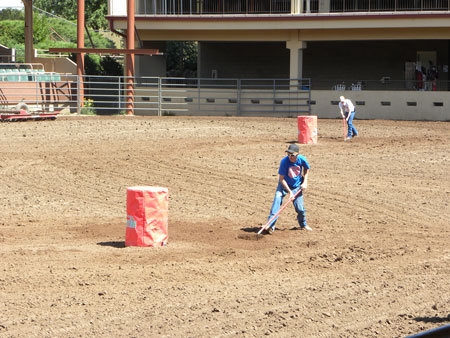
The problem is there is no way to set repeated patterns in quick fashion, such as during a rodeo performance without being slightly off, especially at multiple performance rodeos like Denver, which has 20-plus performances, Pritchard said.
“At a barrel race, the markers are on the outside and you set them in the same place every day, and you can be very consistent,” he said. “You can be within two or three thousandths for every horse, but at a rodeo, when you’re dealing with multiple performances over different days, where the barrels are in the arena, out of the arena, and they’re using the center of the barrel as the marking point—a point you can’t see once you’ve set the barrel, they’re going to be within a few inches and that varies the pattern by more than a hundredth of a second, so to time to a thousandth would be a crap shoot.”
Timer Height
Another variable that affects timing is the height of the timer tripod. Ideally, the height of the beam should hit the majority of horses in the chest. Until the acceptance of Roping Director Patti McCutchen’s 2016 proposal to “specify an actual height of the timer,” the WPRA Rule read, “Set timer the same height and position each performance and lock legs. Height of the tripod shall be waist high.”
The obvious question was whose waist? Tall judge? Short judge? The barrel racing director on hand to stake the pattern?
Now, the rule is being modified to say, “Height of the timer eyes shall be between 36 and 42 inches from the ground,” which was a recommendation from Pritchard.
“We’ve used that for many years and anywhere between 36 and 42 gets you a consistent time,” said Pritchard. On average, that height allows the timer’s beam to hit the majority of horses in the chest.
Based on their Tanner Time analysis and use of lasers, Pritchard discovered that anything above or below that range could make a huge difference. If the timer is set too high—above 42 inches, you could have a difference of a half to full second, depending on what body part the beam hits on a tall versus shorter horse. If set too low, below 36 inches, you run the risk of legs stopping the timer, which can vary.25 or more based on which leg breaks the beam.
The problem with the new proposed rule is that it doesn’t take into consideration the crown on the arena.
In many arenas, the center of the arena is higher than the sides where the timer tripods sit. Ransom recalled one rodeo in the Great Lakes Circuit where they had to put the timers in the back of pickup trucks because the racetrack the rodeo was being held on had such a large crown to it.
The firmness of the ground where the tripod is sitting also factors in to the height—do the tripods legs sit on top of the ground or sink in too soft ground.
“Here we go again with variables on ground,” lamented Wintermute. “If the ground is soft, where does that pod set in the ground? This is something that’s really hard to put in black and white.”
A range, Pritchard said, was the best answer. Even then you may have one judge that sets the tripod deeper in the ground (if the wind is blowing, per se) or places it lightly on top of the ground in fair conditions.
Pritchard expanded, “We used lasers for years and I would go out with a tape measure and see where the laser beam actually hit it. That’s as close as you can be from a practical standpoint.
“If it were me I would take a stick and market it red from 36 to 42 inches and have someone hold it in the center and go over and sight through the timer to see if it was in that red band on the stick as you look across. They asked me for an exact height and you’re never going to get that. There’s no way that a rodeo judge can run out and set those timers out and it be an exact height in a reasonable amount of time. You’ve got to have a range.”
Even still, is a judge going out to check in the middle of a rodeo performance? Probably not.
Ignorance Is Bliss
For something so seemingly simple, accurate timing is deviled with details. Some WPRA directors are hopeful that as the variables are factored out of the equation, maybe one day professional rodeos will be timed in thousandths.
“Timing on the thousandths is very tricky,” said Wintermute, who noted that the WPRA membership was split largely down the middle on the issue. “There are different ways of looking at it. A thousandth has to come from a pretty level playing field, and we don’t have a level playing field from the get go—from the timer, from the ground changing—so how does a thousandth work at the end of the day? If we can change the playing field, then maybe thousandths might work.”
The problem is fixing the variables and putting it in black and white. At this point, at least for the WPRA, continued dialogue seemed the best course of action.
“It’s pretty hard and really frustrating when we start throwing around to see what solutions there are to make the playing field very fair. We’ve gone a lot of different angles…,” Wintermute said, reflecting on the entire discussion before adding simply, “and really we’re lucky if we get a time.”