

Fluidity
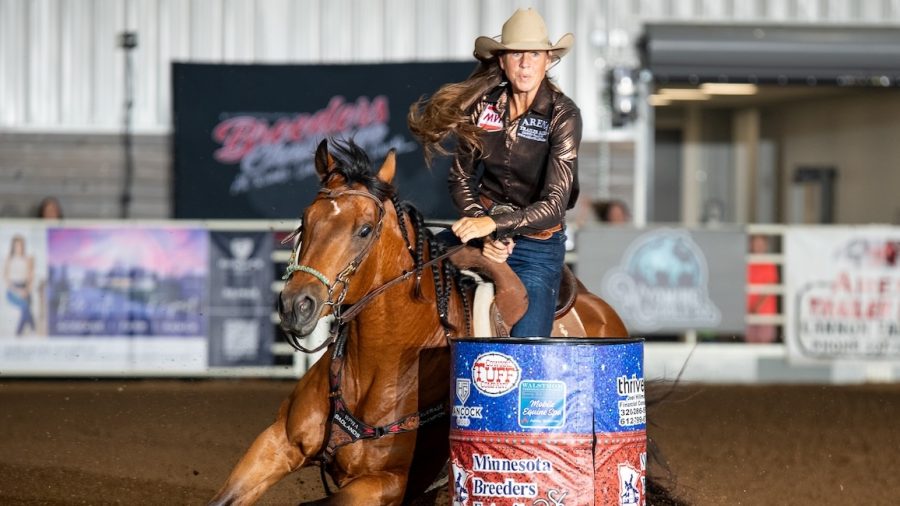
Multiple futurity champion Jolene Montgomery (formerly Stewart) uses a Loomis gag on a number of Jud Little’s horses. She won the 2007 BFA World Championship on Sooner Superstar using a Loomis with a twisted-wire mouthpiece and wire headstall. Her 2009 standout Return Of The Bully, who garnered more than $100,000 in earnings, runs in a custom-designed version of the Loomis with a smooth copper mouthpiece with three links of chain in the middle on a rope headstall.
Montgomery likes the fluidity of the Loomis gag.
“When I start teaching a horse to break at the poll, it’s not harsh or sharp,” said Montgomery, who learned to use the Loomis gag when she was working for Troy Crumrine, who used them for tuning and warm-ups. “It allows the horse some relief and steadies them up. It helps teach them to give to the bridle without a sharp give and release; it’s more fluid. If you have a horse that’s a little funny about their head, an O-ring can be really sharp for them and they’ll throw their head. With a Loomis, they can lean into it a little bit, so it’s not a sharp give and release.”
Montgomery also likes that the Loomis can be forgiving of a rider’s mistakes.
“When you’re making a run, it’s really hard to think that fast, so you put something like a Loomis on a horse so you can stay out of their way. You can pull on them a whole lot with a Loomis and not really do anything,” Montgomery said. “It totally works for me, because I bump them going into a turn and then give it all back in the turn by moving my hand forward, and then on the backside, I give a pretty sharp pull. With some of the O-rings or shanked bits, that would be too sharp of a pull, more like a snatch. With a Loomis, I can give that quick sharp pull, but it doesn’t go through my hands that way. It gives the horse some relief.”
The Loomis also allows a horse to get straighter more quickly when leaving the turn, because the horse can go on and start running again even if Montgomery hasn’t totally released the horse’s mouth yet. Montgomery does caution that you can’t “hang” on a horse too much with a Loomis, because they will become dull to it.
“They figure out they can push through it, and you may need to go back and ride with an O-ring or shanked bit at home to back them off,” Montgomery said.
Learning the Loomis
“A bit is only as good as the hands that are using it,” Joyce said. “The best way to learn how to ride with a Loomis is to ride with someone who uses the bit correctly.”
Her advice is mirrored by Thomas, Cunningham and Kirkpatrick.
Although many trainers use it for many different reasons, when used correctly, a horse will ride with a soft face and supple body. The horse won’t root on the bit or gap its mouth to evade the pressure, making the Loomis an effective and widely used piece of equipment in the right hands.