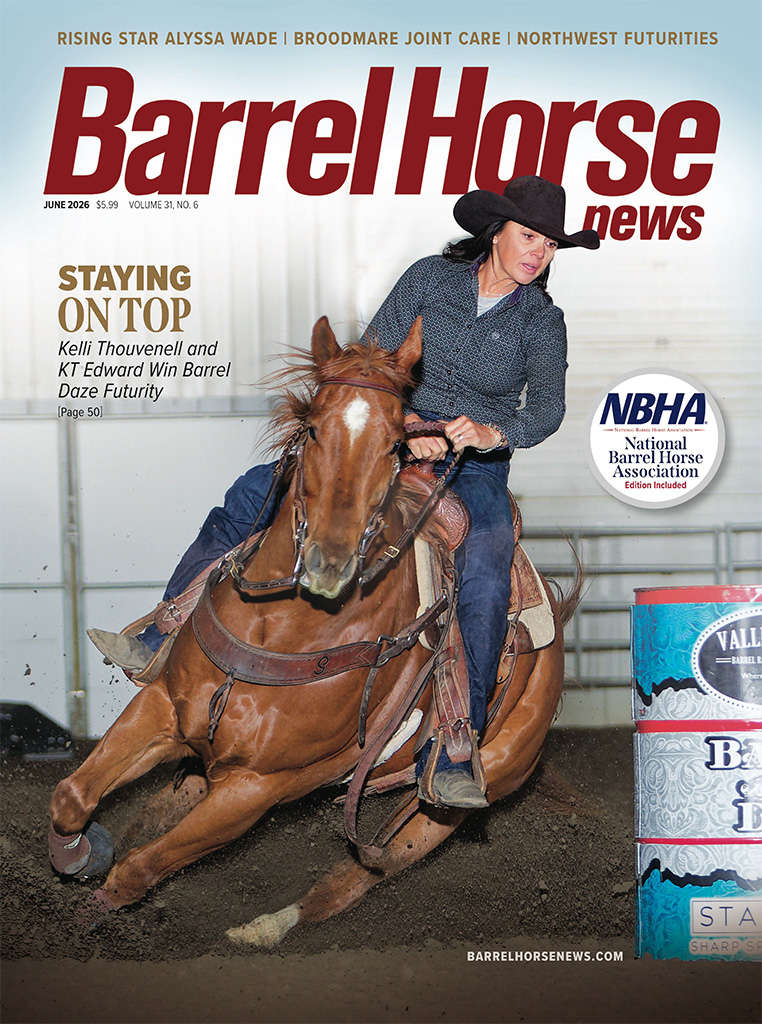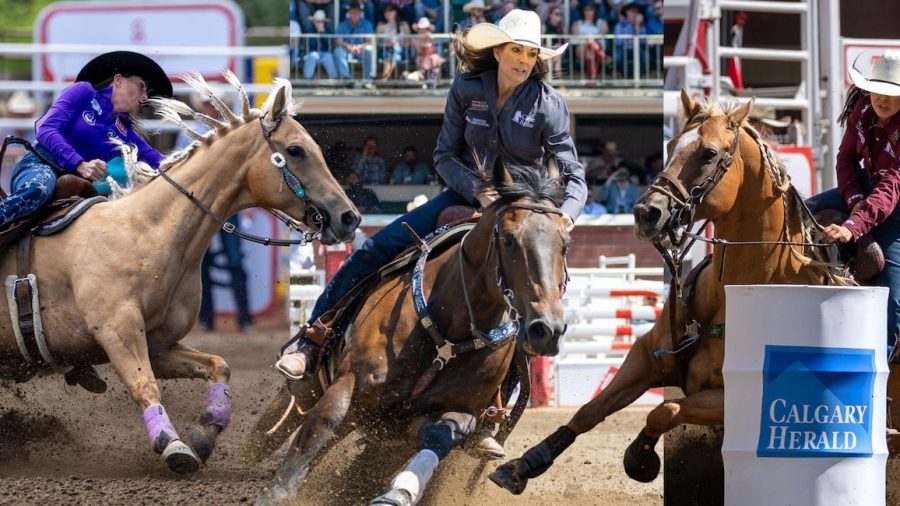

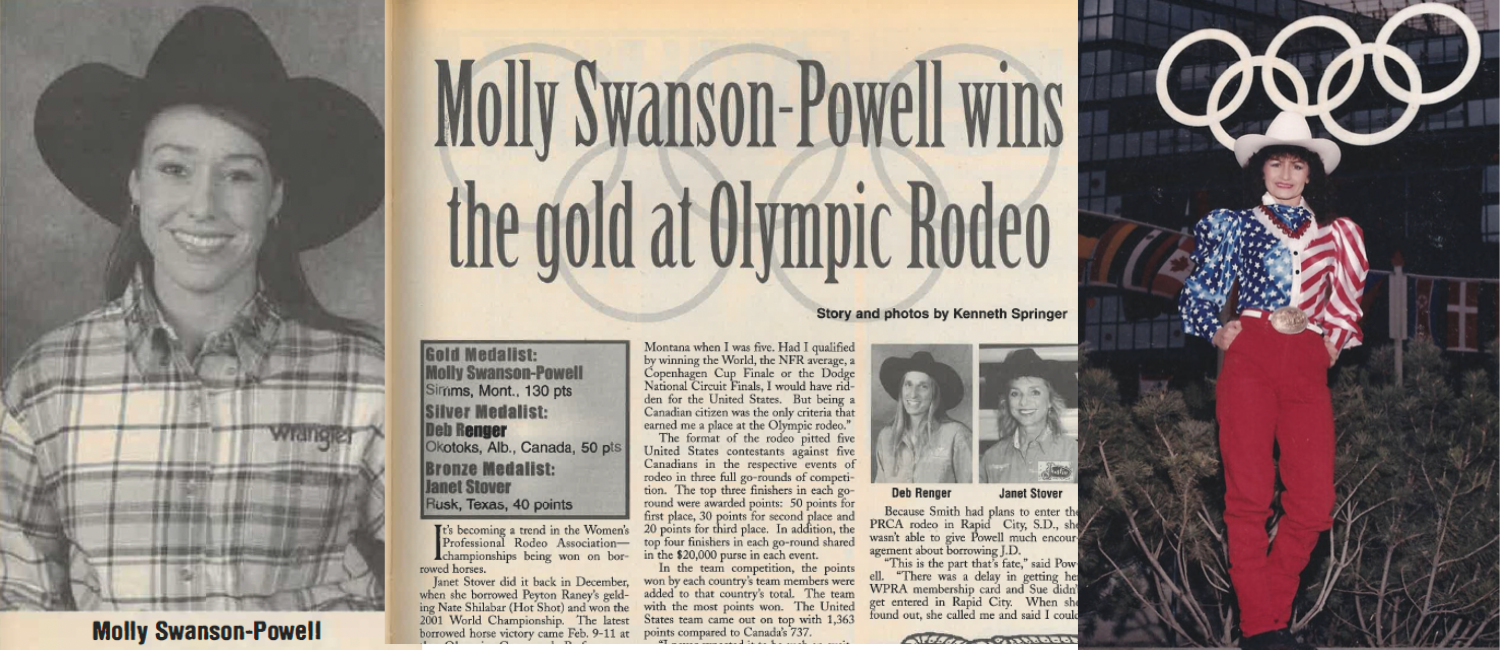
Rodeo was part of the Olympics twice, the 1988 Calgary Winter Games and the 2002 Salt Lake City Winter Games. Rodeo icons competed for the gold, silver and bronze for team USA or team Canada.
In 1988, Marlene McRae won gold, Charmayne James won silver and Martha Josey won bronze.
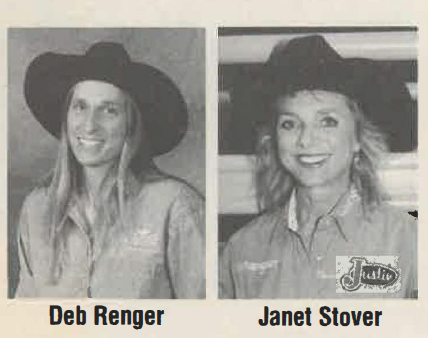
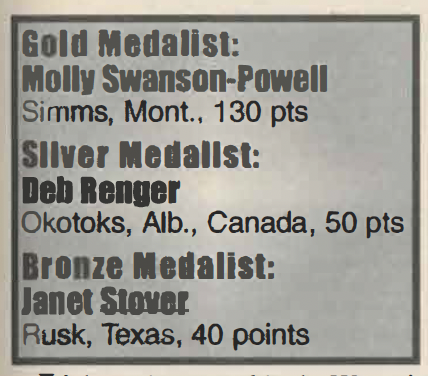
In 2002, Molly Swanson-Powell won gold, Deb Renger was silver and Janet Stover took bronze.
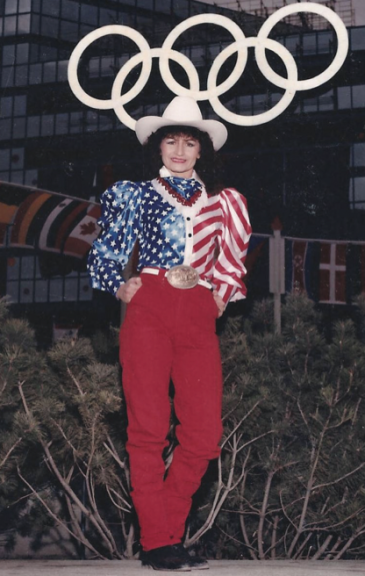
Molly Swanson-Powell wins the gold at Olympic Rodeo
Story by Kenneth Springer, originally published in the March 2002 issue of Barrel Horse News.
It’s becoming a trend in the Women’s Professional Rodeo Association — championships being won on borrowed horses.
Janet Stover did it back in December, when she borrowed Peyton Raney’s gelding Nate Shilabar (Hot Shot) and won the 2001 World Championship. The latest borrowed horse victory came Feb. 9-11 at the Olympic Command Performance Rodeo held in the Legacy Center in Farmington, Utah.
This time it was Molly Swanson-Powell, Sims, Mont., teamed with Sue Smith’s J.D. that was the winning combination. Powell, who holds citizenship in both Canada and the United States, earned a spot among the elite qualifiers by being the highest money-earning Canadian in the 2001 WPRA World standings.
”A lot of people thought I was being a traitor by riding for the Canadian team,” said Powell. “But I was actually born in Canada and moved with my family to Molly Swanson-Powell
This time it was Molly Swanson-Powell, Sims, Mont., teamed with Sue Smith’s J.D. that was the winning combination. Powell, who holds citizenship in both Canada and the United States, earned a spot among the elite qualifiers by being the highest money-earning Canadian in the 2001 WPRA World standings.
”A lot of people thought I was being a traitor by riding for the Canadian team,” said Powell. “But I was actually born in Canada and moved with my family to Montana when I was five. Had I qualified by winning the World, the NFR average, a Copenhagen Cup Finale or the Dodge National Circuit Finals, I would have ridden for the United States. But being a Canadian citizen was the only criteria that earned me a place at the Olympic rodeo.”
The format of the rodeo pitted five United States contestants against five Canadians in the respective events of rodeo in three full go-rounds of competition. The top three finishers in each go round were awarded points: 50 points for first place, 30 points for second place and 20 points for third place. In addition, the top four finishers in each go-round shared in the $20,000 purse in each event.
In the team competition, the points won by each country’s team members were added to that country’s total. The team with the most points won. The United States team came out on top with 1,363 points compared to Canada’s 737.
I never expected it to be such an exciting event,” said Powell. “The coliseum didn’t hold that many people, but the regular seats were $75 per performance and there were people hanging from the rafters. And they were from all over the world.”
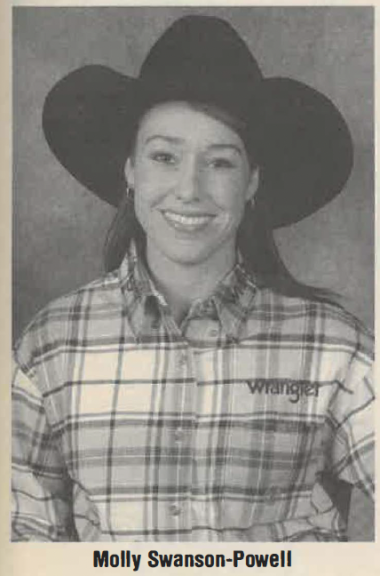
Powell, 26, pulled off an amazing fete by winning the first go round on J.D., a horse she had never competed on in competition.
“I had never been on his back until the afternoon just before the first performance,” said Powell. “I had never even seen the horse run, so I had no idea how to ride him. I got to gallop him around the barrelsabout 6 p.m. and the rodeo started at 8 that night.”
To say it was an instant perfect match up would be an understatement. Powell topped the first go round with a 15.20, placed second in the second go round with a 15.32 and ran the fastest time of the rodeo in the third go round to take first with a 14.96. The gold medal belonged to Powell with her total points of 130, followed by Canadian Deb Reager with 50 and World Champion Janet Stover, also on a borrowed horse with 40.
Along with gold Olympic medal and the prestige, Powell banked $7,333 for her efforts.
“It was my mom’s idea for me to call Sue Smith, who lives in Blackfoot, Idaho. Mom had seen Sue run J.D. and she really thought he was a nice horse. Sue won the Wilderness Circuit Championship, so I knew he was an outstanding horse. Since Sue lived relatively close to Farmington, Utah, a suburb of Salt Lake City, we figured she might let me use him,” explained Molly.
Because Smith had plans to enter the PRCA rodeo in Rapid City, S.D., she wasn’t able to give Powell much encouragement about borrowing J.D.
“This is the part that’s fate,” said Powell. “There was a delay in getting her WPRA membership card and Sue didn’t get entered in Rapid City. When she found out, she called me and said I could use her horse.”
Powell, who has at least two top-notch barrel horses of her own, desired to borrow a horse in order to leave her horses in the South where the weather was warmer and she had a series of big rodeos lined up that were scheduled immediately before and immediately after the Olympic rodeo.
“I was afraid hauling my horses up would increase their chances of getting sick and I was up like I needed to be at all the rodeos and it would have stressed them to make the long trip,” said Powell.
“I had no idea I would be able to win the Olympic Rodeo,” continued Powell. “I had hoped to pay my expenses. My thought was that with three runs, I should be able to ride him good enough to win something by the third go round.”
The luck of the draw put Powell near the bottom of the ground on every run, running seventh, ninth and seventh.
“That shows what a terrific barrel horse he is,” said Powell. “My last run was the most exciting because I felt confident enough to let him work his barrels a little tighter than on the other two runs.”
After sharing the winnings with J.D.’s owner, Sue Smith, Powell plans to use the money earned at the Olympics to improve the place she and team roper husband Turtle Powell recently purchased in Stephenville, Texas. Molly, a six-time NFR qualifier, married PRCA team roper Turtle Powell on Nov. 17, 2001.
“It was a great rodeo,” concluded Powell. “I’m glad I had an opportunity to be a part of it. It was the chance of a lifetime.”
Members of the United States team were: Kappy Allen, Sherry Cervi, Janet Stover, Delores Toole, and Kelly Yates.
Riding for the Canadian team were barrel racers: Carol Barr, Jill Besplug, Joan Hager, Molly Swanson-Powell and Deb Reager.