

How Diet Affects Lung Health
A more affordable and readily available treatment that can potentially achieve the same effects as CES are feeds fortified with the proper concentrations of Omega-3 fatty acids.
“They tend to affect the vascular system, make vessels more flexible and easier for red blood cells to go through the capillaries, and so forth,” Erickson said. “And there’s some evidence that this product may help prevent EIPH, as well, so diet might be beneficial.”
Epp says there are several mechanisms through which Omega-3s may work. It may be by reducing inflammatory airway disease, or it may affect saturation of the membrane fluidity of not only the red cells, but maybe the vessels as well, to make them more elastic instead of more prone to tearing and rupture during high levels of exercise.
Erickson says it wasn’t known yet what combination of Omega-3s were most effective.
“You need a certain concentration and a certain ratio of those for it to be effective,” Epp said.
Hutchins says most commercially available feeds designed for performance horses are already rich in Omega-3s, and that blindly adding more is not necessarily the best thing an owner could do.
Epp is currently working with a feed company to produce a line of feed with the proper ratios of Omega-3s to solve this problem.
“We found that with some concentrations and ratios, we did not have an effect, and with other ones we did,” Epp said, “That’s why the concentration and ratio of the particular Omega-3 fatty acids is critical.”
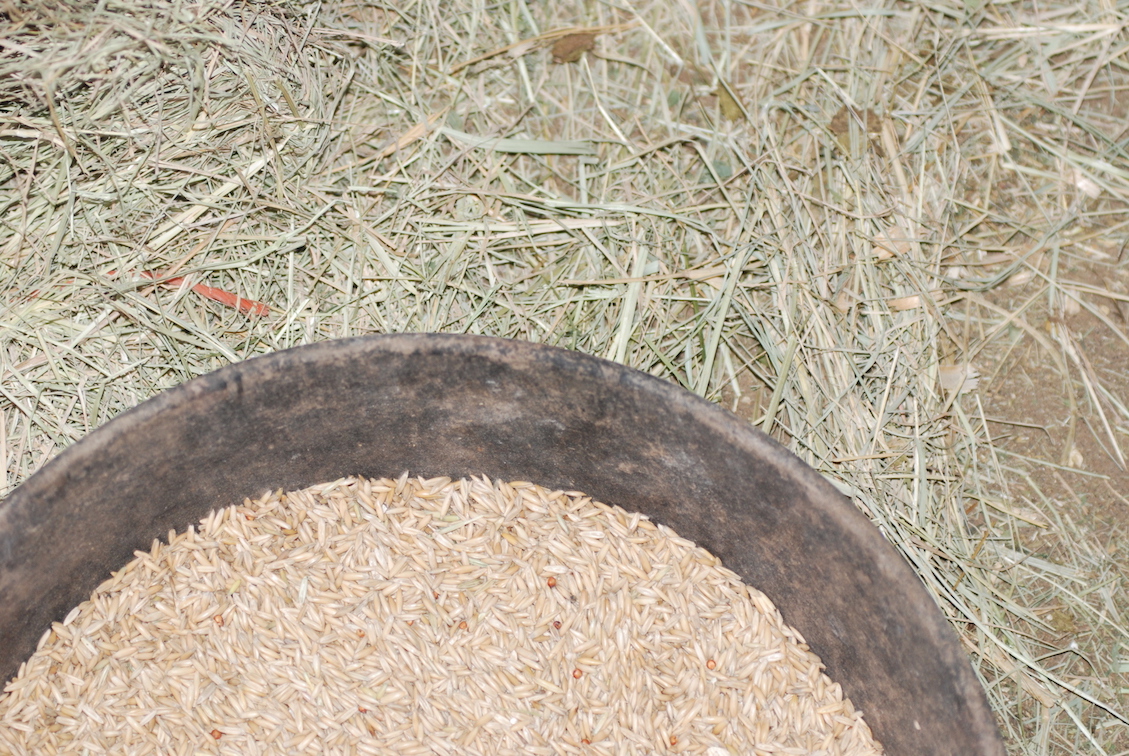 A diet of dust-free hay and a feed rich in Omega 3 fatty acids can benefit horses prone to bleeding. Photo by Danika Kent.Epp says, like CES, the Omega-3s take an extended period of time to have an effect. She says the anti-inflammatory treatments could potentially become a prophylactic use if people started horses on Omega-3s before they went into race training.
“Maybe we could reduce the level that these horses would bleed if they had not been put on these things,” Epp said.
After Lasix, Aminocaproic acid, also called Amicar, is one of the most widely used treatments for the reduction of EIPH. It is an anti-fibrinolytic drug, Hutchins says, and the idea behind the use is if a horse does have an active bleed, the drug enhances the clotting factor, so horses don’t hemorrhage as much.
“It’s not really going to change the hemodynamics of the horse until they bleed, and then it’s going to be effective,” Hutchins said.
One major drawback to using Aminocaproic acid is its short half-life, Hutchins says. He has used it on several barrel horses, with no untoward side effects, but riders have to administer it almost every time they run.
Epp says when they studied Aminocaproic acid, they found that it does have anti-inflammatory properties, though it didn’t significantly decrease EIPH. There was only a slight reduction in bleeding, one much less significant that was achieved using Lasix or nasal strips.
“In fact, we heard from track veterinarians that horses run on Aminocaproic acid seem to not run as well, and that is what we found in our study,” Epp said.
They found horses ran to a stage less or they ran less time or not quite as fast as the horses on control, so they confirmed what track veterinarians had suspected.
Erickson and Epp both say researchers believed the clotting and coagulation effects of Aminocaproic acid played a part in the slower times. Erickson says it also helped explain the trend toward earlier fatigue in horses using the drug.
“It’s been shown coagulation is not a factor in these exercising horses or in EIPH,” Epp said, “If you’re enhancing coagulation, it could cause more problems.”
In the same study, Epp says they looked at Conjugated Equine Estrogens, commonly sold under the name Premarin, and found nearly identical results to Aminocaproic acid.
Epp says the conjugated estrogens did reduce inflammation, though it didn’t decrease bleeding, and the expense of the conjugated estrogens tended to make their use prohibitive.
“If you look in the literature on that, they do think there is some benefit there to try to help with membrane permeability and to try to reduce those capillary beds from rupturing,” Hutchins said. “We do use a fair amount of it on the racetrack, but not so much for the layperson.”
Another more controversial, and potentially dangerous, treatment is the use of nitric oxide gas inhalants.
Nitric oxide works as a vasodilator, giving blood vessels a larger circumference, and as a vascular smooth muscle relaxant. This allows vessels in the lungs to have the capacity to handle the increased pressures in a horse’s lungs during strenuous exercise, without the potential tearing or rupturing of capillaries in the lungs.
“We observed that even though the capillary pressure decreased a little bit, the bleeding actually increased,” Erickson said.
While Hutchins says his practice never uses nitric oxide, they do use other types of inhalant medications, but usually only to treat the most severe cases of bleeding once they have occurred.
Hutchins says they use inhalant steroids and bronchodilators. A short-acting bronchodilator, containing albuterol, is administered, and then immediately after, they administer inhalant corticosteroids.
“That way you’ve got the lung dilated,” Hutchins said. “You’ve got everything opened up, so the steroid can pass deep into the airway.”
Hutchins says although the treatments are costly, from $225 to $300 per inhaler, if you have a horse that hemorrhaged significantly, you want to get it cleared up quickly.
“Along with administration of antibiotics, those inhalant steroids and bronchodilators are a great tool because it gets the particle size of the medicine down to a small enough particle that it actually gets into those airsacs where a lot of other things don’t,” Hutchins said.