

Enteroliths can be dangerous, but treatable with surgery.
A 7-year-old breakaway roping rodeo horse named Lefty was brought into Desert Pines Equine in Las Vegas, Nevada, for a routine Coggins test. His owner, Julie Thigpen, asked veterinarian Dr. Leslie Schur to clean his sheath, thinking he might have a bean because he’d been stretching out frequently and had difficulty urinating. When she further explained that Lefty hadn’t been eating. Schur examined the gelding.
“When I did a rectal exam on him, I was actually able to feel the enterolith through the rectal wall,” Schur said. “It was very large, so it was quite evident it wasn’t going to pass. The stone needed to come out, or we were going to lose him.”
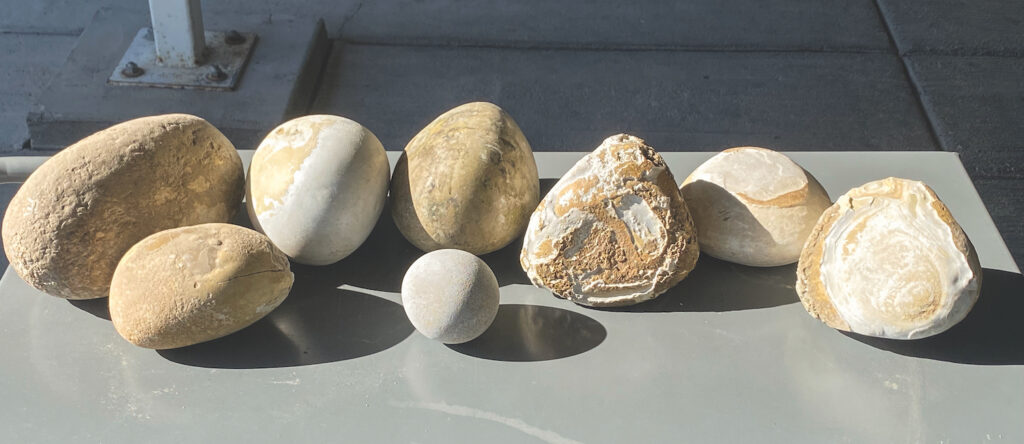
The sight of an enterolith recovered from a horse’s intestines is shocking, often due to the size of the growth, which can tip the scales at up to nine pounds. But what are they made of? How do they form? Are they harmful? Can they be prevented? Barrel Horse News asked Schur to share her expertise on this strange phenomenon that affects many horses each year.
What Is An Enterolith?
In a nutshell, an enterolith is a concretion made up of layers of magnesium-ammonium-phosphate caused by an irritant in the horse’s body, and located in the horse’s large or small colon.
“It’s literally a stone, but if you open one up, they’re layered like a pearl over a year,” Schur said. “Most of the time they start around some type of a foreign object meaning that something irritates the horse and they start to wall it off. The most common is a pebble of sand, but we have actually found wires, nine penny nails, and roofing staples.”
In Lefty’s case, the enterolith was formed around a farrier nail. Schur says in the big scheme of things, the enterolith may have saved his life.
“If that nail had penetrated his bowel wall, he would have gotten an infection in his belly, ad those are often lethal,” Schur said.
The largest enterolith Schur has ever seen weighed nine pounds, and was the size of a football.
“I’ve taken three pretty sizeable, cantaloupe-size stones our of one horse before,” Schur said.
Who Is At Risk?
Enteroliths are most common in southwestern states like Arizona, Nevada and California.
Schur sees at least a dozen cases of horses with enteroliths a year at her practice in Las Vegas. But she also says she’s removed enteroliths from horses from Texas and southern Utah, and has seen cases in horses from the Midwest, Indiana and Florida.
“They’re not everywhere — if it was a horse in the Northwest, you wouldn’t be thinking about enteroliths because they’re not common,” Schur said. “Places that are associated with hard minerals in our hard water, alfalfa that’s been irrigated with hard water, are the perfect recipe for a stone.”
Symptoms
Signs of an enterolith can vary widely, depending on the size of the stone, says Schur.
“Smaller stones are actually more dangerous, because they’re small enough that they can leave the large colon, which is a bigger diameter for them to bounce around in, to the small colon, which is a very muscular part of the colon,” Schur said. “That’s where piles of manure become fecal balls. If those stones get wedged in the colon, and they can’t pass it, then it can cause a catastrophic rupture.”
If a horse has a stone in the large colon, it may cause repeated bouts of colic every six months for a couple of years, for example. The horse could pass very little manure, or just oil when treated for colic.
Or, the horse could start eating a bit slower, losing weight. Their performance could be affected, they could resist doing the pattern or other tasks they’d normally do because they have an enterolith bouncing around their colon.
In some cases, the first time the horse colics due to a stone, the stone is wedged into the colon and no manure can be passed because it’s blocked, even with the administration of gastric laxatives.
“The ones where the stone is small enough to move into the small colon, those horses will get in trouble a lot faster,” Schur said. “Those can even have a catastrophic rupture by the time we see them.”
Sometimes an enterolith can be felt in on a rectal exam, like in Lefty’s case, or they can be spotted when the abdomen is radiographed.
Thigpen had recently purchased Lefty, and said he hadn’t had any problems with him.
“The guy I bought him from said he had had a minor colic here and there, but nothing that as a big deal,” Thigpen said. “Dr. Schur told me that the size of the stone meant it probably had been growing for three or four years, and he was only seven at the time, so he got it when he was pretty young.
Treatment
If a stone is small enough, some horses pass them in their manure. But Schur says for the most part, horses require surgical removal of enteroliths.
“If it’s a good size enterolith, it’s likely not passing without surgery,” Schur said.
Enteroliths can’t be removed without surgery, and they aren’t dissolvable within the horse like a kidney stone, Schur said.
“Anything I could give them that would dissolve a stone would also dissolve their intestine,” Schur said. “They’ve taken stones and set them in straight hydrochloric acid, and nothing happens. One they’re there, they’re there.”
The good news, a surgery to remove an enterolith has one of the highest success rates when it comes to stopping a bout with colic, Schur said.
“With the exception of cases where the enterolith has been there a while and may have torn up the colon, once you remove an enterolith, the horse immediately feels better,” Schur said.
If your horse has had an enterolith, your veterinarian will most likely suggest diet changes to reduce chances of having another surgery five or 10 years down the road.
Although Lefty was not a high-dollar horse, and surgery is expensive, he was a good horse for the Thigpens. They decided to go through with the surgery, and it was successful. The gelding went on to carry Julie Thigpen’s daughter Erica on to high school national finals in breakaway, won the collegiate regional finals and competed at the college national finals together. Even today, Thigpen’s daughter is competing with him at pro rodeos.
“Lefty never looked back,” Schur said. “He did fantastic. At his very first rodeo back to work, [Erica] won the breakaway on him, and sent us a picture of the buckle with his stone and the buckle right next to his stone. It’s such a fun story. He came in for a very routine appointment in the morning, and left five days later with a suture line on his belly and a very expensive paperweight.”
Prevention
If you live in a region where enteroliths are prevalent, Schur recommends keeping alfalfa hay a minimum in your horse’s diet.
Control the sand your horse consumes, or feed a supplement to keep that sand passing, Schur suggests. This will reduce irritants that could turn into enteroliths.
Keep your barn area uncluttered and free of roofing staples, farrier nails and other detritus that a horse could ingest.
Schur says there’s been some reports of success when reducing the pH of the horse’s hind gut by making it a bit more acidic, which can in turn make it more difficult for stones to form. She suggests giving your horse apple cider vinegar, two cups daily over hay or grain, for this effect.
“You can’t dissolve a stone once it’s there, but you can help prevent them,” Schur said.