

Barrel Racer Reviews
Professional barrel horse trainer and clinician Dena Kirkpatrick is familiar with bits used in other timed events such as roping, but the self-titled “snaffle mouthpiece gag bit queen” says she has generally stuck to using jointed mouth pieces traditionally seen in barrel racing. She never would have considered a ported bit to train in, until she met Edwards.

“Honestly, I was very skeptical in the beginning because I thought it would stiffen my horse, and I thought it wouldn’t work for me,” Kirkpatrick said. “I didn’t think what the reiners were using would translate to barrel racing, because they’re very different sports. But I’m not closed-minded either—you better not be if you’re going to continue learning in this world. So I tried them and listened to Jim, and I took some home with me.”
Kirkpatrick tried to use a ported bit on her horse Kates Always First in the past, because the mare’s mouth is so sensitive. But Kirkpatrick still preferred a gag bit with a twisted snaffle mouthpiece on the daughter of First Down Dash.
“She is like a rocket, so finding a good bit to help control her speed without her flinching away from the pressure in her mouth was super tricky when she was younger,” Kirkpatrick said. “The ported roper bit helped a little but still wasn’t quite right. It was a no-brainer to try one of Jim’s bits on her.”
Edwards worked with Kirkpatrick to find the right bit for “Kate,” and Kirkpatrick says the mare feels better than ever. She uses Edwards’ rope gag bits on her younger horses and prefers his non-palate pressure, ported slider-shank bits on a regular headstall for mature horses.
Introducing a New Bit
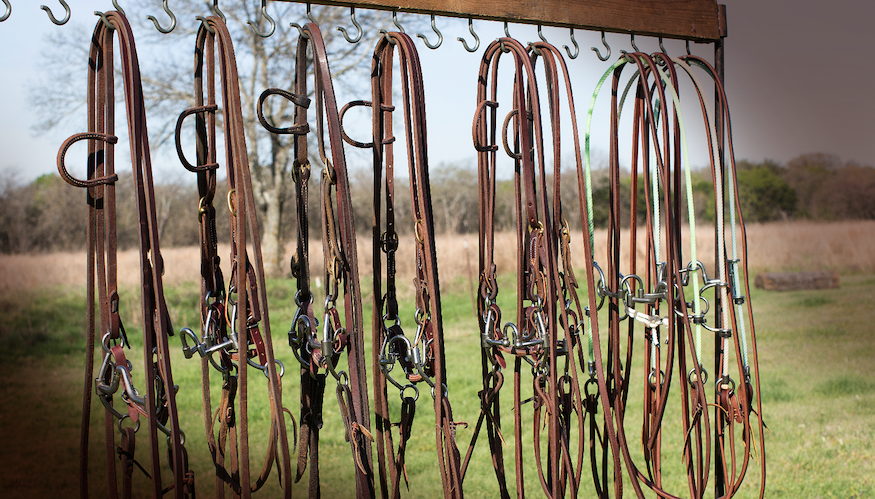
Edwards travels to competitions and out to ranches with a selection of bits. If you work with him, he’ll start out with a fairly mild bit and let you try different styles to find the right one. He recommends trying several bits on your horse before settling on one.
“Until you’ve tried the bit on the horse, you don’t know which bit that horse needs,” Edwards said. “If you go buy a pair of jeans or boots, you’re going to try them on before you buy them. I think that principle needs to apply to bits, too.”
Kirkpatrick advises riders to learn how your chosen bit is meant to affect the horse. What are the pressure points? How does it activate? What results can the bit encourage?
“Some people change bits and don’t think about how the change affects the horse—the movement of the curb chain or the gag-bit action, the angle of the shank,” Kirkpatrick said. “You need to understand how the bit works in your horse’s mouth.”
Barrel racing trainer Jane Fambro switched to using ported bits after meeting Edwards 10 months ago. She says after talking with him about the anatomy of the horse’s mouth, the push for a ported bit made sense to her. She has found gag bits with a port and no palate pressure to be the best fit for her in training.
“I feel I’ve had a lot of success over the last six months taking older problem horses that have had every bit tried on them, go back to softening and relaxing in a [non-palate pressure] rope gag,” Fambro said. “The gag action means they don’t have anything to brace against or get mad about. I can break them at the poll and get them soft in the face so much easier and faster. They figure out it’s awesome; they’re not worried about getting defensive about their mouth, and they come back to the pattern a different horse.”
Ported Bits in Competition
Edwards says it’s very important to introduce a ported bit in the training pen first and get the horse working well before you ever take it to competition.
After working with Edwards’ bits for the several months, Kirkpatrick says she still uses some of her regular barrel racing bits on some of her horses in competition, but she tunes all the horses in several of Edwards’ non-palate pressure gag bits.
“I have found I can get my horses more responsive to the bridle with less work on their mouth and my arms,” Kirkpatrick said. “Currently, I still use a wide variety of barrel racing bits in competition—everything I’ve always used. I have only been experimenting with Jim’s bits a short time, but I have found I can get my horses up under themselves, control their shoulders, flex, break at the poll and soften up in every way I need in a fraction of the time, with a fraction of the stress. Then I may stick my other bits on for competition, for different reasons, but the horses still do better because they were tuned up and softened in a bit they were comfortable in. They seem to manage their bodies better and aren’t bracing against me.”
For competition, Fambro prefers an uncomplicated ported shanked bit.
“They are easy,” Fambro said. “They fit my training style—I just go in there, bump one time and keep my hand forward to follow the horse’s nose around the barrel. These bits work great for that.”
Caveats
Kirkpatrick feels there is potential to misuse any bit, and it is the rider’s responsibility to learn how to effectively and safely communicate with their horse. Improvement in horsemanship and communication should be an on-going task for every barrel racer, no matter what bit you use.
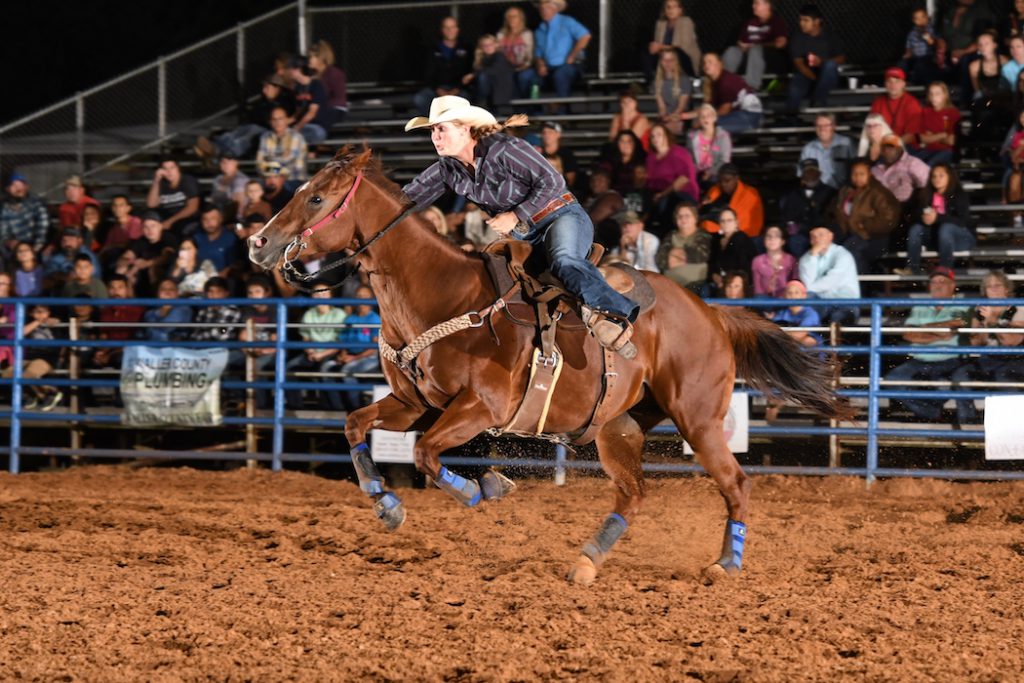
“A good rider should strive to have a feel for the horse so you don’t pull on the horse at the wrong time,” Kirkpatrick said. “You want to shape him up going in, and release as you go into the turn. On the backside of the barrel, depending on your horse’s level of training, you’re going to want to help him finish the turn. If you’re riding in a bit with a curb, you need to carefully give him a little bump to get his nose around. If you start pulling and hang on his face as you go around the turn, he’s going to freeze up. It kills that smooth motion, right when they need to be reaching out and leaving the barrel.”
Kirkpatrick says strong hands with a ported bit will make the bars of the horse’s mouth sore and dull the horse’s response.
“If you don’t know what you’re doing and are harsh with your hands, even one of Jim’s bits can hurt the horse,” Kirkpatrick said. “It might not hurt the tongue, but it’ll make the bars of the mouth sore, and you’re going to pay the price. You need knowledge about your equipment.”
Fambro says she’d recommend a ported gag bit to riders with an experienced hand but cautions a greener rider to learn how any bit is supposed to work before trying it and to always seek help from an experienced professional if you are unsure.
“You must have feel for a gag-style bit—there isn’t much ‘whoa,’ so it can be dangerous if you’re not used to how it works,” Fambro said. “I would recommend a slider shanked, non-palate pressure port bit for many kinds of riders.”

Meet the Experts
Jim Edwards has more than 30 years’ experience designing bits for performance horses. He has worked with a variety of horses in several disciplines. Dissatisfied with conventional bridles available, he began designing his own bits to improve his horses’ performances based solely on the horse’s point of view. World champion competitors in cutting, reining and pleasure horse competition have found Edwards’ bits to be an important key to their success. In the last two years, he’s expanded his bit designs to include bits ideal for ropers and barrel racers. All his bits are produced at his shop in Blum, Texas, with the help of his wife, Elaine, and son, Austin. Find more information at jimedwardsbits.com.
Dena Kirkpatrick is a professional barrel horse trainer and clinician from Post, Texas. She is one of the industry’s top trainers, ranking in Equi-Stat’s top 10 futurity trainers from 1995–2005. She still holds the record as the only horse and rider combo to win all three go-rounds of the Barrel Futurities of America World Championship Futurity in Oklahoma City. Kirkpatrick now focuses on professional rodeos and seasoning aged horses, along with conducting barrel racing clinics worldwide. Kirkpatrick and her husband, calf-roping horse trainer Cliff, have two daughters, Sarah and Hannah, and a new grandson, R.C. Tofan.
Jane Fambro of Stephenville, Texas, has been training barrel horses for 10 years. She owns and trained the 2016 United Professional Rodeo Association Horse of the Year, Guys Cash Task. She has qualified for RFD-TV’s The American semifinals and has competed at the UPRA and Cowboy’s Professional Rodeo Association finals the last two years. She is married to Camron Fambro.
This article was originally published in the May 2017 issue of Barrel Horse News.

This is a great article regarding educating yourself and choosing bits carefully for your horse!! I love the fact that Jim makes all of his bits .