
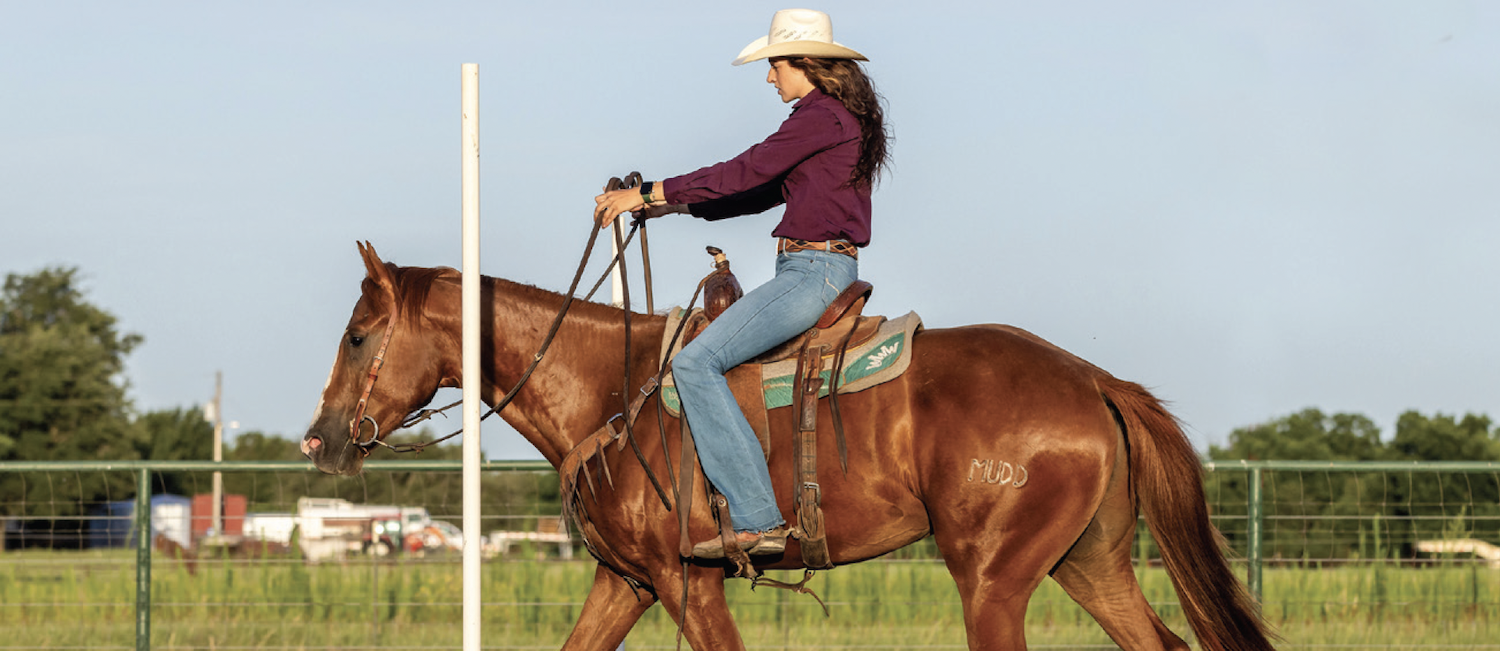
Teach your horse to hustle when it counts with this square pole drill from trainer Abby Fields.
Photos by Abigail Boatwright
When you start going fast on a horse, you need it to not be afraid of the change of speed from high to low and back up to high speed. It needs to listen and respond when you ask it to turn, even at high speeds. That’s what this drill addresses.
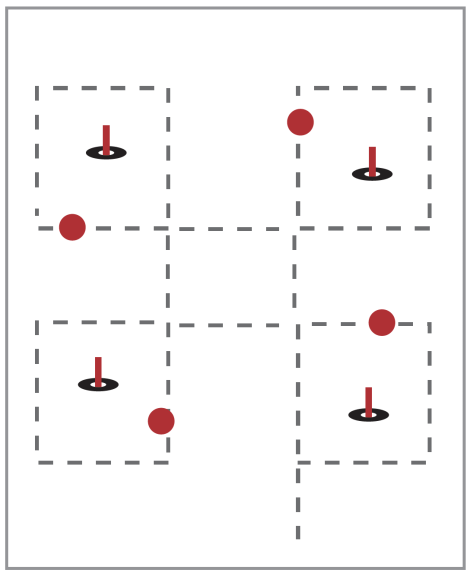
For this exercise, I set up four poles in a square. It’s kind of like a four-barrel drill, but I like using the poles to get away from being on the barrels and use something different. We’re doing kind of a cloverleaf. I focus on sending my horse pretty hard between the poles and pulling it around in the turn. I want them to learn how to stand up and go to the next pole, eventually getting to where they can do it on their own without you having to pull them around.
I do this mainly for colts that need to figure out where their feet are, but it’s a drill I’ve done on all my horses, and I love it. It’s not complicated, but at the same time, it gets them thinking and gets their feet moving.
How It Helps
A staple of my program is brokenness. Some people think they have their horses broke, but they don’t actually go and test it out. I think this is a drill that will show the holes in the horse’s training and what you need to work on.
I use this drill more on a horse that might not be paying attention when its feet start going fast. If you send one across the pen and it’s all over the place, not paying attention to where its feet are, this drill will help. When you send them between the poles and make them go fast, when you go by a pole, you are pulling around it and making the horse start thinking about you instead of just going fast.
It also helps the horse get back on its feet and get balanced. If you have a horse that wants to lean, push out, or doesn’t want to finish the turn, this drill also helps. If your horse is wanting to cheat, you don’t even have to turn the pole, you can just go past it.
There’s a bunch of different things you can do on this drill, but I mainly use it when I want the horse to go fast but still pay attention to me.
The Set-Up
I use four pole bending poles set about 21 feet apart in a square, with one pole at each corner. There’s a certain distance between the poles that makes it really effective. If they’re way too close together, you’re not going to have enough space for the horse to move out and then come back to you. If the distance is too far, you’ll lose the horse’s focus when it is running in between poles.
When to Do the Drill
I do this drill when I’m warming up or when I want to give a horse a break from the barrels. I also do it when I want the horse to pay attention and have to go turn something. If I have one that’s getting really hot on the barrels and just doesn’t want to work the barrels quietly, I’ll go work these poles, and then when I take the horse back to the barrels, it seems to have more respect — when it does go fast, it’ll come back to me.
Equipment
You can use any bit with this exercise. I have a Jim Edwards Mullen snaffle that I like to use, because it doesn’t give the horse something to lean on because it’s a bit wiggly and exposes all of your holes, and then you can fix them.
The Drill
You will be making a cloverleaf pattern. Start by picking an entry point in between two poles — it doesn’t matter which direction you approach the square.
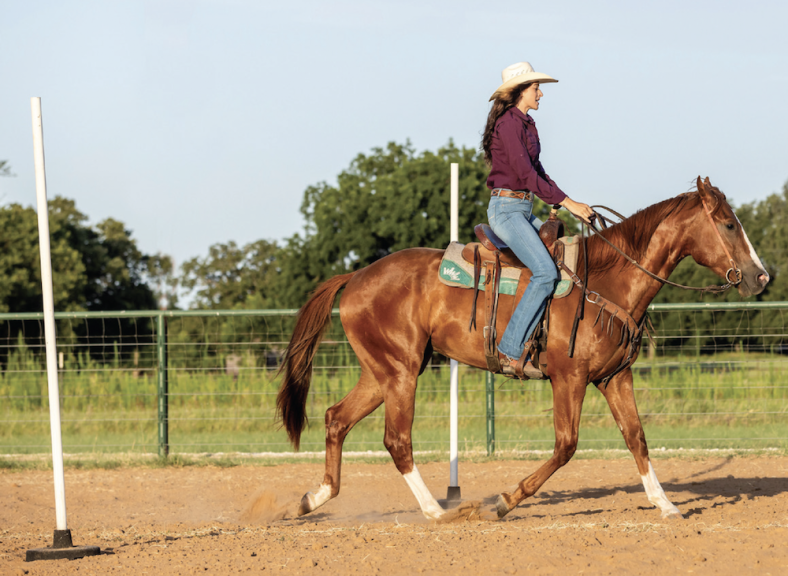
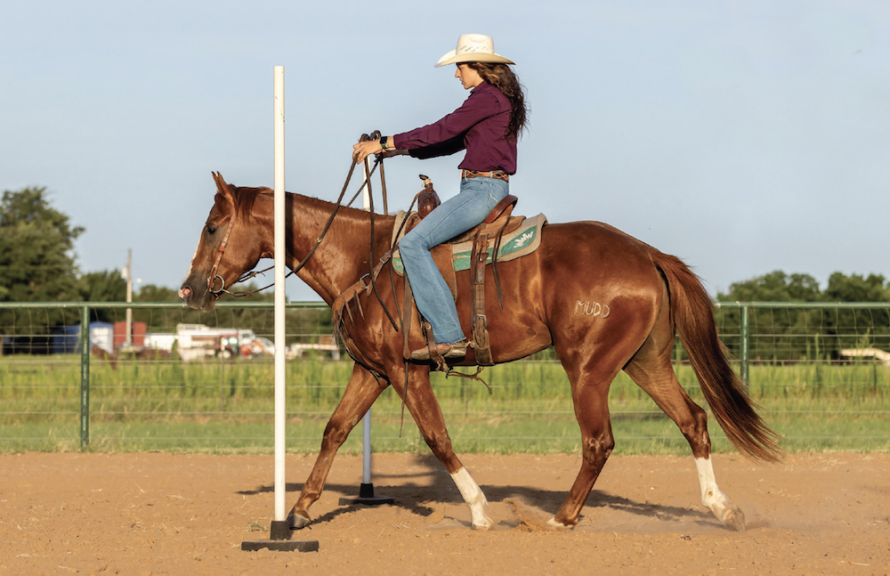
I walk or trot past the first pair of poles to the second set, keeping the horse’s body square. I will continue until my leg is past the pole before I ask them to turn. I don’teven want them to think about turning until my leg, or their hip, is at the pole. If they start the turn when their head and neck is at the pole, that would be too soon.
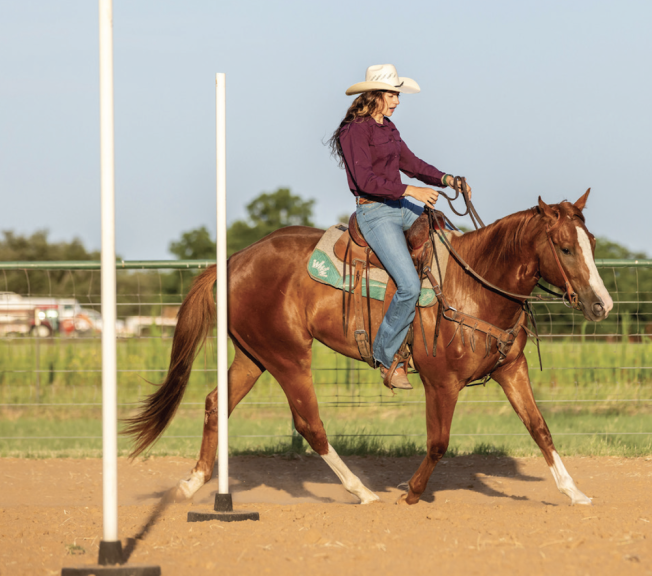
Stay centered and balanced in your seat, focusing on pushing the horse with your body all the way up to the turning point. Once I get there, I cue with my inside rein, drawing toward the next corner around the pole.
If it doesn’t follow my hand and stand up, I will use my outside rein by drawing it across the neck to get the horse to stand up going to each corner. I will then let it turn and come back around, back through the center of the square.
I will keep turning corners around the pole until it responds to my inside rein and stands up, coming across the points square, soft and responsive. I will then send it on to the next pole.
However, if a horse is hot, I will not circle over and over. I give it one or two opportunities at each pole to come back to me and get soft, but if it isn’t paying attention, I’ll move on to the next pole and the next until it starts paying attention.
At the next pole, I will turn again — always turning in the same direction. If you make a right-hand turn as your first turn, keep turning right at the next pole, and the next.
If your horse wants to lean or push out, you can turn around one pole multiple times and get it to stand back up before you go to the next one, and really send it in between.
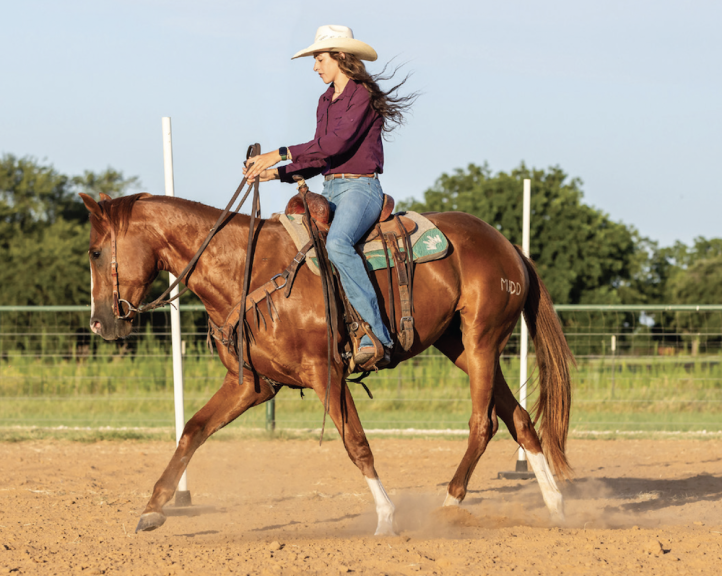
When I feel like the horse is dialed in to me, I’ll stop and reward them for coming back to me. You will then do the drill making turns the other direction. If you have one that really wants to move its feet, then you can let it lope and pull around the turns. If they want to be hot, let them be hot — they’re going to get tired, and it will bring their mind back to you.
If you have one that wants to be lazy and dull, you can really ask them to step up, go faster and move its feet. On those horses, you can start at a lope. If your horse understands the drill and you want to step it up, you can move into a lope.
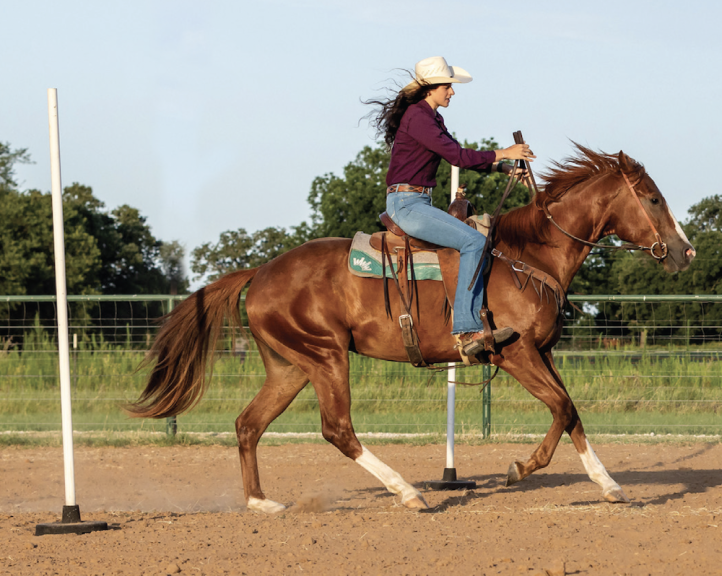
Fine-Tuning
I’ll work on this drill for around 5 to 10 minutes. If I get on a horse and I push it through the poles and it’s listening right away, both directions, I could only take 5 minutes on it. If it wants to be naughty and maybe run off or isn’t listening, it could take 10 to 15 minutes.
You don’t want the horse to get too hot on it; you want to find an ending point. If you have to slow back down to get it paying attention, you can, but ideally, the point of the drill is to get them to where they can fire between the poles, come back to you, and repeat.
But you don’t want to do it for too long, because they could get too hot. I do think you can do this drill too much. If you have a horse that’s a little on the hotter side, a little more free and wants to run off, you don’t want to do this every single day without also slowing them back down to come back to you.
You need to let them have a release or a resting spot, or they’ll get sour to this exercise, which defeats the whole point of the drill. Your goal is to capture their attention using poles to give a break from the barrels.
This article was originally published in the September 2023 issue of Barrel Horse News.