

Working Out the Kinks
Lovendahl spends three to four months fine-tuning a horse’s foundation on the drills. As the pieces fall into place, he rolls out the barrels to test the horse’s progress on the pattern no more than once a week. Once the horse has mastered the drills, however, the pattern takes precedence. At this point, the pattern should be no big deal, Lovendahl says, but whether or not the horse is ready for the pattern depends on your honest evaluation of the horse’s progress.

“I don’t ever put my horses on the pattern prematurely,” Lovendahl said. “If I’m going through the pattern over and over and things are not perfect, then the horse is going to learn everything that is repetitive, right or wrong. Keep that in mind at all times—that may help you to avoid pattern issues before they arise.”
Undeniably, there is a learning curve that applies to even the most promising prospects. When a horse starts to show signs of trouble on the pattern, Lovendahl takes the issue elsewhere.
“If at any time I go through the pattern two times and at some point I had to fix something twice in a row, I won’t go back through a third time. I’m going to set up a drill that I know eliminates that problem,” Lovendahl said.
In taking a step back to work out the kinks in a drill instead of on the pattern itself, the colt is far less likely to develop anxiety on the cloverleaf.
“I can fix it with a drill and they never splice that into a particular part of the pattern. On the drill, they learn to focus on your hand or your body cues instead of the barrels and pretty soon that’s all that’s on their mind. When you go back to the pattern, it just adapts right in there and whatever issue you were having just goes away. If you try to fix it on the pattern, you’re creating a spot for that horse to really notice,” Lovendahl said. “It’s like when you see somebody’s horse get scared of something and the rider spurs him up to it, pretty soon that horse thinks, ‘Shoot, the next time I see something like that, he’s going to spur the heck out of me.’ Once again, it’s about understanding the thought process of the horse.”
Dodging Disaster
Perhaps the two most common problems Ryan Lovendahl sees on the barrel pattern both stem from a shaky foundation.
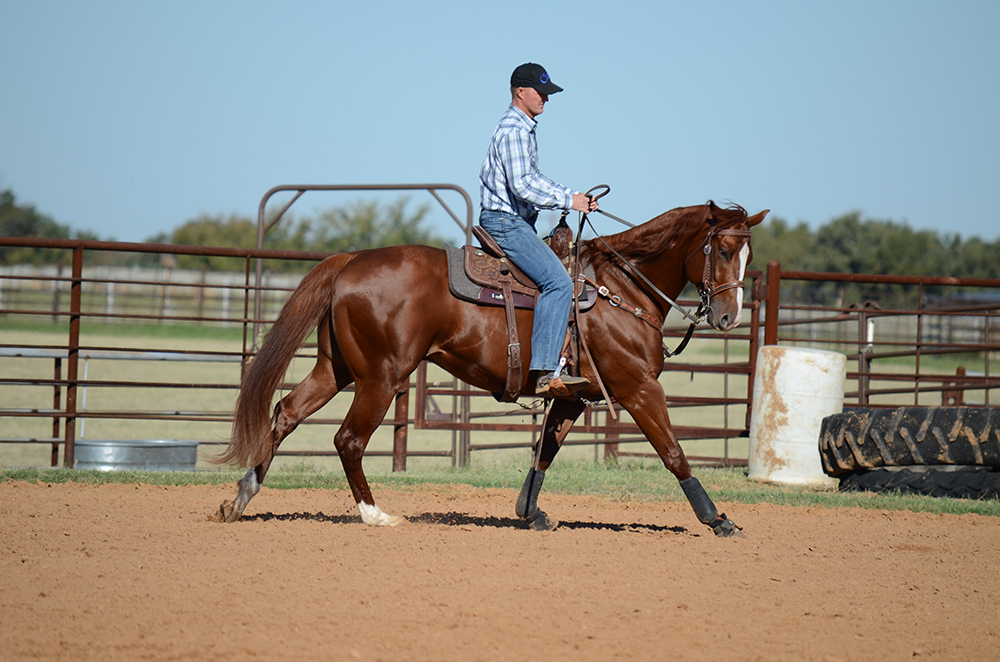
Ducking: “One of the main reasons a horse ducks is because he’s not broke well enough to the inside rein,” Lovendahl said. “Most horses get shorter the more we run them. When that happens, without the inside rein as a tool, a rider will try to steal a run by snatching that outside rein to keep their horse going in a straight line. On this type of horse, instead of moving forward when you pick up that inside rein, he leans into that pressure and cuts you off and will ultimately end up ducking in front of a turn or hitting a lot of barrels. Once a horse has ducked, it’s like a drug; it’s one of the hardest problems to fix. So one of the most important ways to avoid it is to teach the horse that when your inside hand is up and against the inside of his neck, he needs to continue on a straight, forward path until he’s told otherwise.”
Drifting: “A horse that drifts is getting too round in a turn, and that’s usually because he has never learned to respect the cues on the outside of his body. You’ve got him well-broke to the inside, but when it’s time to run him, he feels “noodle-y” on the inside and he moves right through your outside leg and outside rein,” Lovendahl said. “That’s your clue to start cleaning up the outside of the body. A horse shouldn’t push on your legs like they shouldn’t push on your reins. I’m going to put a little pressure in my outside stirrup and pull with my inside rein, which is going to apply pressure to the outside rein, as well, and that’s going to bring the outside of his body with it. A counter arc is an exaggerated way to teach a horse to pick his shoulder up and get off of an outside rein while also teaching him neck-reining cues.”