

Precision on the Pattern
In the first installment of this series, which appeared in the February 2014 issue of Barrel Horse News, Lovendahl emphasized the importance of establishing incentive for a horse to work on its own. Adding barrels into the mix takes this concept to the next level. When performance on the pattern pays, precision comes into play.
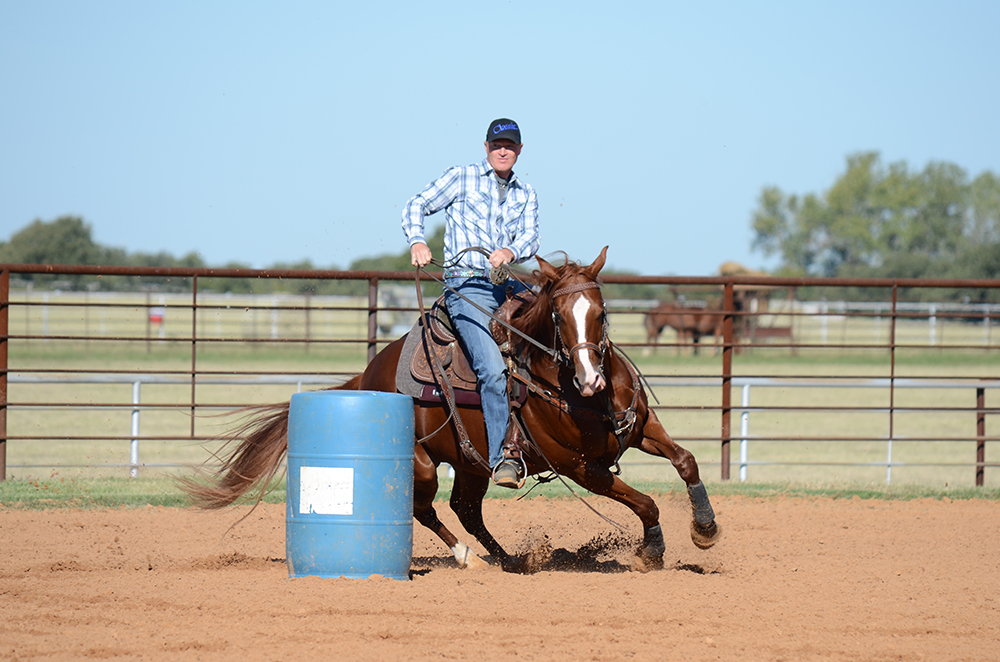
“I’ve been to rodeos where the girls have to start from a corner gate,” Lovendahl said. “If you’re on a patterned horse that is used to coming in the exact same spot, when you have to run him from another starting spot, you’re going to be in trouble. You’ll hear someone say, ‘My timing was off,’ but to me, it isn’t that you’ve taught a horse to go to the exact same spot every time, it’s that he’s so precise with your hand and your leg cues that he’ll go anywhere you want, precisely.”
Lovendahl says if your horse is broke enough and trained through consistent cues, you should be able to point him at any spot and expect him to listen.
“If you want to run in there full blast and take him all the way to the wall, he really should go to the wall. A good horse is going to give you trouble about going to the wall, but you should be able to get it done without too much of an argument,” Lovendahl said. “So for me, precision is more about how broke they are and how precise they’re listening to your hand, and then of course being extremely consistent with the pattern.”
For Lovendahl, that consistency comes easiest when a horse can comprehend his cues. Rather than trying to keep a colt guessing, Lovendahl works with the horse’s thought process.
“I don’t want to go extremely wide around a barrel one time and then turn it tight the next; you’ve got to have some kind of balance so the horse isn’t frustrated and confused,” Lovendahl said. “Instead, if I trot up there and he gets onto my hand a bit, I’m going to pick up on him harder to say, ‘No, don’t get onto my hand.’ I won’t usually have to go far, but I’m going to go as far as it takes until he gives up and gets off of my hand. Pretty soon, he’s going to give up a lot sooner because he understands how to get away from your pressure.”
While he admires an honest work ethic in a horse, it must be kept in check.
“As soon as a horse takes over the reins and says, ‘I’m going to do this all on my own,’ he’s getting ahead of you. Ultimately, our horses do run barrels on their own, but they need to allow you to help them,” Lovendahl said. “One of my pet peeves is when someone is selling a horse or telling you how to ride their horse and they say, ‘You can’t touch his face,’ or ‘He doesn’t like you to handle him, you just have to put your hand down and let him go.’ I think nine out of 10 runs, even on a good, finished horse, you’re going to have to help him somewhere. If he’s not broke enough to allow that, you’re not going to have that precision. It’s going to make for a lot of inconsistency and the biggest place that gets you into trouble is when the ground is bad.”
Precision is required on the rider’s part, as well. Even the most basic horsemanship has implications that are magnified when speed is added to a run.
“The reason you sit down when you’re teaching a horse to stop is because when he stops, you want to be stopped first, not second,” Lovendahl said. “You need to remember that in your rate, too, because when the horse gets in the ground, if you’re not in the ground first, you’re going to get pitched forward. When you get pitched forward, the horse is going to follow you forward and end up on his front end before you get to the turn. It’s the same thing when you leave a turn; you want to be up and forward before that horse is or you’re going to get pitched backwards and the horse is going to have to drag you through the turn and it’s going to be a lot slower. You make the first move and let the horse follow underneath you, because if you’re second, you’re late and that’s going to show up on the clock.”
Read more in the final installment of this three-part series in which Ryan Lovendahl takes us through exhibitioning and the first year of entering.
Meet Ryan Lovendahl
Ryan Lovendahl grew up in Bluffdale, Utah, with six siblings and an enduring interest in horses. From his first hard-earned trophies at the age of 3 aboard a Western pleasure horse to the stepping stone that is 4-H and on to a collegiate career as a calf roper, Lovendahl honed his competitive nature. After college, he went to work for Noel Skinner, a renowned reining horse trainer, and had a hand in the training of Jerry Lees Surprise, the 1996 National Reining Horse Association Open Derby Champion.
“I had a pretty major background,” Lovendahl said. “I got to ride around some pretty awesome reining horse guys that I think gave me a really good foundation for how to get a horse broke outside of the barrel pen. But it never grabbed a hold of me like the speed does.”
Armed with the influence of a Talmadge Green clinic, Lovendahl went on to become one of the first men to barrel race competitively in the western United States when he turned his calf horse into a barrel horse and found immediate success in the amateur and novice classes. He then went to work for Talmadge and Mike Green before starting his futurity ventures. These opportunities eventually led him to Busby Quarter Horses, where he currently heads up the barrel horse program.
“It takes a good team to get multiple horses trained and KC Groves has been my assistant trainer for 15 years. He plays a big role from getting these horses started to the point where I can compete on them. He takes on the tough jobs with the greener horses and he does great work with them,” Lovendahl said. “We are so excited to be involved with Busby Quarter Horses; they give us the best working conditions and provide optimal care to some of the most amazing horses in the industry.”
Danika Kent is a former managing editor of Barrel Horse News. Email comments on this article to [email protected].