

In Part Two of a two-part series on drills, Charmayne James presents a few useful barrel racing drills you can practice at home.
I explained last month about how drills can fit into your training and conditioning program and why drills are helpful for horse and rider. A few key takeaways are No. 1, drills help you hone your fundamentals and the controlling mechanisms you need during a run; No. 2, drills help you develop muscle memory of correct riding and your horse’s muscle memory of where to place its feet and how to use its body; and No. 3, drills help train your horse in a fun, different way without repeating the barrel pattern over and over.
This month, I want to share a couple of my favorite drills that you can practice at home: the Six-Barrel Drill and the Micro-Pattern Drill.
The Six-Barrel Drill
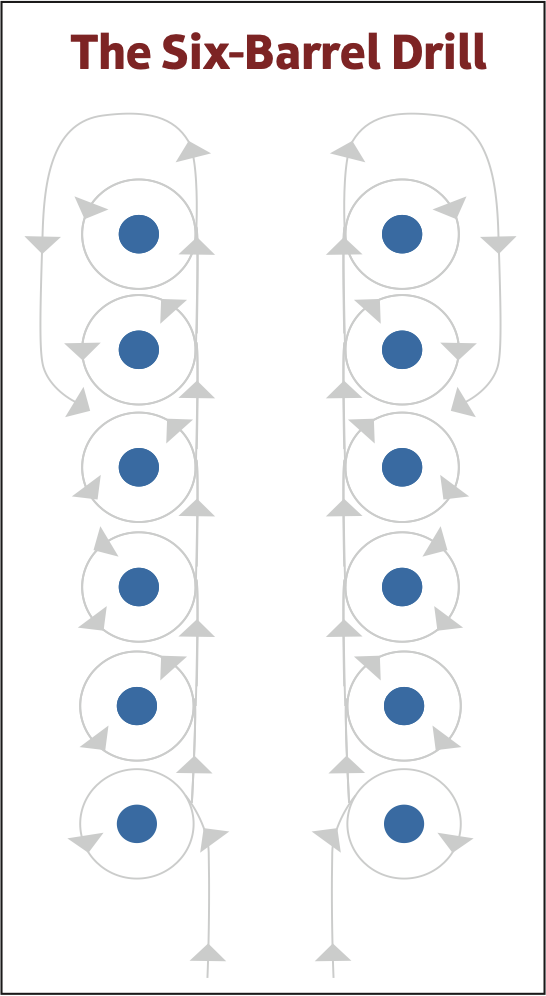
The Six-Barrel Drill is a popular one that we do at my clinics. Ideally, you’ll need 12 total barrels for this one — six in a row down each long end of the arena — however, you can set it up using fewer or as many barrels as you want, as long as it’s even on both sides. I don’t like to use cones or poles for drills, because I think horses need to learn their positioning around the barrels, just because of the size. Barrels are not small, and I think that makes a big difference and directly applies to how they need to turn in a competitive run.
I like to do this one at a lope. You’ll turn each barrel in equidistant circles going the same direction down the line, then switch directions for the other side of the arena.
Take off in a straight line and lope once around the first barrel in line, then continue to the next one, making even circles around each barrel — a young or greener horse may need more room around the barrels. Slow down slightly for the turn to shorten the horse’s stride, just keep it real basic, and them guide a street line to that next barrel. Continue until you get to the end barrel, then work your way back down, circling each barrel again and keeping a straight line in between. When you’ve gone down and back once, go to the other side of the arena and go down and back the other direction.
Practicing that straight line or angling out a bit is huge. If your horse is starting the turn too early or you’re crossing your hands over the neck in a run, this drill is a great opportunity for you to learn to ride square with both reins, keeping your hands wide, your horse’s nose down, not speeding up, just controlled and collected loping through there. Because there’s so many barrels, you have plenty of opportunity to develop that muscle memory and feel of riding correctly into a turn, and your horse will start to loosen up and think it’s fun when they’re not getting picked on. They begin to enjoy it, and now you’ve just worked your horse and he doesn’t even really know it.
There’s a few things as a rider you can work on throughout this drill:
- Eyes. Many riders have the tendency to look down the sides of the horse rather than straight ahead. Think about the windshield of a car; you don’t look where you’re going out the side window. Work on looking over your horse’s head, because it greatly affects your weight and how its shifted in the saddle. When you’re doing this drill, look out in front of you on a straight line, and in the turns look at the road ahead of you about a quarter of the way around the turn.
- Hands. I ride this drill two-handed. It’s important to get comfortable riding both one-handed and two-handed, keeping even pressure on the reins in a straight line and each hand on their respective sides of the neck, never crossing over. Most barrel racers have gone overboard tipping the nose; I want my horse’s face soft and the nose tipped slightly around the circle but not overbent to the inside.
- Seat and feet. I’m sitting square in my saddle, not leaning forward or backward or to one side, and sitting down on my butt. I put some weight in my stirrups, and I’m constantly moving my feet a little to keep my horse pushed into the bridle. If you feel their body bending out too much or you have too much nose, I’ll pay attention if I need to tighten my outside rein or put a little outside leg pressure on. I will use inside leg if I feel like the horse is locking me out or not wanting to give in the face. But my feet are always moving, just bumping here and there. Don’t automatically kick or dig your spur if the horse locks you out or floats away; ask for a little first and if they don’t respond or are ignoring you, then use more. Typically, most horses figure out what you’re asking. You’re teaching by pressure and release, taking, giving, taking again, giving, so that’s how they figure out what you’re asking of them.
The Micro-Pattern Drill
Another thing we implemented at the clinics is setting two or three mini patterns in one arena. You can set them
up sideways in your arena and come at them from different directions. Changing it up like that and making it smaller helps horses that may have developed habits in your main arena that are carrying over to competition.
You can also have three different sets of them, two in your main arena and one somewhere else, even in the pasture, and just go through each one of those at a trot or lope. I’ve seen some great things come out of that, because the smaller pattern gets their attention and gets them listening, which is great for seasoned horses to change things up and break habits or for colts that need help focusing on their job.
It’s OK to Make Mistakes
If I make a mistake as a rider or the horse makes a mistake, I take that opportunity to just go on and get it at the next one, but I’m also ready for it to happen and thinking about why — did I do something with my hands? Am I anticipating or clenching in my body or hands? It’s OK to make mistakes, but it’s crucial to pay attention to what led up to the mistake so you can take action.
I’m not picking on my horse for little mistakes, because I don’t want to make it a bigger issue. Eventually, especially in the Six-Barrel Drill because there’s so many opportunities to keep going without picking on the horse at the same barrel, you’ll get the horse to open up through those drills to where it becomes effortless. The last thing you want is a horse that’s nervous and on the fight, especially if you’re trying to fix something. If you can stay relaxed and get a horse in really good state of mind, that’s where the best learning takes place.
Work on it a little every day, because you can’t make things perfect in one day. Drills are about continually building so you can have that same smooth, effortless feel when you get on the barrel pattern.
This article was originally published in the June 2023 issue of Barrel Horse News.