
Lasix and Nasal Strips—The Performance Enhancers
The rapid amount of fluid and weight loss caused by Lasix is a main reason why its use is illegal in many countries outside North America due to its performance enhancing properties as well as its potential to be used as a masking agent for other performance enhancers.
 Nasal strips open the horse’s airways during exercise, allowing the respiratory system to circulate oxygen quickly to the horse’s muscles with less effort and strain. Photo by Danika Kent.According to the Merck Veterinary Manual online, studies have shown that Lasix improved the performance of horses equally among bleeders and horses that had never bled, indicating that Lasix improves performance for reasons other than the reduction of bleeding in horses with EIPH.
According to an August 2006 article in the Equine Veterinary Journal Supplement, a study conducted by the Washington State University College of Veterinary Medicine allowed some horses dosed with Lasix to lose weight, while others were burdened with an equivalent amount of weight lost due to drug administration. The findings showed that improvement of performance was due more to weight loss than an improvement in the severity of bleeding.
The use of nasal dilator strips is another treatment option available for those who do not like the idea of injecting their horses with Lasix or other medications.
Epp says because horses are obligate nasal breathers, they experience some level of nasal collapse during heavy exercise, resulting in a reduction in airway size and causing a horse to work harder to get oxygen.
Erickson says nasal strips don’t work on the vascular pressure as much as they work on the airway. He says the nasal strip is a valuable alternative for attenuation of EIPH, given the purported ergogenic effects of Lasix.
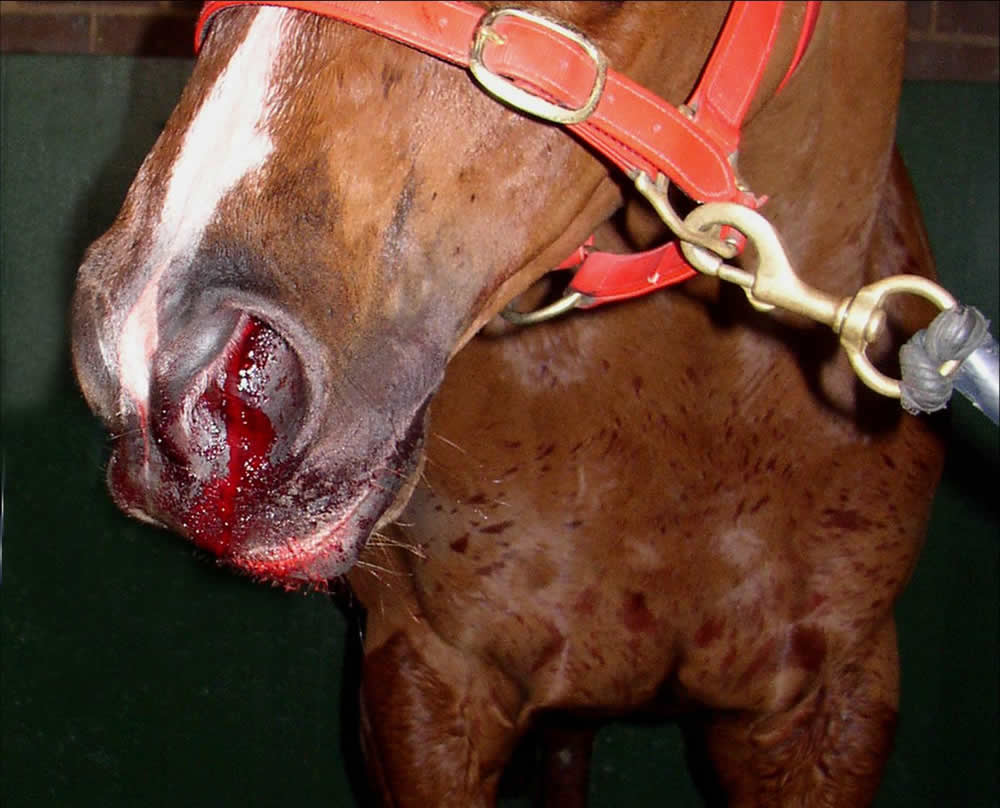
“There’s a part of the nasal passage that’s not supported by bone, and when a horse inhales, that constricts in,” Erickson said. “That creates large negative airway pressures down within the pulmonary circulation, and that tends to cause rupture of the capillaries. We have confirmed the benefit in particularly heavy bleeders. Horses wearing the nasal strip returned quicker to competition than horses that did not.”
A study published in the November 2001 Equine Veterinary Journal conducted by Kentucky Equine Research, Inc., showed the external nasal strip appears to lower metabolic cost of extreme exercise in horses.
“We found it allows the horses to breathe the same amount of air, but their respiratory muscles don’t need to work as hard to do that because of the dilation of the nasal passages, so that allows more oxygen to go to the working muscles,” Epp said.
Results of a University of California at Davis study conducted by Sandra Valdez found the heaviest bleeders showed the most improvement when using nasal strips.
“The nasal strip was kind of the opposite of Lasix,” Epp said. “It was about 33 percent effective at a lower level of exercise, and as the horses began to work harder, it became about 50 percent effective, so it became more effective as the horses worked harder.” Nasal strips become more effective as a horse works harder, making them a viable alternative to Lasix for heavy bleeders. Photo by Danika Kent.
Concentrated Equine Serum, also called Seramune, is a product used to treat Failure of Passive Transfer in foals that many veterinarians are now using to treat EIPH, Erickson says. CES is a product taken from several draft horse donors that contains high levels of immunoglobins and other serum proteins.
CES resulted in a 53 percent reduction of red blood cells and a 32 percent reduction in white blood cells, according to BAL results, Erickson says.
Based on results of a study Erickson conducted at Kansas State University, Erickson says CES may have an immuno-modulatory effect and anti-inflammatory effects that are beneficial in the reduction small airway disease, which could be one of the causes of EIPH. It may also improve the healing of lung tissue and reduce scar formation.
Epp says according to the study, CES reduces bleeding by about 50 percent, most likely through the reduction of inflammatory airway disease. However, she says CES took between two to three months to have a measurable effect.
“We think there are some things internally that have to occur for that to be beneficial and take effect,” Epp said.
Hutchins says it’s the extended use of CES before any benefit is seen that likely makes it something most people would choose not to use.
“It’s one of those things that sort of becomes an inconvenience issue, because it takes a fairly large dose to try to be effective,” Hutchins said. “The volume you need to administer and use, I think, can start to be a costly venture for one, and two can be a hassle.”