
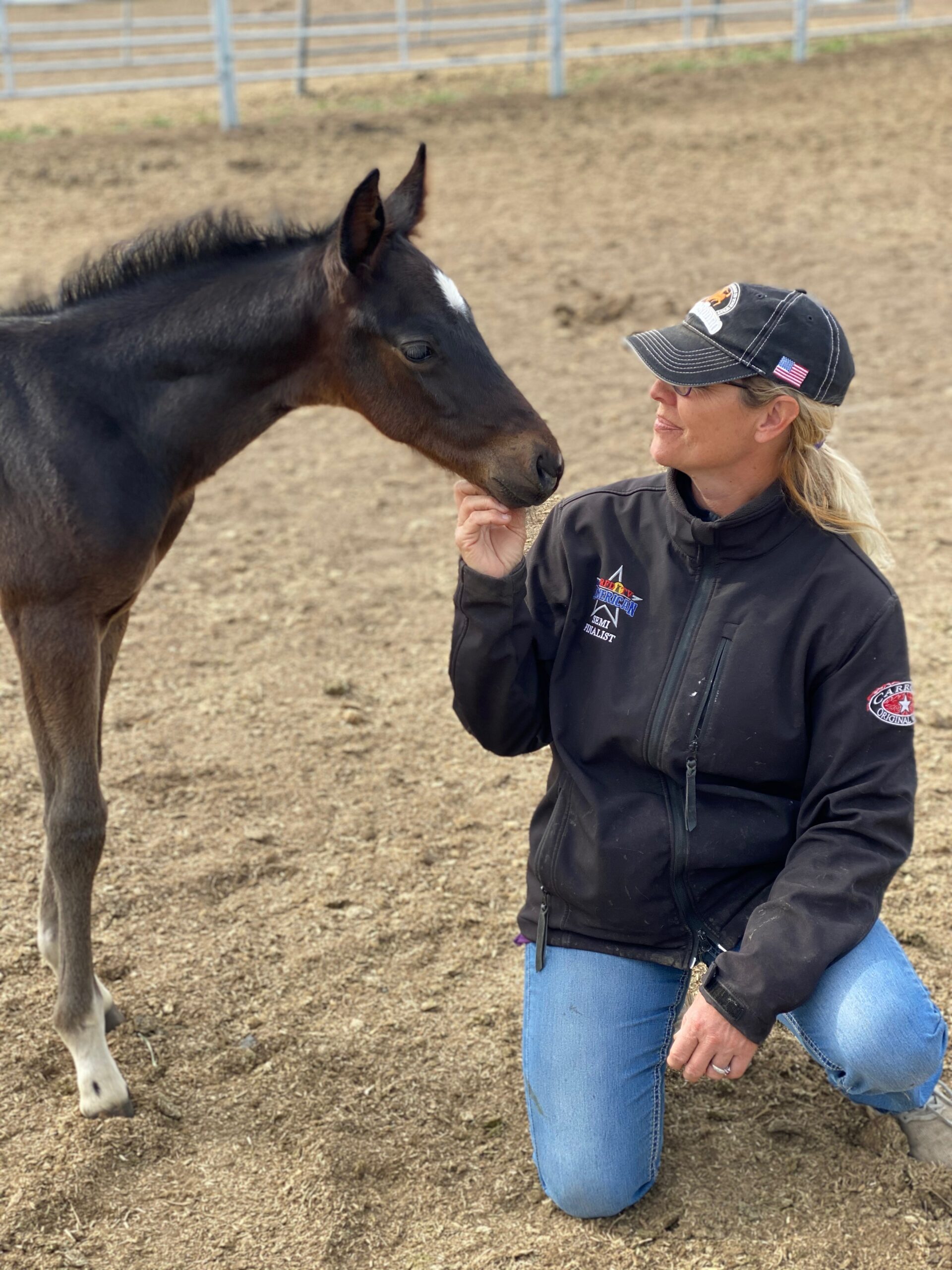
Kathy Grimes built her breeding program, Nine-Oh Barrel Horses, around mare power and speed, learning as she went to fulfill lifelong dreams in the arena.
She was a barely a teenager when she decided she wanted to be a veterinarian, a decision that would ultimately lead to a National Finals Rodeo Qualification on horses she raised and trained. Now, Kathy Grimes continues to breed, train and compete on homegrown horses.
Not only does she love animals, but after pursuing vet school at Washington State University, she found she loved learning about medicine as well. Amid schooling, she started to try her hand at breeding with her family’s stallion.
“My Family had a young stallion—Beaus Scoop Of Sun—that they had raised but none of us had been in the breeding business, and nothing was getting done with him,” Grimes explained. “I was in my junior year of vet school and had a Thoroughbred mare from Washington State’s research program and that was the first mare I bred and first foal I had. It was the beginning of a steep learning curve into the world of breeding, foaling, raising and training barrel horses.”
Mare Power
While in vet school, Dr Barrie Grant, who was Grimes’s mentor through undergrad and vet school, hired Grimes and a few other students to ride racehorses at the research track.
“He was always giving us pearls of wisdom. One of which was when he said the mare is the most important — just look at your own mothers,” Grimes said. “I just filed that away and hadn’t even begun to think about having any kind of breeding program, I just wanted to be a veterinarian.”
After graduating, Grimes was busy starting her career and didn’t have the time or money to find mares to breed to Beaus Scoop Of Sun, who she had started barrel racing on. Her sister was retiring her barrel horse, so Grimes bought her as a broodmare.
“Her name was Jodalito Cielo and little did I know she would become the cornerstone of the ‘mare power’ that I really didn’t understand yet,” Grimes said. “She had four foals with three different stallions — two mares and two geldings — all of them ran a 17.1 on a standard pattern. Once her foals began to excel in the barrel pen, that tidbit from Dr Grant came back to me and I began to understand a bit more about mare power.”
Those four foals were 1998 gelding Mr Sun Dollar by Beaus Scoop Of Sun, 2000 mare Do It For Beau a full sister to Mr Sun Dollar, 2002 gelding Raren To Turn by Raren To Dash, and 2003 mare Winning Gold Chex by Extra Dry Chex.
Embryo Transfer


Grimes lost Beaus Scoop Of Sun in 2000 and Jodalito Cielo in 2004, so she was back to needing a broodmare.
“One of the mares that Jodalito Cielo had was Do It For Beau and she was showing real promise in the barrel pen and I had always wanted to try embryo transfer as opposed to just getting some mares that maybe didn’t have as many accomplishments as the one I was riding,” Grimes said. “In Veterinary school we didn’t even get to use ultrasounds for breeding and embryo transfer was never even mentioned so I was off to continuing education and a whole new learning curve.”
Wanting to use embryo transfer with Do It For Beau so she could continue competing on her, Grimes needed to find a stallion. Before many incentives had formed, there was a local stallion auction through the Valley Girls Barrel Racing Association in Washington. Judge Cash was one of the stallions in the auction. He was Grimes’s top pick because of progeny like Amy Dale-Coelho’s mare Quick Judge and Brenda May’s gelding Judge Buy Cash, both NFR qualifiers.
“In 2006 I had no equipment or recip mares so I drove five hours to go to a facility to do the flushing and utilize their recip mares,” Grimes shared. “The first attempt no embryos were recovered and I was thinking that maybe I should rethink this endeavor. It was a lot of time and money away from what was now still my solo practice, but I had opened a veterinary clinic as well. But I pressed on and tried again and this time Do It for Beau would double ovulate and we got two embryos and both stuck.
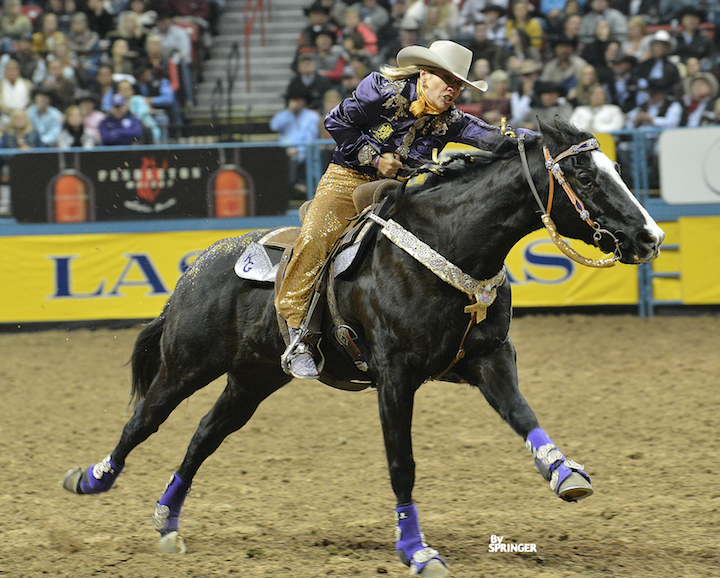
The result were two foals born in 2007— KG Justiceweexpected and KG Cashin In On Beau. Grimes sold KG Cashin In On Beau as a 4 year old to friend and colleague Leslie Schur, DVM to go on an earn more than $80,000. She kept KG Justiceweexpected to train herself. “Issy” was a natural, going on to earn more than $460,000 in lifetime earnings. In 2017 she helped Grimes qualify for the NFR and achieve a goal set nearly 25 years ago. She also helped Grimes to a 2018 The American qualification and the RAM National Circuit Finals twice.
Not only was Issy dominant in the arena, especially smaller indoor patterns, but she now has $637,500 in progeny earnings as well. Do It For Beau has progeny earnings of more than $780,000, with her highest earner being Issy.
“Issy has 24 foals on the ground, 20 of which are of running age,” Grimes said. “12 different sires. She has five foals due in 2025. This is what embryo transfer has done for my breeding program, it’s been a huge gamechanger.”

Breeding Decisions
The second stallion Grimes chose to breed Do It For Beau to was Blazin Jetolena after she had been competing against him and liked his style. The result was KG Blazin Nine Oh who also helped her with the 2017 NFR qualification. She said she likes seeing a stallion compete and seeing progeny be successful when selecting what to breed her mares to.
“Initially I think I had some dumb luck in making decisions for breeding but I’d like to think I have an actual plan for choosing now,” Grimes said with a laugh. “I pick stallions by their ability to complement my mares. If I have a mare that is real turn-y I will choose a stallion with a big speed index. The second mare Jodalito Cielo foaled in 2003 (Winning Gold Chex) was so easy to run, she never got past a barrel and I crossed her on stallions with a big speed index such as Rare Bar, Azyoucansee, Judge Cash and Desirio.”
With a proven program and process, Grimes now stands four of her own stallions:

- KG Do It For Fame, a 2010 chestnut stallion by Dash Ta Fame out of Do It For Beau.
- KG Azure Winnin Chex, a 2010 palomino stallion by Azyoucansee out of Winning Gold Chex.
- KG JustStealingCash, a 2015 sorrel stallion by Judge Cash out of Do it for Beau.
- KG Jukebox Hero, a 2017 bay stallion by Blazin Jetolena out of KG Justiceweexpected, her highest progeny earner with more than $195,500 in lifetime earnings.
Keep or Sell
Grimes learned early on that she could only care for and ride so many horses each day and that the high numbers of offspring from mares being fertile, often double ovulating, meant she needed to sell some she had planned to keep for herself.
“I breed because I think it will be a great cross and I look forward to riding that particular cross but there are also financial decisions that affect who I get to keep and who sells,” Grimes added. “Living in the northwest and traveling to different rodeos and races make it hard for me to get a 4 year old ready to futurity so mine are almost always 5 year olds. There have been a couple that took a little longer to get that consistency, horses don’t know a calendar but since I ride for myself I don’t mind taking the extra time.”

Grimes has her colt starter put 60-90 days on the horse during the summer of their 2 year old year and then she continues on the barrel training process.
“Obviously I really like the ones that are super easy and make me feel smart but I try to tell myself that the challenging ones will make me a better rider and trainer,” she said. “I like to get them ready for futurities, where I live it helps to have deadlines to want to get out in the cold to ride. Depending on their personality and mental stability I’ll start going to some rodeos usually as a 6 or 7 year old in slack before introducing them to the chaos of rodeo performances.”
Breeding her mares with goals of keeping the foals for herself, Grimes knows what she likes to ride and now has a proven program with mares and progeny that have earned money in the arena.
“When I started my breeding program for my mares I picked stallions that I thought would complement them and that I wanted to ride and keep,” she said. “It took several years for me to be able to sell foals and embryos. Nothing happens overnight and there are a lot of setbacks that honestly often outweigh the successes but it has been an amazing journey and I would do it all again. That’s my advice for someone starting their breeding program.”
Her breeding season typically goes from mid March to Mid June and requires 24/7 availability so she fits it between winter and summer futurities and rodeos.
“Last year we bred about 130 mares and manage about 25 recip mares,” she said. “I breed mares to my stallions and ship outside stallions as well.”
Grimes hopes to continue breeding, training and competing on homegrown horses. After reaching her goal of an NFR qualification on homegrown horses, she hopes to continue that in the next generation of her horses.
“Its not just one mare that has mare power but three generations,” Grimes said. “I think that really says something! With a stallions ability to breed hundreds of mares in a single season, there is a lot of opportunity to have some great offspring but when a mare is limited to the number of offspring she can produce even though ET and ICSI have increased that dramatically, I think that is a definition of mare power.”