

Treatment Options
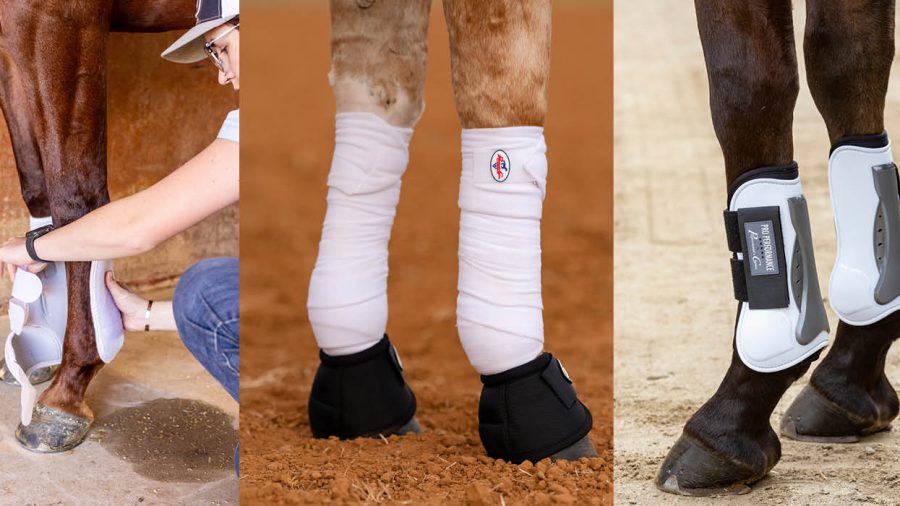
“If you notice one is bigger than the other, initial first-aid treatment would be icing the leg or cold hosing, and wrapping,” Baxter says.
These steps, along with rest and confinement so the horse won’t be using the leg, can help keep the problem from getting worse. Treat it like you would a sprained ankle or muscle injury in a person.
“This is most likely what happened—hyperextension of the fetlock joint, pulling those tendons, or a twist or sprain of structures around the tendon sheath. Along with cold therapy and wrapping, you can also use a topical anti-inflammatory medication such as Surpass. This would be helpful as part of the first-aid treatment. Icing and wrapping are very important early on, especially if there is heat in that area,” he says.
This will often resolve the problem if it’s a simple strain or sprain.
On occasion other problems interfere with normal movement, such as adhesions, synovial masses, or pressure due to narrowing (caused by thickening of the annular ligament located around the back of the fetlock, across the tendons), similar to carpal tunnel syndrome in humans. The annular ligament can be cut, to relieve the restriction.
 Though once viewed as insignificant, windpuffs can provide clues to problems in the tendon sheath. Photo by Gary Baxter
“Sometimes people assume any problem in the tendon sheath or in any horse with windpuffs is an annular ligament problem, but this is not true. The more we learn, the more we find that there are other things that can lead to problems in tendon sheaths other than the annular ligament, and I think fewer surgeries are being done today. We are realizing that surgery is not treating the primary problem and doesn’t fix it,” Baxter says.
McClure says there are several ways to manage tendonitis, depending on the degree of severity.
“Suspensory branch degeneration is a chronic disease condition which is not reversible,” McClure explains. “The tenosynovitis is giving an early clue about a more severe, ongoing problem.”
If it’s an athletic horse the owner wants to try to treat to hopefully recover and continue a performance career, treatment will depend on what is diagnosed and identified with ultrasound examination.
“If there’s an annular ligament issue, we might transect the ligament to release the pressure so the tendon has more room,” McClure says. “If there is a superficial or deep digital flexor tendonitis or inflammation in those tendons, sometimes we just treat the tendon sheath to eliminate the inflammation. There are many things we can use for managing tendonitis, including platelet rich plasma (PRP), anti-inflammatory drugs, etc.”
McClure advises coordinating with your veterinarian to figure out what might work best for your particular horse, and getting a prognosis for the horse following treatment.
“Hopefully the horse just has a mild synovitis which ends up being a simple blemish, and then he will be fine,” McClure says. In such cases, the fetlock joint areas are merely enlarged with soft lumps toward the rear.
“One of the important things to realize is many of the horses that have lots of fluid or asymmetrical swellings may have injury to the deep flexor tendon or superficial flexor tendon within the sheath itself,” Baxter says. “This must be properly diagnosed, because this injury should be treated differently than a simple windpuff.”
Usually a horse with an injured tendon is lame. With an inflamed windpuff there may just be a little heat or swelling, or some discomfort when the swelling is pressed.
“Horses with an increased amount of fluid, with no lameness, can be treated with ice and wrapping. Then if the swelling doesn’t respond, people might consider using an intra-synovial injection such as hyaluronic acid (HA) or a small amount of steroids. That’s fine, but if there is any lameness before you treat with these injections, I would highly recommend ultrasounding the leg in order to find out exactly what is wrong, and not just mask the pain or discomfort with steroids,” Baxter says. “Some of the things people use now are regenerative medicine products like stem cells or IRAP, for instance, and less steroids. We see more use of IRAP or PRP in the tendon sheath, rather than injecting with HA and a steroid.”
“If there is no tendon injury, yet the inflammation is still persistent, you could potentially use regenerative medicine therapies to decrease inflammation in the tendon sheath,” Baxter says. “This could be an option, especially if the effusion is persisting and you feel you have ruled out all the other possible problems.
“In my view, however, there are still a lot of horses that respond well to HA and a little bit of triamcinalon. But if there is a tendon injury, we are less likely to inject a steroid into the sheath, and might treat with something like regenerative medicine products that might help the injury heal, as well as reduce the inflammation,” Baxter says. “We do not recommend repeated injections (HA and steroids) into the tendon sheath. If you have to do this over and over again, you need to look further in order to find the problem. If the windpuff keeps recurring, there is usually a reason, and we need to investigate it further.”
McClure adds that windpuffs are a common condition in hard-working horses, but it’s worth having your vet examine your horse to determine if there’s a deeper issue.
“Many horses develop windpuffs,” McClure says. “Some enlargements appear after a hard day of work, and then the swellings resolve. If the enlargements persist, it may be worth having your veterinarian take a look.”