

Rational in the Round Pen
Lovendahl spends the first 30 to 60 days in the round pen with a 2-year-old, taking advantage of the physical and mental barriers that come with solid walls.
“I feel like the horse has a little bit of security for his own mind, and you have a lot more of his attention when you’re in there,” Lovendahl said. “One of the biggest things right from the get-go is to build a bond for the horse to really rely on and trust that the rider knows what they’re doing. That horse has got to know that whatever you’re asking him to do is not going to get him into trouble, and that will make him more willing.
In the round pen, Lovendahl installs tools as well as trust. In the first two months, his 2-year-olds learn the foundation of his time-tested program. He uses a methodical approach based on an understanding of the horse’s thought process to introduce the basics.
“If I’m stopping, the first step is to sit down, the second step is to say whoa, and the third step is to pick up and ask him to stop with my reins. Pulling on a horse’s mouth is not what he wants,” Lovendahl said. “So if I sit down and say whoa and he still doesn’t stop, I pick up the reins, stop him, and go ahead and get onto him a little bit and back him up. If you’re consistent with those steps, a horse learns that when you sit down and say whoa, the next thing that comes is the pulling on the mouth and backing up. He thinks he can avoid you pulling on his mouth. You have to let him know that’s the truth. When he feels you sit down and say whoa, he’s going to stop and you leave him alone. Now he’s learned to listen to much lighter cues.”
Following this philosophy instills in a horse the incentive to work on his own. Lovendahl applies the same approach in teaching a horse to give to pressure from his reins and legs.
“When you’re teaching a horse leg cues, you have to show him what direction you’re asking him to go. That may be even going forward,” Lovendahl said. “I’m not a big kicker; the only reason a horse ever gets spurred on is because he’s not done something when I’ve asked him or he’s not tried hard enough. As soon as that horse does try hard enough, you’ve got to give it back to him. You can’t just keep kicking on him or he’s never going to see a way out or have any incentive to be better.”
Lovendahl uses this thought process to teach a horse to turn.
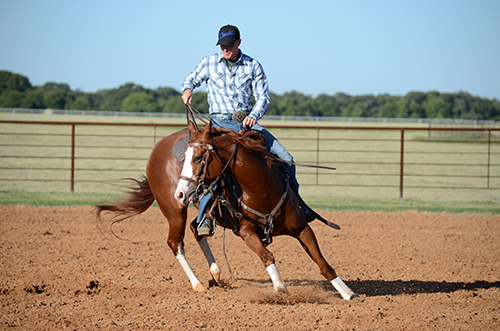
“The turn is going to be the same type of deal. I’m going to pull the nose first, then come with the outside rein, and then I’m going to spur him with my outside leg,” Lovendahl said. “Pretty soon, when you come with the very first cue with the inside rein, he knows the steps that are going to follow and he’s going to come to that inside rein and bring the outside of his body with him, because he knows that if he doesn’t, you’re going to get him in trouble and bring in that outside leg to make him finish. Pretty soon, these horses start to listen to your fingertips because they know if they beat you to the punch, you’ll leave them alone.”
Lovendahl cites this process as the reason his horses stay relaxed and work willingly and consistently at the top of their game.
“They know what’s coming. They’ve got that confidence, and it’s just the same thing they do everyday and it’s no big deal,” Lovendahl said. “But in the same sense, they’ll go in there and give you 110 percent because they know what you expect.”
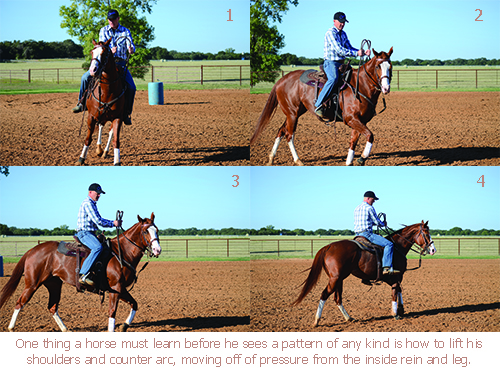
Before leaving the round pen, Lovendahl again turns to the wall to teach his young horses to lift their shoulders and counter arc as they move off of pressure from the outside rein and leg, with the nose tipped in that direction. The solid wall deflects some of the confusion and frustration that may otherwise come with learning the maneuver in a different setting.
“Getting the outside of the body broke is just as important as the inside of the body, and that is going to help with a more balanced turn and keep your horse standing up and safer on bad ground,” Lovendahl said.
Taking the time in the round pen to make these tools second nature to his horses translates to fewer steps backward should he encounter issues on the pattern later.
“The round pen gives a horse a little bit of guidance from the walls so you don’t have to immediately start pulling on his face. It’s not for safety reasons; it’s for mind control,” Lovendahl said. “If you have not installed any or enough tools, you risk starting over or going on and blowing them up altogether, which, unfortunately, you see a lot of. Getting a horse broke first is going to take more time, but in the long run I feel it is the best way to better the odds that the horse will have a long, sound future.”