

To the Pasture, Not the Pattern
From the round pen, Lovendahl bypasses the arena and rides out to the pasture with all the necessary tools at his disposal.
“When my horses are handling really well in the round pen, I venture out to the pasture. I have them out turning trees, jumping over logs and into and out of dried up river beds, even loping circles in the water,” Lovendahl said. “These skills and different situations add to their athletic ability and teach them how to handle their feet. At this point, I’m not putting a lot of mental pressure on them, but I’m teaching them that whatever obstacle comes up, if I point you at it, just deal with it and move on. Down the road, if there’s a wet spot in the arena, it’s no big deal.”
In the first six months of training, Lovendahl imprints this foundation into his 2-year-olds. While he doesn’t expect immediate perfection, a horse that is ready to graduate from this phase has demonstrated an understanding of and a willingness to respond to the trainer’s cues.
“The first time I ask, a horse needs to immediately understand and get into whatever position I’m asking him to get into. If I have to force him into a counter arc or force him to back up and get off the bridle, he’s not ready to go on. If I ask him, he should immediately form up and stay that way until I ask him to do something else,” Lovendahl said. “I need the horse to understand 100 percent so that when I start introducing drills and the pattern itself, I can do that with very light pressure and hopefully very few arguments so I don’t run into a fight he will associate with the barrel pattern.”
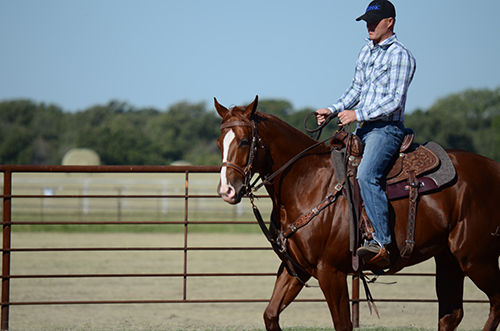
While it may be tempting, it is unlikely that a horse in Lovendahl’s barn will see a barrel much before his 3-year-old year.
“We don’t just get on a 2-year-old and start trotting the pattern and hope he figures it out soon enough,” Lovendahl said. “I’ve got some 2-year-olds you can tell are phenomenal horses, and if you were to trot them through the pattern 10 times, you could fake somebody out and say they’ve been on the barrels for 90 days. But there’s no way I would ever do that, because once they’ve been patterned, especially at a young age, it’s really hard to go back. I don’t want them to take over control from me.”
It is because of the same thought process Lovendahl described earlier that he avoids taking a horse to the barrel pattern too early.
“If I’m trotting a colt through the barrels without really having any control of him but he’s really easy and you can sneak the turns out of him, at some point he’ll start trying to beat you to the punch and start turning too tight, which is usually what happens with a good one,” Lovendahl said. “It’s the same sequence I just talked about. If you understand how a horse tries to please a person, the barrels are the same thing. As soon as he does that, if you don’t have him broke enough to immediately put a stop to that, it could be something you deal with for the rest of their lives.”
For many horses, this stage represents a fork in the road. A horse may be patterned and taught where to go, or trained with the tools he will need to work through challenging situations that arise later.
“You can get them patterned so they know where they’re going to run, but if they ever get off pattern, you’re in trouble because you don’t have any way to help them through things,” Lovendahl said. “You can get them trained to where you can get them consistent, but you’re usually going to run them at a rodeo or two and you better hope you’ve got somewhere on the road you can find a practice pen and go right back to the drawing board. If you go slow and have all the tools, that’s what turns them into a finished, automatic barrel horse versus a constant project. There are a lot of girls that win on constant projects, but they’re super handy girls. The first 30 days, to me, is really the foundation you’re going to probably deal with their whole entire career.”
Tangible Tools
In addition to the techniques he teaches his 2-year-olds, Ryan Lovendahl has a couple of indispensable, perhaps unconventional and occasionally misunderstood tools of his own.
Shanked Bits: “People say their horse doesn’t like a shanked bit, but I think if you’re being honest, I don’t think any horse likes a bridle at all,” Lovendahl said. “A ring bit can be a little easier for a horse to understand, but as a trainer, you have to know how to introduce a curb strap and a shank to a horse. I think it’s good to get it over with at an early age so they learn to give in and get away from that pressure. I think you’re much further ahead doing that right off the bat so you have that tool when you start speeding them up and putting them on not-so-optimal ground.”
Tie Downs: “My horses are going to have a tie down within the first couple weeks to the first 30 days for the exact same reason,” Lovendahl said. “I hardly ever run them with a tie down holding their head down, but they’re broke to one from the get-go. I use wire because I don’t want them balancing or pushing on it. A lot of people will put a tie down on thinking they’ll balance on it, but anytime they’re balancing on it, they’re usually getting pretty front end-y. They need to learn to respect that just like they respect a bridle; they’re going to stay in frame and maneuver off their hind end a lot better.”
Meet Ryan Lovendahl
Ryan Lovendahl grew up in Bluffdale, Utah, with six siblings and an enduring interest in horses. From his first hard-earned trophies at the age of 3 aboard a Western pleasure horse to the stepping stone that is 4-H and on to a collegiate career as a calf roper, Lovendahl honed his competitive nature. After college, he went to work for Noel Skinner, a renowned reining horse trainer, and had a hand in the training of Jerry Lees Surprise, the 1996 National Reining Horse Association Open Derby Champion.
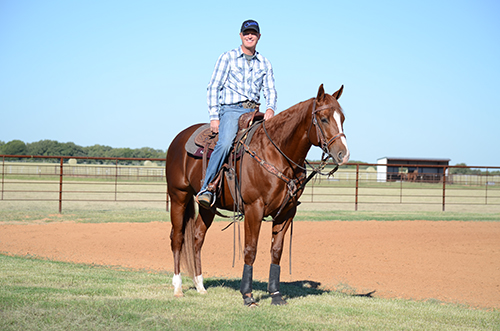
“I had a pretty major background,” Lovendahl said. “I got to ride around some pretty awesome reining horse guys that I think gave me a really good foundation for how to get a horse broke outside of the barrel pen. But it never grabbed a hold of me like the speed does.”
Armed with the influence of a Talmadge Green clinic, Lovendahl went on to become one of the first men to barrel race competitively in the western United States when he turned his calf horse into a barrel horse and found immediate success in the amateur and novice classes. He then went to work for Talmadge and Mike Green before starting his futurity ventures.
These opportunities eventually lead him to Busby Quarter Horses, where he currently heads up the barrel horse program.
“It takes a good team to get multiple horses trained, and KC Groves has been my assistant trainer for 15 years. He plays a big role from getting these horses started to the point where I can compete on them. He takes on the tough jobs with the greener horses, and he does great work with them,” Lovendahl said. “We are so excited to be involved with Busby Quarter Horses; they give us the best working conditions and provide optimal care to some of the most amazing horses in the industry.”
Follow Lovendahl’s training process in the next articles, From Round Pen to Rodeo Ready, Part Two and Part Three.